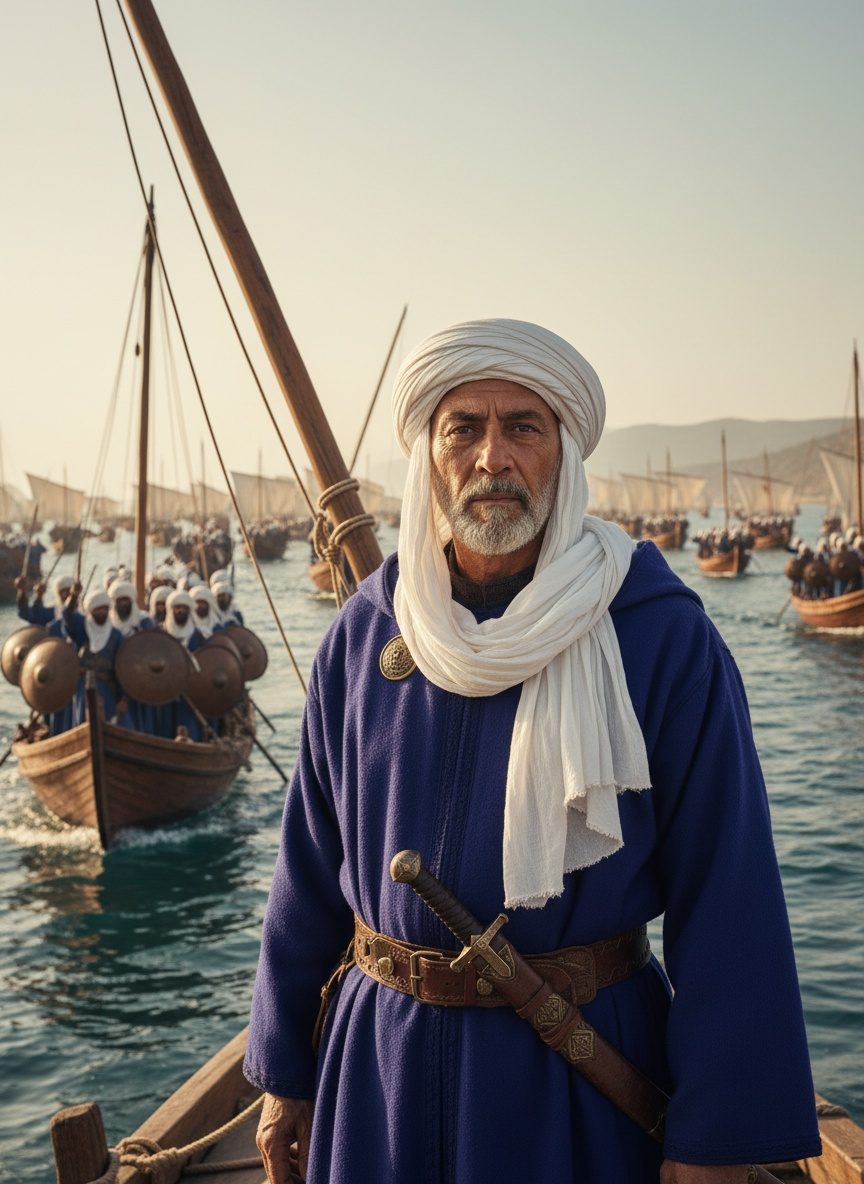
The call to prayer echoed faintly across the desert expanse, a gentle reminder of divine rhythm in the hushed night. Yusuf ibn Tashfin, the venerable commander, stood solemnly before his men. The salt-laden breeze of the Atlantic bore witness as he prepared to embark on a mission that would etch his name into the annals of history. Encircled by his most trusted warriors, the air buzzed with anticipation and tension, a potent mix of commitment and doubt. At almost seventy, Yusuf’s deep-set eyes saw beyond the horizon, toward a promise he intended to keep, even as the odds grew with the setting sun. It was October of 1086, and the poetically named battle would become legendary: Sagrajas.
The Plea from Across the Sea
On the Iberian Peninsula, the Muslim taifa kingdoms found themselves in a precarious position. Fragmented and enfeebled by internecine conflicts, they were increasingly vulnerable to the relentless campaigns of Alfonso VI of Castile. The Christian king, unyielding in his quest for Reconquista, loomed large over the divided Muslim entities, like a shadow creeping steadily across the land.
Desperate and cornered, these rulers turned their gaze southward, across the narrow Strait of Gibraltar, to the formidable Almoravid Empire. Commanded by Yusuf ibn Tashfin, the Almoravids had forged an imperial tapestry stretching from the Sahara to the Atlas Mountains. Yusuf, the astute Berber leader, was already a legend in Africa; now he was seen as the savior the Iberian Muslims so desperately needed. A delegation was sent, their plea laced with urgency, seeking Yusuf’s intervention in what seemed an inevitable march toward destruction.
The Commander Unleashed
The aging but indomitable Yusuf answered the call. Possessing a mind sharpened by decades of landscape-defining campaigns, he was not one to ignore such a summons. Marrakesh, the city he had founded and cradled into a pulsating hub of Islamic learning and culture, was testament to his vision and tenacity.
Preparations for the arduous journey were set in motion. An experienced tactician, Yusuf understood the intricacies of warfare and the delicate dance of alliances. He amassed an army of devoted Berber warriors, seasoned veterans who knew the unforgiving terrain of both desert and battlefield. Their loyalty to Yusuf was unparalleled, promising a force driven not just by command but by devotion.
The journey across the tumultuous waters of the Strait of Gibraltar took them into the lion’s den, a foreign land rife with politics and peril. Yet, as Yusuf’s feet touched Iberian soil, he brought with him more than just numbers and might; he carried the transformational weight of faith and an iron-willed strategy.
The Clash at Sagrajas
The two armies met ominously at Sagrajas, a grim testament to the ever-present pendulum of power. On one side stood Alfonso VI, backed by a formidable Castilian force burning with determination to drive out the ‘Moors’. On the other, Yusuf and his coalition of Almoravid and Andalusian troops, determined to defend the Islamic stronghold in Spain.
The battle was ferocious, a tapestry of tactical brilliance woven with chaotic melee. Dust churned into the air as cavalry charges met flanking maneuvers, while the cries of battle mingled with the ominous clang of steel. It was during this thunderous engagement that Yusuf’s prowess shone. His strategies, evolved over a lifetime of warfare, came alive as he orchestrated his forces with deft precision.
With the sun setting on the horizon, the scales tipped in Yusuf’s favor. The Castilian army, unable to withstand the relentless pressure and strategic acumen of their opponents, crumbled before the seasoned Berber commander. Alfonso VI, recognizing the breadth of his peril, retreated, leaving behind a battlefield consecrated with the echoes of a defining victory.
The Calm After the Storm
With the battle won, Yusuf’s mission in Iberia came to a triumphant but temporary conclusion. Opting for prudence over conquest, he returned to Africa shortly after, entrusting the Andalusian allies with the task of maintaining the newfound equilibrium. Behind him, he left a region imbued with temporary reprieve, buoyed by the weight of his intervention.
This tactical withdrawal to Africa was as much a testament to his commitment to the stability and prosperity of his expansive empire as it was to his understanding of geopolitical nuance. The Almoravid Empire and its founding principles remained his primary concern; the glittering prize of a taifa kingdom was not one to tempt him away from his vision back home.
The Echoes of Empire
Yusuf ibn Tashfin’s crossing of the sea at seventy and the resounding victory at Sagrajas offer more than just a chapter in military history. It is a tale of leadership seizing its moment amidst the currents of inevitability. This story serves as a stark reminder of how the tides of fate and the unwavering resolve of an individual can alter the trajectory of peoples and lands.
The sheer audacity and determination exhibited by Yusuf ibn Tashfin speak volumes of a kind of leadership that is both visionary and pragmatic. His legacy, transcending the sands of time, echoes through history as a testament to the unyielding spirit of those who forged paths others dared not tread. The Almoravid Empire, under his guidance, became a beacon of cross-continental influence, its luminescence still faintly visible in the histories of today.