He was a slave who changed the way Romans recorded their thoughts. His name was Tiro, and he invented a system of shorthand that is still acknowledged today. But it's not just his contributions to writing that make his story exceptional; it's his enduring loyalty to the man who, instead of simply being his master, became a partner in an intellectual journey that transcended the typical boundaries of their era.
In the vibrant yet cutthroat world of 1st century BCE Rome, hierarchical structures could determine a person's entire existence. Yet, in the household of the renowned orator and statesman Marcus Tullius Cicero, there emerged an unusual symbiosis. Tiro was more than just a slave to Cicero; he was his confidant, his secretary, and, remarkably, a trailblazer in his own right. While his status might suggest a life bound by labor and subordination, Tiro managed to carve out a legacy that even the free-born couldn't easily achieve.
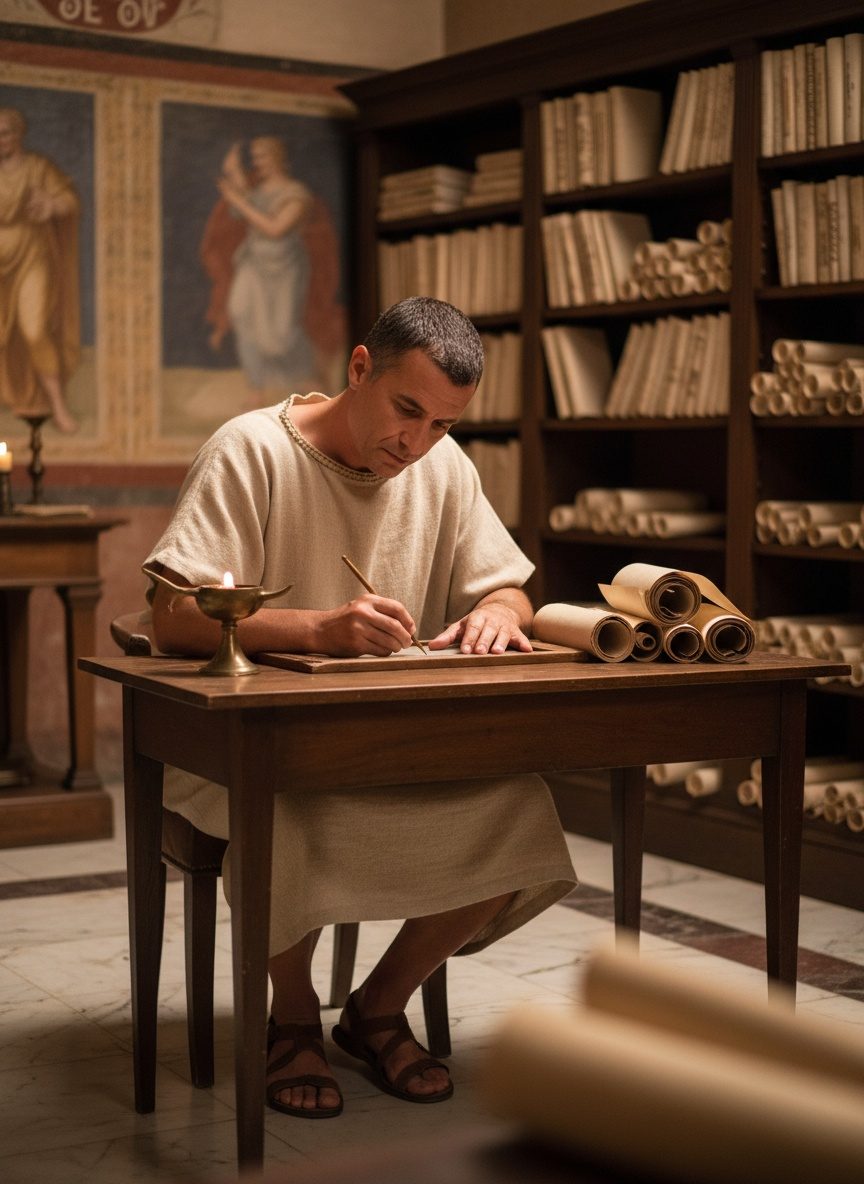
Imagine Rome at the time, a bustling epicenter of politics, philosophy, and culture, where words wielded power as surely as swords. For men like Cicero, mastery of language could make or break careers. It was in this atmosphere that Tiro crafted a shorthand system, known as "Tironian Notes," enabling rapid transcriptions of speeches and discussions. His system was revolutionary, allowing scribes to keep pace with the rapid oratory of Rome's leaders without losing the essence of their words. Few realize that this methodology laid the groundwork for modern shorthand and significantly influenced the written communication of the Western world.
The intellectual partnership between Tiro and Cicero was extraordinary. Tiro's brilliance was evident in how he managed, organized, and even edited Cicero's numerous letters and speeches. Every letter he preserved and every speech he recorded helped build the legacy that would immortalize Cicero in history. The scribe was no longer just an observer but rather a curator of history, crafting the narrative that would echo through time.
When Cicero decided to manumit Tiro, granting him freedom, it was a decision that spoke volumes of their relationship and mutual respect. Roman laws were precise about the conditions under which slaves could earn their freedom, often requiring years of service and loyalty. For Tiro, freedom was earned not just through dedicated service, but through an intellectual exchange that raised both men to greater heights. Yet, when given the freedom to leave and forge his own path, Tiro chose to stay, a decision both unexpected and enlightening.
Why would a man, finally unshackled from the chains of servitude, decide to remain in the household where he once served as a slave? The answer lies in the bonds of camaraderie and mutual intellectual pursuit that Tiro shared with Cicero. He was not merely an aide but a collaborator in a cultural mission. Tiro staying on as a free man was a testament to their shared vision, a unity that transcended social conventions of their time.
As much as Cicero championed the cause of republican values and freedom, it was Tiro's commitment, quietly working in the background, that ensured those ideas would not be lost. His detailed recording of the thoughts and strategies that flowed through Cicero's mind provides us with a vivid record of Roman political life and thought in this era. Tiro essentially served as the bridge that spanned the chasm between the transient spoken word and the lasting written account. Without him, significant portions of Cicero's contributions — and by extension, critical parts of Roman intellectual history — might not have endured.
Beyond his intellectual contributions, Tiro exemplified a form of loyalty not bound by coercion but by genuine respect and partnership. In a time when the roles of master and servant were rigid and clearly delineated, Tiro and Cicero’s relationship blurred those lines. It demonstrated that the shared pursuit of knowledge and understanding could transcend the conventions of power and privilege. Tiro’s story reflects a partnership that was unusual, a rich intellectual camaraderie that defied the societal norms of their age.
The fact that Tiro's Tironian Notes survived and continued to be used well into the Middle Ages is testament to their ingenuity. Monks in medieval scriptoria relied on these symbols to copy manuscripts swiftly, proving that his invention had an impact far beyond its original context. The endurance of Tiro’s system through the centuries is a testament to its utility and brilliance, characteristics that are too easily overlooked if one considers his contributions only within the confines of his servitude.
In the end, Tiro's decision to remain with Cicero speaks to the human desire for relevance and connection. His choice revealed an understanding that true freedom did not merely come from the absence of chains but from the presence of purpose and partnership. In staying, Tiro ensured that Cicero's voice would echo through history, turning what could have been ephemeral discourses into the bedrock of Western rhetoric and philosophy. Marcus Tullius Cicero is rightly celebrated for his oratory genius, but it is the steadfast presence of Tiro that preserved that genius for generations. Indeed, without Tiro, much of what the world knows of Cicero might have been silenced by time. Their story offers an enduring lesson on the power of collaboration and the resilience of the human spirit in shaping history's course. It’s a story they never taught you in school, but one worth remembering.