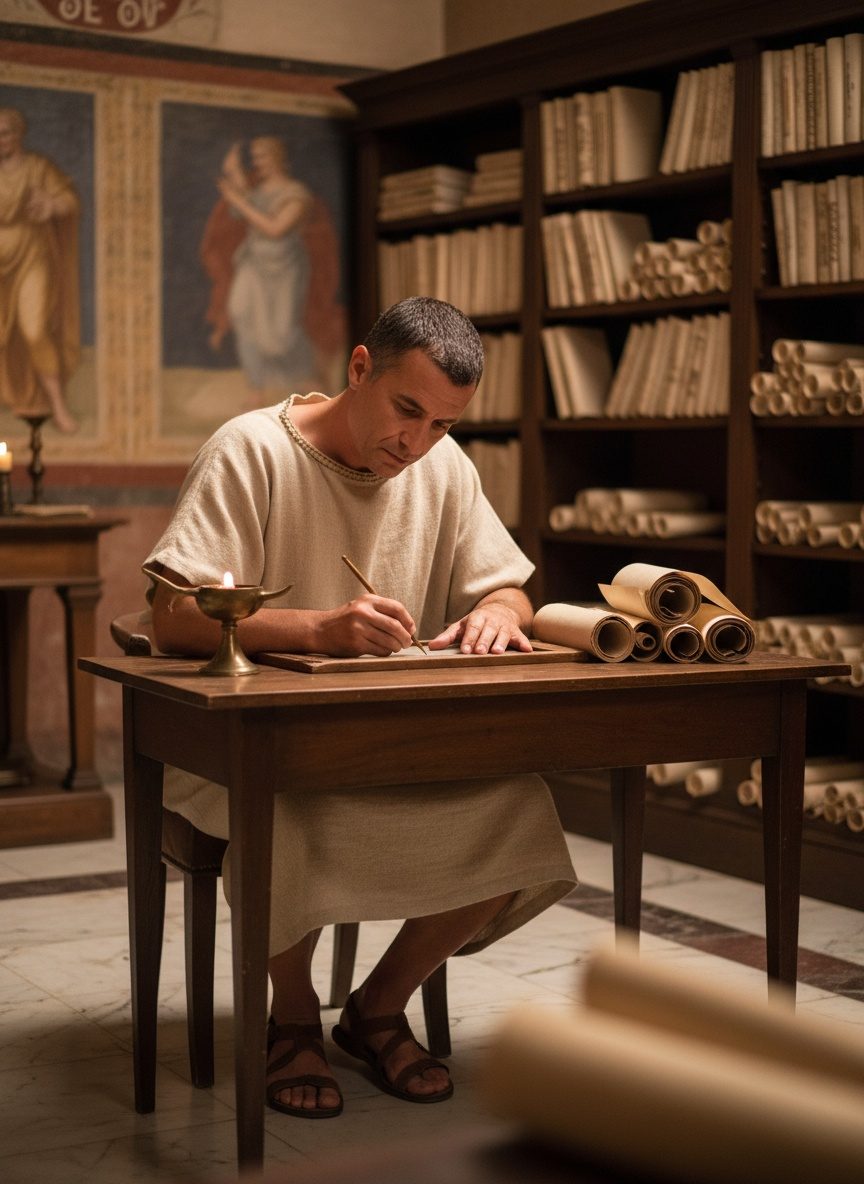
The air is thick with the aroma of papyrus and ink, warmed by the relentless Egyptian sun streaming through the library’s open courtyard. Rows upon rows of scrolls line the towering shelves, each one whispering the secrets of the world to those who dare to listen. In the heart of Alexandria's great library, amid the soft rustlings of unfurled parchment, sits Eratosthenes, whose mind hungers for understanding, unquenched even in this bastion of knowledge. It is here, with shadows cast long by the midday sun, that a single stick in the ground would lead to a revelation of cosmic proportions: the first accurate measurement of the Earth's circumference.
In 240 BC, Alexandria hummed with intellectual vigor. This city by the sea, with its iconic lighthouse guiding mariners from afar, was a crucible for learning and discovery. Yet, it was not the waves that intrigued Eratosthenes that day, but a peculiar report from a distant well in Syene—modern-day Aswan. On one day each year, during the summer solstice, the sun appeared directly overhead, casting no shadow in the well. Such a phenomenon was noteworthy, and to Eratosthenes, it spurred a series of questions that only the rationality of mathematics could answer.
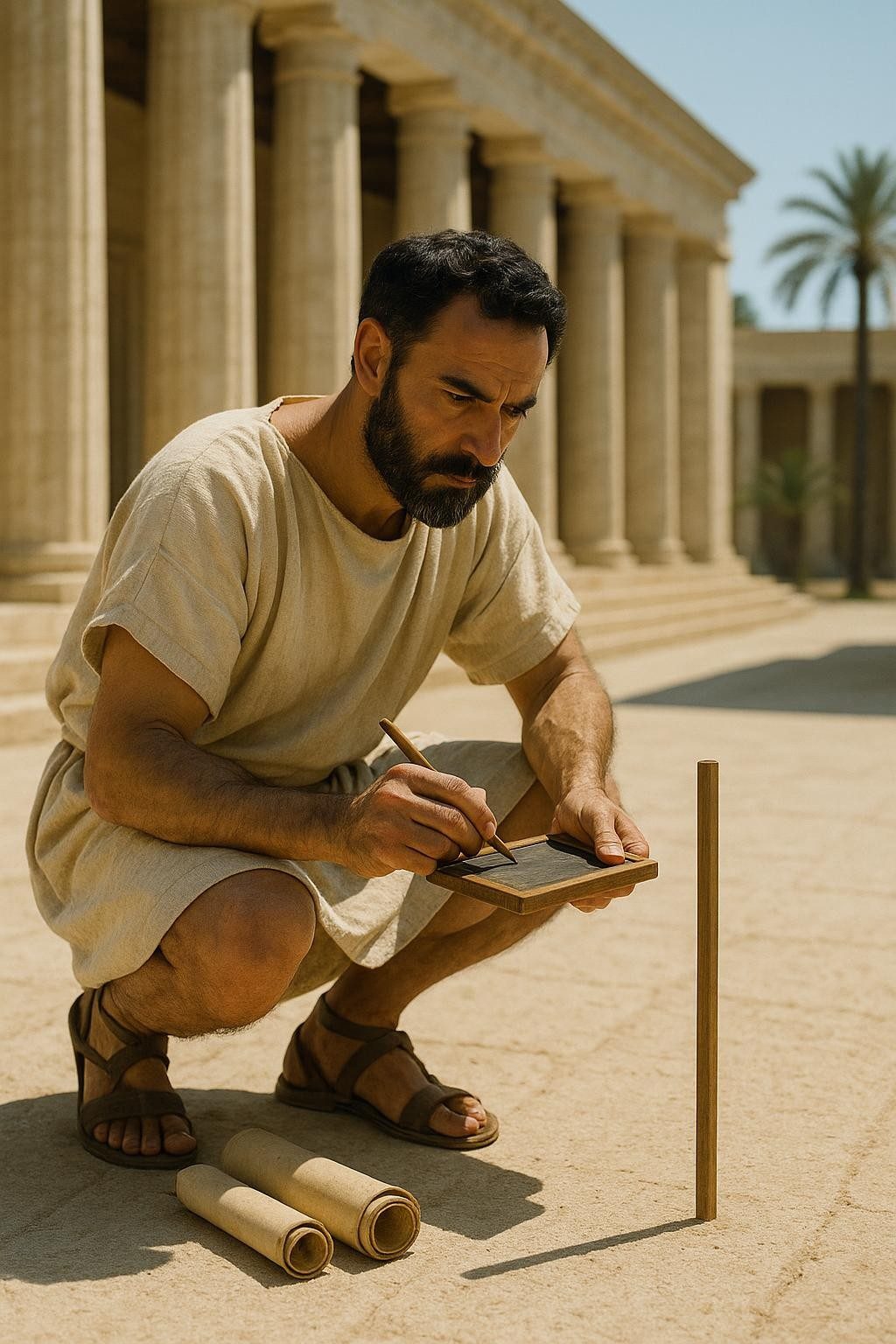
Visualize Eratosthenes as he begins his thought experiment. In the glaring sun of Alexandria, he plants a stick into the ground. As the solstice approaches, he watches the shadows with keen interest. At noon, a shadow stretches out, measurable and precise. The concept is simple yet profound: if the sun is directly overhead in Syene, but casts a shadow at an angle in Alexandria, the curve of the Earth itself must be the reason. The shadow’s angle, if measured correctly, could reveal the arc of the Earth's surface between the two cities. Armed with this insight, Eratosthenes was poised to answer a question that had eluded humanity for centuries.
The calculation relied on two critical measurements: the angle of the shadow in Alexandria and the distance between Alexandria and Syene. The angle of the shadow, Eratosthenes determined, was roughly 7.2 degrees—a fraction of a circle. In geometric terms, this angle suggested that the distance from Alexandria to Syene represented approximately one-fiftieth of Earth's total circumference. Without digital precision tools or satellite imaging, Eratosthenes needed a straightforward way to measure this distance. Luckily, the Egyptian Royal Road provided a measured route between the two locations: about 5,000 stadia, according to the reckoning of the time.
Imagine the simplicity and elegance of this geometric insight. With just a stick and his intellect, Eratosthenes envisioned the Earth not as the flat or infinite plane that so many believed, but as a sphere, finite and vast. This moment was revolutionary. Working entirely from theoretical considerations and simple tools, he posited that the Earth was a circle requiring no more intricate precision than a learned mind and a few basic measurements. The accuracy was astounding—less than two percent off by modern calculations—and all achieved without leaving his country.
The methodology of Eratosthenes did more than measure the Earth's girth—it laid down the blueprint for scientific inquiry. The experiment demonstrated a foundational principle: understanding could be built through observation and replication, ideas that would echo through the corridors of time, influencing countless scholars and adventurers who sought to map the world and the heavens. In an era when myth often overshadowed fact, this Librarian's logical deduction proved the power of human intellect when applied with clarity and creativity.
Considering the resources he had at his disposal, and the resistance to unconventional ideas at the time, Eratosthenes’s achievement was nothing short of extraordinary. This Greek polymath, respected but often overshadowed by his contemporaries, had, through his calculation, defined a new horizon for his civilization. Where others saw mystery and myth, he saw opportunity for revelation. The shadows Eratosthenes studied were fleeting, but the illumination they provided for humanity was enduring and profound.
Today, as we orbit our globe by aircraft or satellites, it's easy to take for granted how quantifiable our world has become. Yet the story of Eratosthenes stands as a reminder of human curiosity's unparalleled capacity to transform understanding. More than a feat of mathematics, it reflects a shift in intellectual perspective, a notion that the world, for all its enormity, could be comprehended through the lens of an analytical mind. It was here, in this sunlit courtyard surrounded by the wealth of human knowledge, that a librarian who dared to look at the shadows changed forever our view of the planet we inhabit.