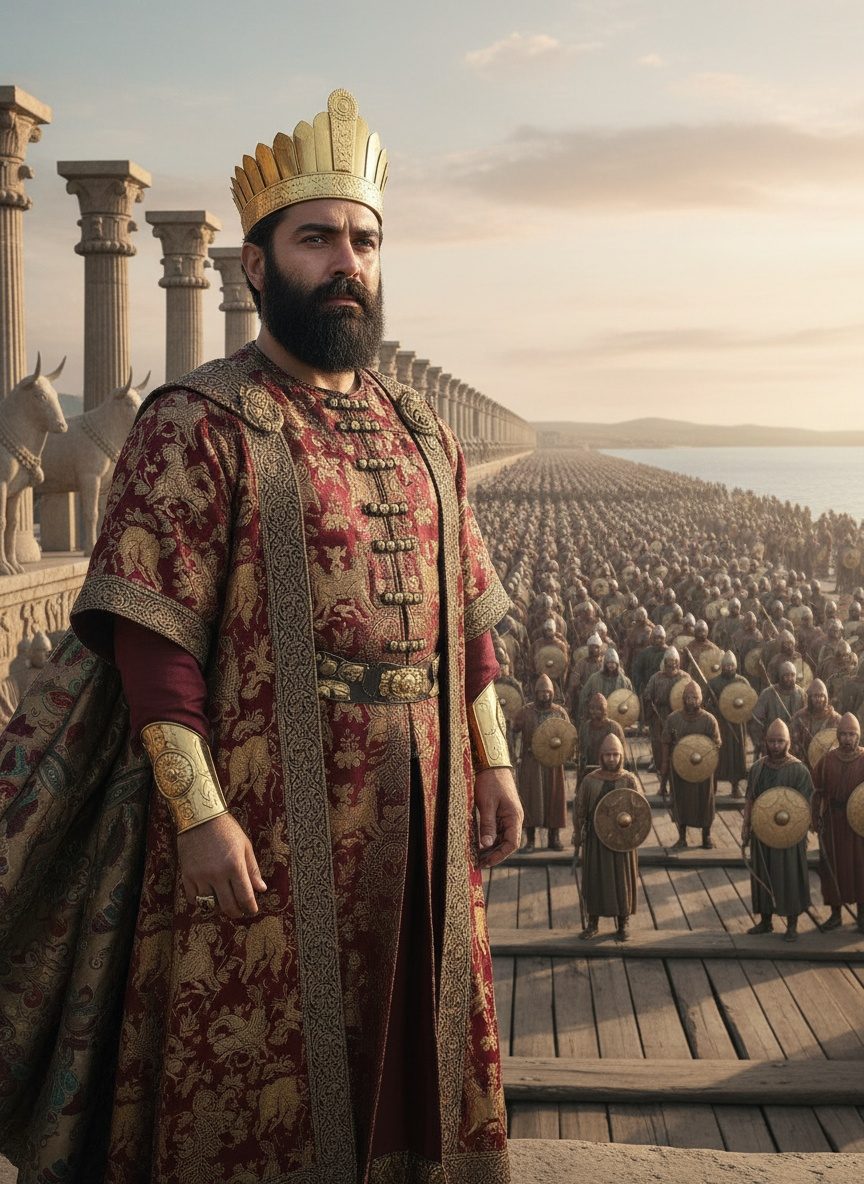
480 BC. The cold waters of the Hellespont churned beneath an overcast sky. High above, perched on the strategic heights, stood King Xerxes I, monarch of the Persian Empire. Around him, a sea of humanity stretched as far as the eye could see, a living testament to the vastness of his dominion.
This was no ordinary gathering. Below Xerxes assembled the largest army the ancient world had yet conceived—a formidable host summoned to subdue the impudent Greek city-states that defied Persian commands. Here, at the narrow strait that separates Asia from Europe, the drama of a millennium hung in the balance. Yet, amidst this grand display of power, something singular transpired: Xerxes, the Great King, wept.
Such tears seemed out of place amidst the pomp of conquest. When questioned by a sympathetic observer about his tears, Xerxes offered a revelation that echoed beyond the bounds of his ambitions. "I weep," he purportedly said, "for of all this multitude, not a man will survive to see old age." In that moment, the imperious shadows of mortality pierced even the mind of an emperor, knotted deep in the cadence of human fragility.
However reflective his mood, Xerxes was not swayed from his purpose. His tears dried, overtaken by the imminence of action. Below, the Hellespont turned from a barrier to a bridge, as the Persian engineers unleashed their innovation upon it. They linked the continents with a miraculous feat of engineering—a pontoon bridge crafted from lashed-together boats, stretching formidable miles across the strait. The vision was audacious, the execution even more so, transforming a watery expanse into a precise path for tens of thousands of soldiers to tread.
As the bridge came together amidst the shouts of laborers and the creak of vessels bound with Persian ingenuity, Xerxes surveyed the results of his command. Now the vast army would move with surefooted confidence into the Greek mainland, and the man at its helm was ready to gamble with fate.
The Persian crossing of the Hellespont in 480 BC was no ordinary march. At its core was a potent mixture of mesmerizing ambition and chilling resolve. The army, drawn from the corners of Xerxes' immense empire, assembled under his banners, answered not just to lines of prestige but to the indomitable will of its ruler. Estimations flare to hyperbole suggesting a million men in uniform, a tide of soldiers that boggled the logistic minds of contemporaries and onlookers alike.
So grand was this martial tapestry that contemporary Greek historians, such as Herodotus, were given to awe and hyperbole. Yet even beyond exaggeration, the achievement was a historically resounding one. It was more than mere numbers; it was the orchestration—the supply chains of grain, water, and weapons, the diverse languages spoken within the ranks, the outlines of elephants making their rare appearance over the horizon.
Stepping onto the bridge, one could sense the energy coursing through ranks, the hesitant creak of wood underfoot combining with the rhythmic sound of feet stamping in unison. Veterans of many campaigns marched shoulder to shoulder with young recruits, each man turned into a piece of the great sweeping ambition of Xerxes. There was promise and dread in every footfall across the living bridge, beneath the uncaring currents of the Hellespont.
The sight that greeted the Greek defenders was unparalleled; it was a challenge, not just by sword but by scale. Here was to be seen the vivid discrepancy between the modest forces of Greek city-states and the sprawling spectacle of the greatest army ever to take the field. Undoubtedly, this view sowed dread, but it also kindled fierce resolve in those who would stand against such an omnipotent force.
Xerxes' ambition steadily drove him onward. The armies flowed across to mount a campaign marked by some of the most legendary confrontations in the annals of history. From the heroic last stand at Thermopylae to the naval showdown at Salamis, the clashes between the Persians and Greeks would light a fire in the millennia to come—a fire fed by ideas of freedom, dignity, and the perennial struggle against overwhelming odds.
Ultimately, Xerxes' colossal venture would falter in Greece, as myth and history collided to forge stories of daring exploits and improbable triumphs. But the crossing of the Hellespont itself stood as a miraculous testament to what humanity can achieve when driven by vision, relentless drive, and a willingness to brush against the boundaries of possibility.
Today, the weeping of the Great King before the crossing reads as a moment of temporary human vulnerability amid the hard imperatives of power. No amount of might can obscure the inescapable truth that every emperor, as well as every soldier in the rank and file, meets the same end. The dust of time did indeed find them, transforming the vast armies into memories and tales shared across generations, a poignant reminder that the sweep of history ultimately belongs not to the grand armies, but to the legacy they inspire.