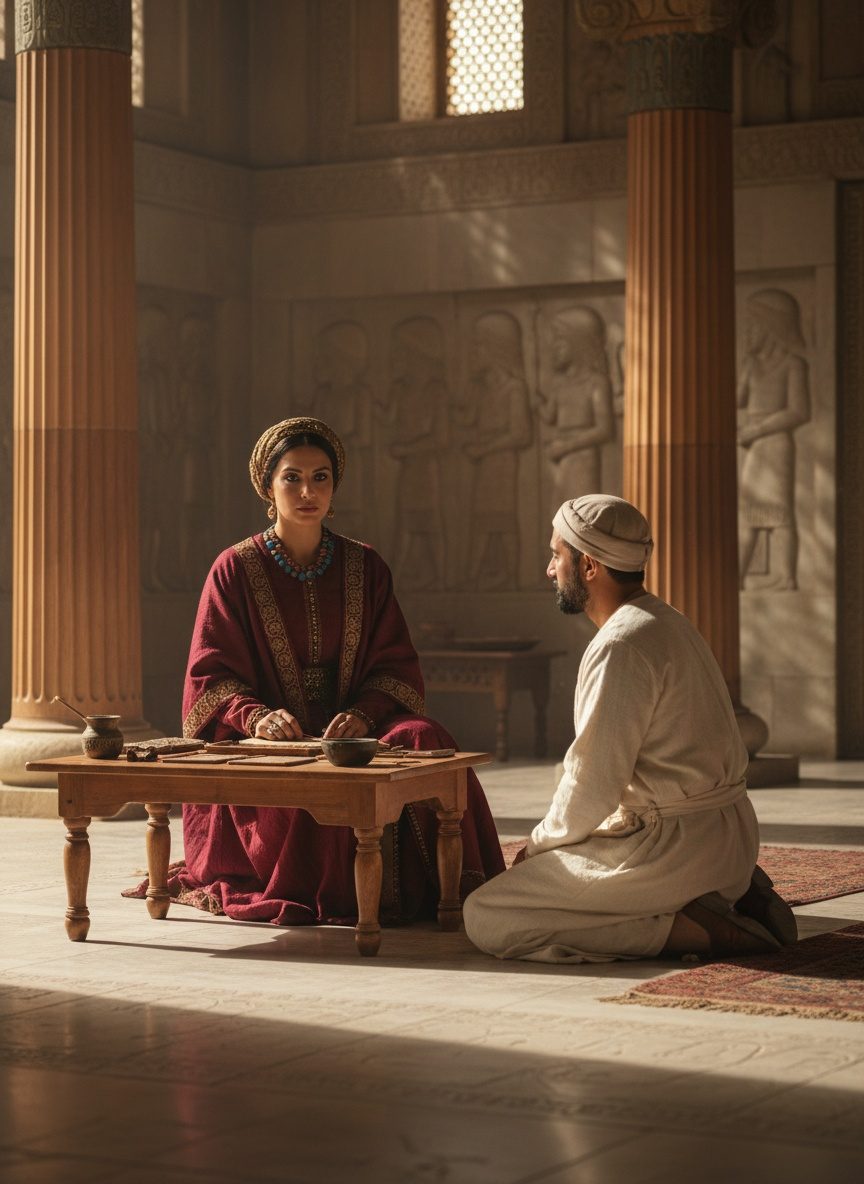
The aroma of fresh-baked flatbread mingled with the pungent scent of spices as Artystone stepped into the bustling courtyard, her eyes scanning the rows of laborers organizing the day's provisions. Sounds of clinking clay tablets and the rhythmic scratching of styluses echoed softly against the stone walls. As the wife of Darius the Great, king of Persia, Artystone held no regal title to announce her power, yet here, amidst the organized chaos of Persia’s expansive treasury, her influence was unmistakable.
In an empire that stretched from the Indus Valley to the Balkans, encompassing a vast array of cultures, languages, and economies, Artystone's role was as expansive as it was compelling. Known among scribe and officer alike, her name appeared repeatedly upon the administrative clay tablets that chronicled the inner workings of the empire. Despite the traditional constraints that muted female voices in history, these ancient records speak volumes about Artystone’s authority.
She wasn't merely a figurehead or the silent partner to her husband’s global ambitions. Artystone was the axis around which a critical portion of the empire’s operations turned. As overseer of the royal estate, she wielded unparalleled influence — the power to direct labor, to distribute wages, and to provide sustenance not only for the workforce but for the logistical feat of Persian military operations. It was in this hub of activity that the unseen wheels of governance turned under her watchful eye, etching her contributions not in stone monuments, but in the clay tablets that would endure for millennia.
Each order she authorized became a part of the sprawling network that supported Darius’s ambitions. While inscriptions on grand monuments praised the king’s conquests and deific claims, Artystone’s directives facilitated the infrastructure that underpinned such achievements. She wasn’t a commander on the battlefield, yet the rations she managed daily for soldiers in distant lands fortified the king’s armies. Operating from her base far from the heated dust of conflict, her mastery of logistics ensured that every soldier received bread, beer, and cuts of meat appropriate to his rank. Her influence reached deep into the heart of Persia, quietly affecting the lives of thousands who never knew her name.
The workers themselves held a unique position in her system. Men and women from various backgrounds found employment across the empire, evidence of the vast pluralism that characterized Persian rule. Skilled craftsmen, agricultural workers, and builders were all under her purview, their skills harnessed to create the grand palaces and administrative centers that dotted the landscape. From the sweeping terraces of Persepolis to the diligent scribes in Babylonian archives, these were the hands and minds that Artystone guided, rewarding their labors with fair wages and, occasionally, bonuses that were inscribed upon those very clay tablets.
It wasn’t all work within the boundaries of Artystone's influence. The care of Persian nobility extended to ensuring that the empire’s prosperity was reflected in its cultural richness. The lavish banquets held at the royal court necessitated a seamless supply of goods from the corners of the empire. Each product passed through networks overseen by Artystone’s directives — their origin, distribution, and consumption bearing the invisible stamp of her management. This unspoken acknowledgment of her involvement reveals a world where women could engage in significant political and economic arenas despite the absence of formal acknowledgment in hierarchical structure.
These seemingly small acts of governance, inscribed meticulously into clay, offer us a glimpse into her world — a world where the image of a powerful woman existed in the flickering light of lamps illuminating storerooms and archives. Her legacy lives within the very structure of the Achaemenid administration, a testament to bureaucratic sophistication and her rare position within this male-dominated setting.
In the contemporary sphere of historical analysis, Artystone’s contributions provoke a reexamination of gender roles in ancient civilizations. As modern scholars unearth more tablets and uncover additional fragments of history, the narrative of influential women like Artystone reshapes our understanding of women's roles in ancient governance. Her story serves as a reminder of the countless untold narratives of women who navigated complex power dynamics and made an indelible impact within the shadows of history.
The clay tablets survive as artifacts of administrative genius, their inscriptions the silent judges of historical significance. They whisper Artystone’s determination to future generations, challenging the conventional narratives that too often overlook quiet, enduring power. Her story matters because it urges us to look beyond crowns and titles and to examine the foundational structures and systems upon which great civilizations stood and thrived.