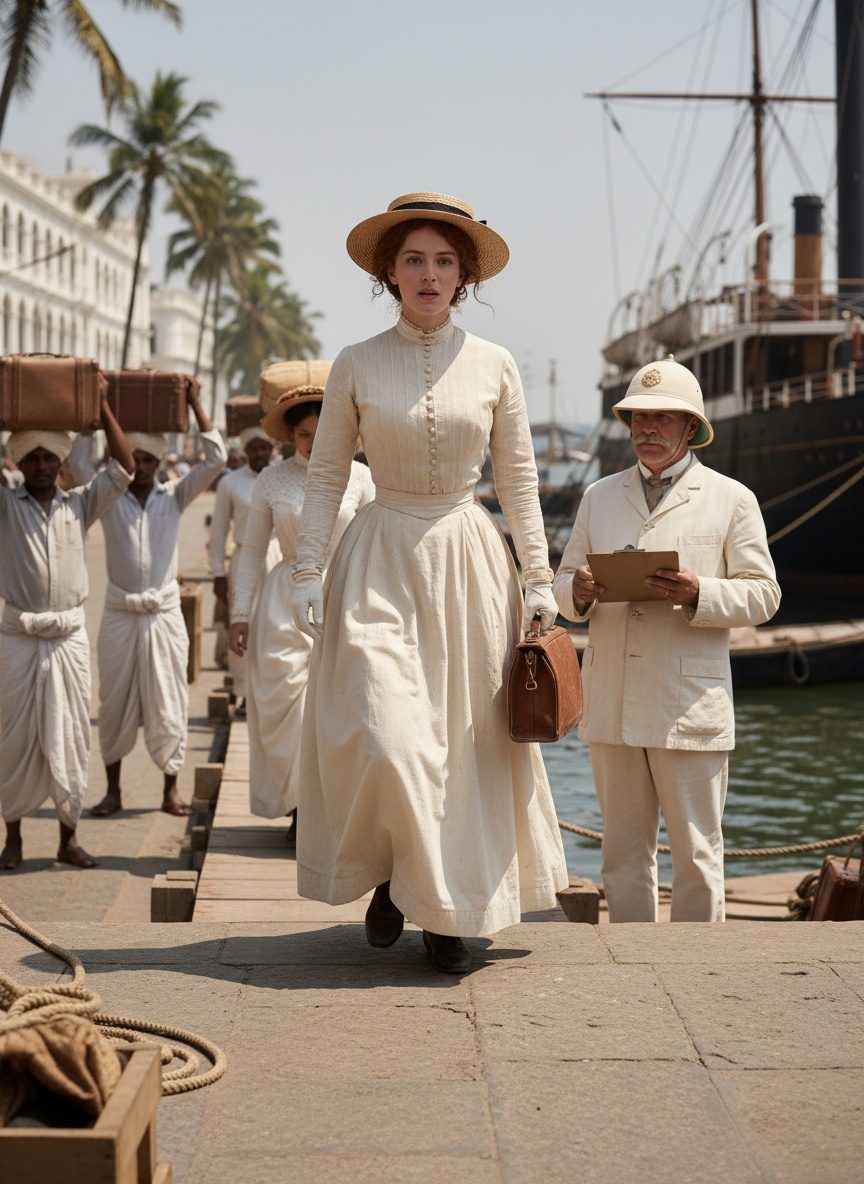
The glare bounced off the azure waters of the Arabian Sea as the gangway shuddered beneath her feet. The aroma of spices wafted through the humid air, mixing with the salty tang of the port. She hesitated only for a moment, adjusting the brim of her bonnet against the unrelenting sun. Around her, the bustling Apollo Bunder was alive with voices—a symphony of unfamiliar languages and sounds. This was Bombay, 1880, the gateway to the vibrant and tumultuous tapestry of British India. The young women stepping ashore with her were collectively known as the "Fishing Fleet," their arrival eagerly anticipated by a society ready to welcome fresh faces into the folds of the Raj.
The Great Voyage
Each autumn, with the first chill winds announcing winter's approach, ships set sail from the familiar docks of Southampton. They carried neither soldiers nor merchants, but young women from various social strata of Victorian England, all bound for Indian shores. For these "Fishing Fleet" girls, the voyage was a prelude to a season of hope and uncertainty. Leaving behind fog-laden cities, they embarked on a sometimes six-week maritime quest. The steamship, a marvel of its time, was both a refuge and a microcosm of the society they left behind, fraught with the same divisions of class and decorum. Yet, it was also an initiation—a trip fraught with seasickness and socializing, where forging friendships (or rivalries) was unavoidable.
Onboard, dreams were stoked during long afternoons on deck and starry nights resonant with the hum of the engines beneath. Elder chaperones imparted wisdom to the younger women, instructing them on decorum and potential courtships, while deck promenades became the stage for romantic possibilities and whispered conversations. This grand adventure was an escape and a solution to the economic disparities at home, where a surplus of unmarried women faced bleak prospects. In contrast, the Empire, basking in the glory of the Raj, offered the promise of an exotic new life.
Upon Strange Shores
For most of these young women, the first sensation after disembarking at Bombay's Apollo Bunder was the overpowering heat—a relentless embrace that saturated their English tweeds and faded resolve. The fragrance of cardamom, cumin, and unfamiliar flowers mingled with the pervasive dust hovering in the humid air. Bombay was a confluence of contrasts, where tradition and modernity, poverty and opulence, coexisted. Rickshaws, bullock carts, and the new-fangled motorcars vied for space on the teeming streets, sharing it with merchants touting silks and precious gems.
Bombay in 1880 was the beating heart of an empire and a city in transformation. The city's architecture, a beguiling mix of Gothic and Indian influences, towered over markets laden with the bounty that had made the city legendary. Clad in their best dresses—some ultimately unsuited for the climate—the young women from the Fishing Fleet were thrust into a world that promised romance tempered by harsh realities. For many, it was their first confrontation with diversity on such a scale, meeting people whose cultures, traditions, and lifestyles couldn't have been more different from their own. Their arrival coincided with the monsoon, the air heavy with anticipation and the sky gathering clouds ready to explode in torrential release.
The Season of Chances
The ambitious land of opportunity awaiting these women was also one of societal expectations and pressures. Their suitors, officers, bureaucrats, and planters, were stationed across the vast expanses of British India, their lives defined by regimental routines and a longing for companionship in an often isolated existence. The fate of most women from the Fishing Fleet was decided during these critical months, with many securing matches that would significantly alter their destinies. After all, the destiny of a Fishing Fleet girl wasn't just to find a husband but ideally a good match—one that promised economic comfort and social standing.
There were social events to attend, receptions at the Governor's palace, garden parties under the shade of banyan trees, and afternoon teas brimming with possibilities—all stages where courtships were performed and alliances forged. The reality of colonial politics and the informal segregation subtly shaped every interaction, whispering reminders of one's place in the social order. Despite this, not every woman found her aspirations met. Some would return home, their dreams unfulfilled, but with stories of an exotic land that was theirs, however briefly.
The Empire and the Monsoon
The stories of these women, forgotten perhaps in the grand narratives of Empire and the harsh critiques of colonialism, remain whispers of personal desires against a backdrop of imperial ambition. They reveal the intricate lacework of culture, gender, and power at play in a world defined by contrast—a thriving Empire perched on the cusp of modernity yet bound by Victorian sensibilities. The monsoon, arriving in earnest, was a predictable yet untamed force, much like the experience of these intrepid women—both a metaphor for the ideas they encountered and an uncontrollable reality of their new lives.
The legacy of the Fishing Fleet extends beyond the scope of marriages made or fortresses found. It speaks to the enduring complexities of cultural encounters, the personal sacrifices entwined with the movements of Empire, and the inexorable change brought on by such daring ventures. These women, each uniquely transformed, wove threads into the fabric of a colonial society straining under the weight of change. As the monsoon sirens called with their rain-song, the Fishing Fleet had carved its niche in history, a testament to resilience, adaptation, and the ceaseless quest for connection at the fringes of a sprawling Empire.