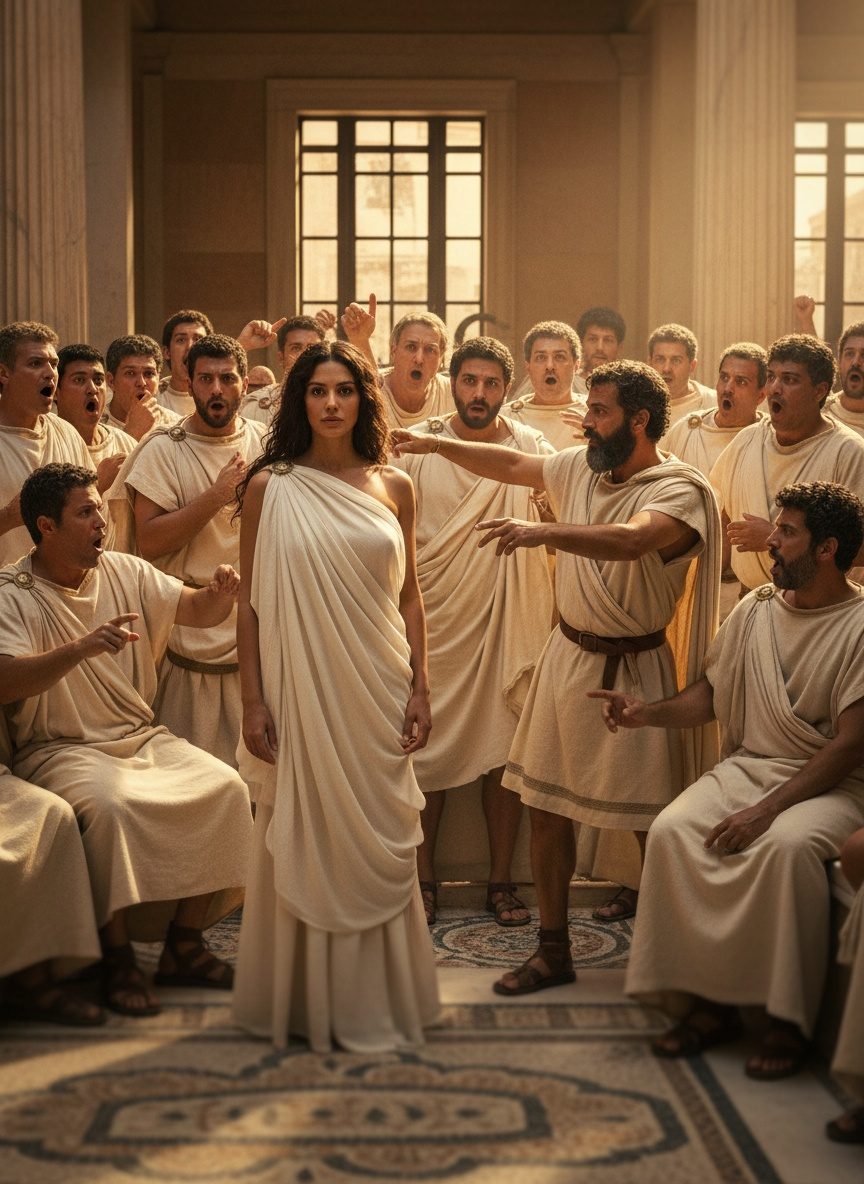
The humid air hung thick in the great city of Athens, the sun casting long, wavering shadows as it reached its zenith. Sweat gathered on brows as Athenian citizens crowded into the courtroom, the earthy scent of dust mingling with the salt of perspiration. The low murmur of voices bounced off ancient stone walls, a sound reminiscent of the chorus of Cicadae echoing through nearby olive groves. This was no ordinary day, nor was this trial of the ordinary sort. Gazes were fixed on Phryne, the most celebrated woman in Athens, who stood accused of a crime that could rip the city’s moral fabric asunder. The tension crackled like a storm waiting to break, yet what would unfold next was beyond anything Athens had ever witnessed.
The Enigmatic Beauty of Athens
Phryne was no stranger to the gaze of the populous. Her beauty was legendary, her allure spoken of in both hushed whispers and loud proclamations across Athens and beyond. Hailing from Thespiae, she had built a life that navigated the paradoxes of Greek society — a world where the divine was worshipped and the earthly revered, yet perilously fragile. Phryne was reputed not only to be a courtesan of stunning beauty but also a woman of wit and wealth, a figure who danced at the intersection of adoration and disdain. It was said that the great sculptor Praxiteles used her as the model for his iconic statue of Aphrodite, forever immortalizing her image in marble.
But this adoration was coupled with danger. Her beauty, which had elevated her to divine muse status, also made her a target. Accused of impiety, a crime that invited hatred and fear, she stood before the city’s judges, her life hanging precariously in the balance. She risked the ultimate penalty — death — for allegedly mocking the gods. The charge was as ephemeral as the Athenian summer breeze, yet ripe with gravity. Phryne’s fate rested in the hands of the great orator Hypereides, her defender in this nail-biting legal theatre.
The Moment of Silence
The courtroom was a cacophony of heated rhetoric and persuasive oratory. Hypereides, known throughout Athens as one of its finest speakers, invoked every trick and trope to sway the judges. Yet, the matter of divine disrespect weighed heavily on the scales of justice, poring over centuries of religious tradition. Like a maestro conducting a symphony from a fragmented score, Hypereides wove arguments that danced around Phryne’s allegations, attempting to dismantle the prosecution’s narrative. Yet, as the sun began its descent and their patience waned, a collective anticipation rippled through the room.
Devoid of new arguments, Hypereides found himself at a precipice — and with it came an unconventional act, one of desperation fused with profound inspiration. In a moment forever etched into the annals of history, he approached Phryne, undid her robes, and revealed her beauty to the judges. A hushed awe blanketed the room. Here, laid bare, was not merely Phryne the accused but an embodiment of the divine itself. The ancient Greeks revered beauty as a reflection of the gods, an inexplicable force interwoven with the sacred. The silence that ensued was deep and reverent, as though time itself held its breath.
The Unexpected Verdict
To this day, scholars debate the ethics and implications of Hypereides’ gambit, yet its effectiveness is unquestioned. In revealing Phryne without artifice, through an act as raw and compelling as the high summer midday, he jolted the judges into a recognition that transcended words. In her unveiled form, she was Aphrodite herself, a living testament to the beauty the gods could bestow. There was an inherent kinship between her and the divine, one that could not, in their eyes, be the source of impiety.
Every judge cast their vote, the collective murmur growing from silence into a clamor of indelible consensus — not guilty. The decision reverberated through Athens like the bell of triumph, the applause of the city echoing long after the court had cleared. Phryne walked free, a living enigma, yet her trial had woven into the city’s history a myth that blurred the lines between mortal and myth, justice and awe.
The Legacy of Phryne
In the corridors of time, where history and legend entwine, the trial of Phryne raises fundamental questions about power, perception, and the societal values we hold dear. Was the trial about Phryne’s alleged transgressions, or did it become a referendum on the blend of divine beauty with human frailty? It is a story of how the perception of power can shift in an instant, how the human heart still dances to the tune of the extraordinary. Through this trial, we are offered a glimpse into ancient cultural dynamics — questioning what we hold sacred and how society grapples with what it cannot easily define or contain.
Phryne’s story is a testament to the timeless intrigue of the human condition. In revealing herself in that courtroom, she opened a window to eternity, reminding us that the allure of human beauty—whether physical, rhetorical, or artistic—can wield the grace of the gods and the gravity of judgment. As we reflect on this ancient trial, we are called to consider the intersection of law, morality, and the power of perception, finding echoes of its resonance in the tapestry of our own contemporary world.