He was a fugitive with a price on his head, hiding in the very shadows of the forests that sheltered him. Yet, he never wielded a sword in battle; instead, he wielded words.
The Flight of the Poet-Prince
In the tumultuous cosmos of the Aztec world, 1430 was a year torn from the fabric of myth. This was a world that echoed with the whispers of ancestors and the roars of ambition, where the jagged lines of power were drawn in both blood and ink. Nezahualcoyotl, the poet-prince of Texcoco, was fighting for his life — not with armies, but with the resilience of his spirit and the power of his verse.
His tale was borne out of tragedy and survival. His father, the King of Texcoco, had been brutally betrayed and murdered, leaving the young Nezahualcoyotl to flee into a world that wanted him dead. For years, he vanished into the wilderness, slipping through the fingers of those who sought his life. Each cave was a sanctuary, each forest a hideaway. Yet even in hiding, Nezahualcoyotl was not truly silent. He composed poems and songs, his voice reaching the ears of gods who seemed to listen more keenly to his lyrical laments and dreams of a brighter future.
The tales of his escape spread far and wide, becoming the stuff of legend. It was said that Nezahualcoyotl could become one with the landscape, that the jaguars themselves guided him through the jungle's dangerous underbrush. While deprived of armor and armies, he was never without his mind or his voice. Whispers of his survival slipped through the mouths of peasants and nobles alike, tales of a prince rising from ruin, with verses vibrant enough to rouse the sun from its slumber.
Return With a Song
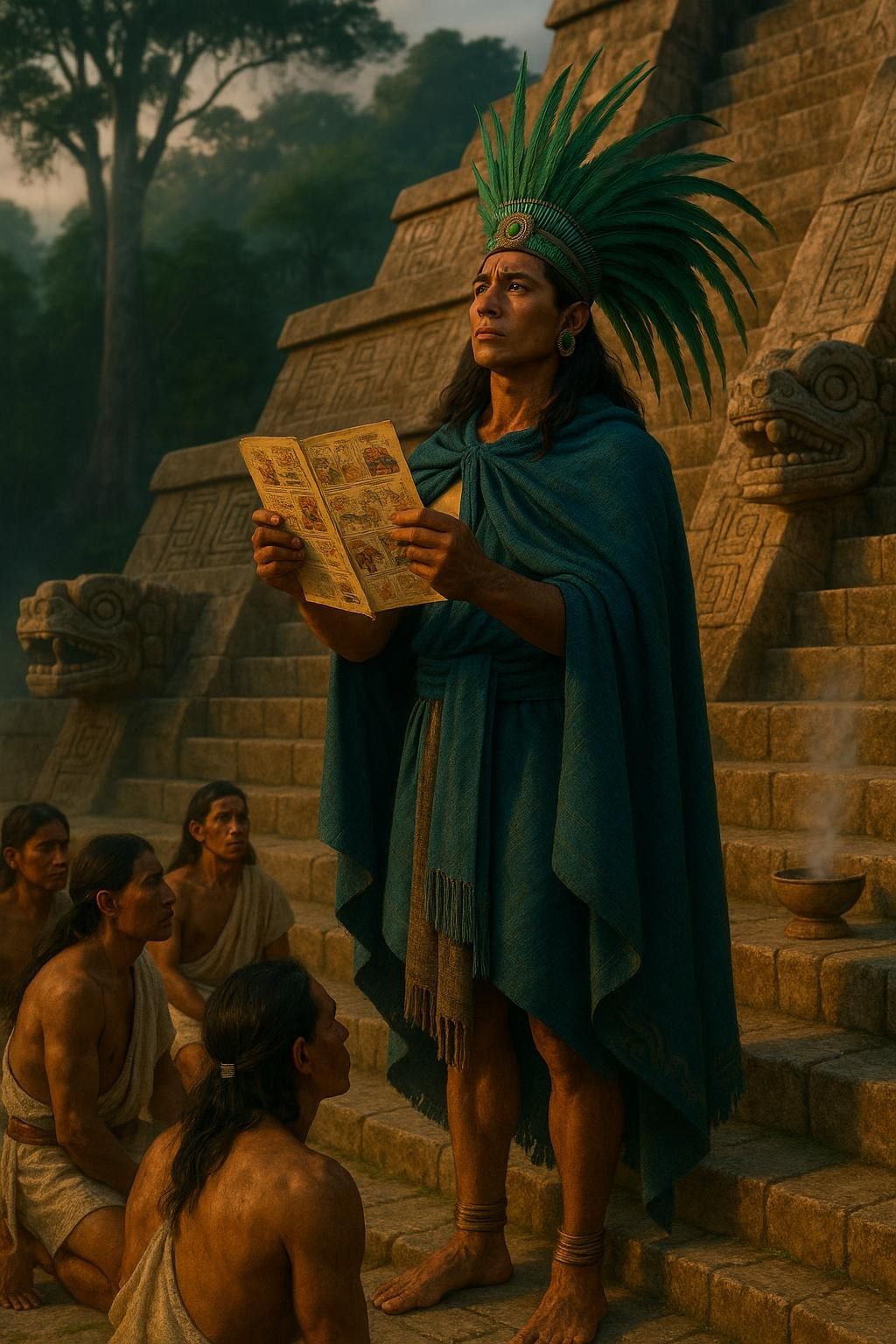
Few could have imagined that after decades of exile, Nezahualcoyotl's voice would summon not just allies, but an empire. Returning to his homeland, Nezahualcoyotl faced a kingdom in disarray, a place where his father’s legacy lay buried beneath layers of treachery and defeat. Yet he walked back into Texcoco not with vengeance in mind, but with songs that soared over the desolation like eagles.
His poems were more than just beautiful; they were transformative. He sang of reconciliation and redemption, painting with words a picture of unity that transcended old enmities. His verses captivated both commoners and nobility, slowly weaving a tapestry of allegiance and memory. He soldered alliances through shared narratives and mutual respect for heritage, nurturing relationships that would grow and fortify the nascent empire. Soon, the murmurs from the jungles spoke of a prince who sought a crown not of gold, but of empathy and intellect.
The words of Nezahualcoyotl had a curious power over the hearts and minds of his people. He spoke with the authority of ancestry and divine inspiration, poetically linking himself to the celestial realms above and the fertile earth below. In doing so, he rekindled the spirit of Texcoco, instilling pride and purpose in a land that had nearly forgotten its own history. His deft poetic touch transformed discord into harmony, crafting an alliance of cultures and communities under a shared vision of the future.
A Legacy Written in Verse
Nezahualcoyotl’s re-ascension was more than a reclamation of a throne; it was a testament to the unseen powers of art with the ability to forge kingdoms. Where others built with stone and steel, he built with the subtle strength of stanzas and song. His verses became the fabric of governance, his compassion the foundation of policy. Under his rule, Texcoco emerged as a beacon of enlightenment in the Aztec Empire, its culture as rich as its history.
The poetry of Nezahualcoyotl stands as a tribute to his visionary leadership. Many of his compositions still exist, resonating with themes of mortality, beauty, and the natural world — a dialogue between the man and the divine. His ability to articulate complex emotions and ideals into structured meter and rhyme elevated him beyond a mere ruler, transforming him into a living bridge between past and future, reality and aspiration.
Today, the tales of Nezahualcoyotl linger in the corridors of history, speaking of a time when the power of art could eclipse the might of armies. In a world ever more reliant on force and might, his story reminds us of the potential of creativity and compassion to inspire, to lead, and to transform. Nezahualcoyotl’s life illustrates a profound truth: that often, the most powerful weapon is not the sword drawn for battle, but the voice raised in song.