November 2, 1783. The chill of an autumn morning settled like a mist over the remnants of an army that had once roared with the fervor of revolution. The Continental Army, steeled by years of hardship and inspired by the vision of a free nation, gathered for what would be their last order.
The Last Command of a Gallant General
George Washington, the towering figure who had led this ragtag force through the crucible of the American Revolutionary War, had summoned his men for one final gathering. At this moment, the field in Newburgh, New York, was more than just a camp; it was the ground on which legions of dreams had fought and won their independence from oppression. In the eyes of each weathered soldier was the unspoken understanding that they stood on the brink of dissolution. The war had been won, and with it, the purpose that had fueled their valiant crusade against a mighty empire. As the day unfolded, Washington, their commanding general, looked upon his troops with both melancholy and pride. He understood that this assembly was not merely an end but a profound beginning.
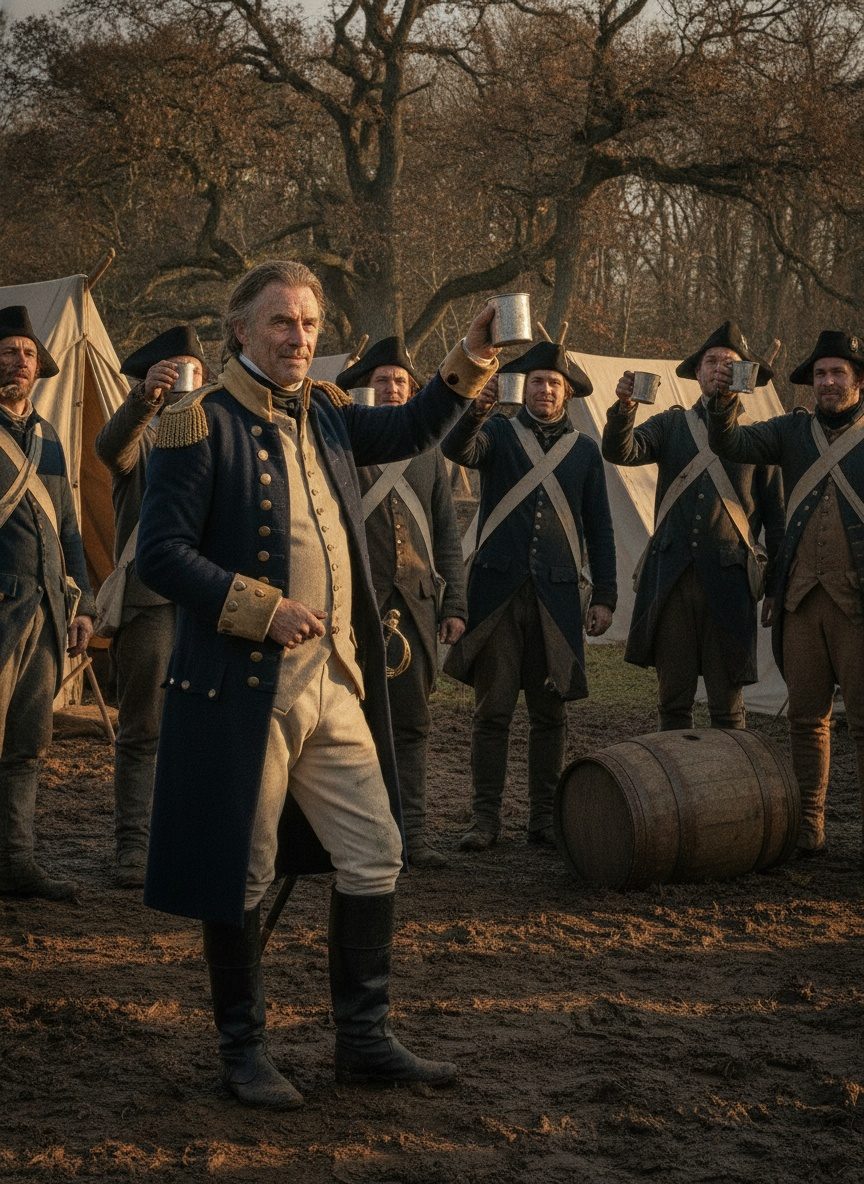
In an act of recognition that transcended the usual military protocol, Washington issued a final directive, not from the pages of tactical manuals but from the heart — a ration of rum for every man. It was a gesture imbued with gratitude and camaraderie, signaling a farewell that words could scarcely capture. For the Continental Army, it was more than the smooth sting of alcohol; it was a ceremonial parting gift from their respected leader, marking the transition from soldiers to citizens of a fledgling republic. George Washington's decision reflected his deep appreciation for the sacrifices these men made, a symbol of trust in their journey into civilian life where their contributions would help shape the nation they fought so hard to create.
The rum ration served as a liquid handshake, an unstated bond acknowledging unyielded courage and unbreakable solidarity. This moment, poignant in its simplicity, carried the weight of an era coming to a close — a collective salute to endurance, resilience, and the unrelenting spirit that had bridged the chasm between colonial subjugation and independence.
From Revolutionary Fighters to Founding Citizens
The final toast brought a sense of closure but also a daunting uncertainty. As Washington's voice faded into the crisp air, the significance of the moment reverberated among the ranks. These were the men who had forsaken the comforts of home and the certainty of safety for the tumultuous realms of war. Theirs were feats borne of necessity and unyielding belief in a brighter horizon. And yet, as they savored their rum ration, their fates seemed intertwined with the very future of the nation they had helped establish. The evolutionary step from soldiers in arms to citizens of a republic was unprecedented in its magnitude and equally elusive in its expectation.
The past years had been etched with sacrifice and endurance: the freezing winds of Valley Forge, the chaos of battlefield engagements, and the devastating scarcity that stalked them at every turn. Yet, those chapters of struggle had paved the way to triumph. As they toasted to past victories and forthcoming challenges, these men knew America's true test lay not on the battlefield but in the formation of its ethos and governance.
In the liminal space between military duty and civilian responsibility, Washington's rum ration encapsulated the ethos of a shared struggle for liberty — an acknowledgment of their collective journey. From a practical standpoint, it offered a moment for reflection, to remember fallen comrades and celebrate a vision fulfilled. Additionally, it served as a reminder that the road ahead required bravery not of the physical sort but of the philosophical kind. This challenge to nourish a young nation with the values and principles they had fought for was daunting yet essential, a mission Washington knew they could shoulder.
An End and a Beginning
As the sun slowly descended below the horizon of Newburgh, the rum-mellowed conversations echoed with stories of a war that had transitioned the men from loyal subjects to revolutionary torchbearers of American ideals. George Washington’s final order became the unofficial coda to an extraordinary period in history, marking the surrender not of spirit but of swords. They were now custodians of a hard-won freedom, entrusted with crafting a nation reflective of their labors and ideals.
Walking away from that historic gathering, the soldiers of the Continental Army did so not as defeated men but as architects of a new chapter. Their duties as guardians had only morphed from martial protection to civil guardianship. Each man, now set to return to homes and villages, carried the embedded knowledge that the American experiment was his to nurture, to guide, and, above all, to protect from tyrannical perils, both foreign and domestic.
This history — often overshadowed by battles and political machinations — holds essential lessons. The closing days of 1783 remind us that the end of warfare is not merely about disbanding troops, but it’s about transitioning those who served into harbingers of peace and democracy. Washington’s parting gift of rum may seem quaint, yet it was a potent reminder of shared sacrifice and an invitation for these early Americans to embark on the demanding journey of nation-building.
Ultimately, their legacy lives on in every democratic institution, in every right upheld. The men toasting that day at Newburgh would walk away into history as both victors and visionaries. As they left their rudimentary encampments for a new life amidst homesteads and fields, they planted the seeds of a great republic, reaffirming that the echoes of their bravery would never fade into history, but rather carry forward as inspiration for generations to come.