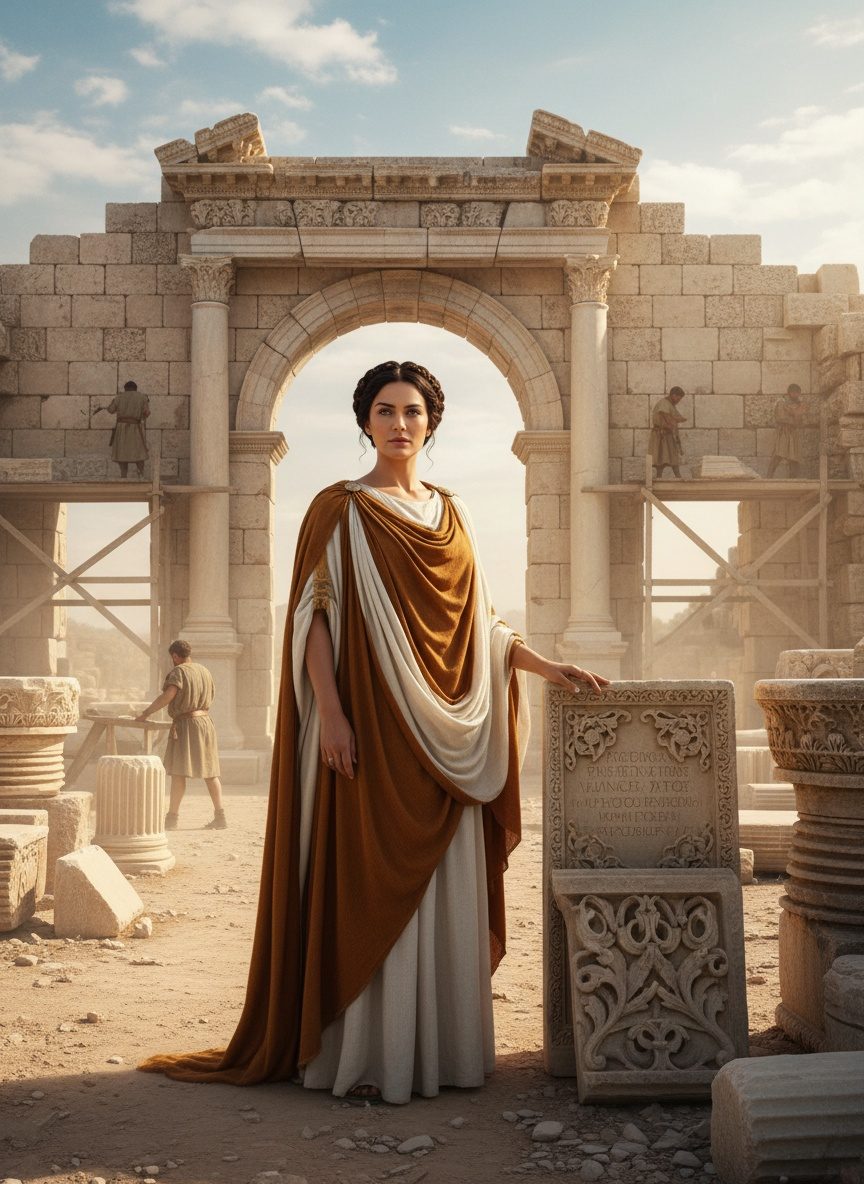
The clang of chisels echoed through the bustling streets of Perge as dust clouded the air, mingling with the aroma of fresh spices wafting from the nearby agora. It was AD 121, and the Pampleans had gathered to witness the latest marvel to grace their city: a monumental gate funded by a woman whose resolve defied societal norms. Plancia Magna's name was about to be etched into history—both literally, on the stone arch above, and in the memory of her city.
The Unseen Power of a Woman
As the daughter of Marcus Plancius Varus, a Roman Senator, and the Herodian Princess Julia, Plancia Magna was no stranger to influence and responsibility. Born to a family of notable stature, she walked the corridors of power from a young age. Yet, it was in the fragrant streets of Perge, rather than the Roman Senate, that Magna left her indelible mark.
While her father and brother were honored as ktistes or "founders" of the city, Plancia Magna herself became its heart, taking a role seldom afforded to women of her era. Her marriage to Gaius Julius Cornutus Tertullus and their progeny, Gaius Julius Plancius Varus Cornutus, tethered her to the fabric of Roman nobility, yet it was the people of Perge who felt the true force of her dedication.
Monuments and Memory
Under the reign of Emperor Hadrian, Plancia Magna emerged as a financial savior to the city. Perge, a bustling metropolis along the trade routes of Asia Minor, was in desperate need of revitalization. The city gates, portals to commerce and conversation, yearned for restoration. With a keen eye for necessity and a deep purse lined by her family's wealth, Magna orchestrated the construction of an awe-inspiring gateway around AD 119-122.
Her dedication to the emperor and her city was palpable in every stone laid. Unlike the transient tributes of military conquest, this was a civilian endeavor, a testament to community and continuity. Magna's monument did more than flank the city; it framed its future, displaying her name prominently in Latin inscriptions—a bold claim to history in a world where women were often relegated to its shadows.
The Triumph of Patronage
The unveiling of the gate was a spectacle to behold. The throng buzzed with anticipation, their chatter intermingling with the melodious beats of lyres and tambourines. As the fabric shrouding the portal slipped away, the crowd erupted in applause. The grandeur of the architecture was rivalled only by the significance of its patron.
As a high priestess and decurion—an elite member of the city council—Plancia Magna held her own amongst Perge's male leadership. Her appointment was not mere ceremonial decorum; it was a statement on her unparalleled influence and her strategic vision for the city's prosperity. She was more than just a benefactress; she was a symbol of the potential held by women to shape the public sphere.
A Name Carved in Stone
Symbols of Roman might and civic pride are peppered throughout the Empire, yet the Perge city gate bore a unique narrative. While emperors found glory in conquest and dominion, Plancia Magna etched her legacy through civic devotion. Statues of her likeness adorned the urban landscape as testaments to her indomitable spirit.
Her name, inscribed above the arch for all to see, served both as an act of defiance against traditional gender roles and as a permanent reminder of her contribution. Just off the bustling street, under the stone's shadow, her presence remained constant—a reassurance for her fellow Pergaians that their city was a place of prosperity and progression.
Why Memory Matters
The city of Perge thrived under the shadow of Plancia Magna's monumental gate. Her story is not one of isolated charity but a reflection of a woman's ability to redefine her place in history. In a society where monumental acts were predominantly the realm of men, Magna's self-financed endeavor spoke volumes. Her choice to dedicate both to the Emperor and her city exemplified her understanding that true legacy lies in deeds that outlive us.
As the dust settled and the city of Perge continued to buzz with life, the stones of the gate stood resolute—an homage to the remarkable woman who dared to build in her own name, and whose vision extended beyond the tangible into the realms of the possible. In crafting a legacy so intrinsic to the city, Plancia Magna ensured that Perge would never forget her, and that Rome's annals would always include a chapter written by her hand.