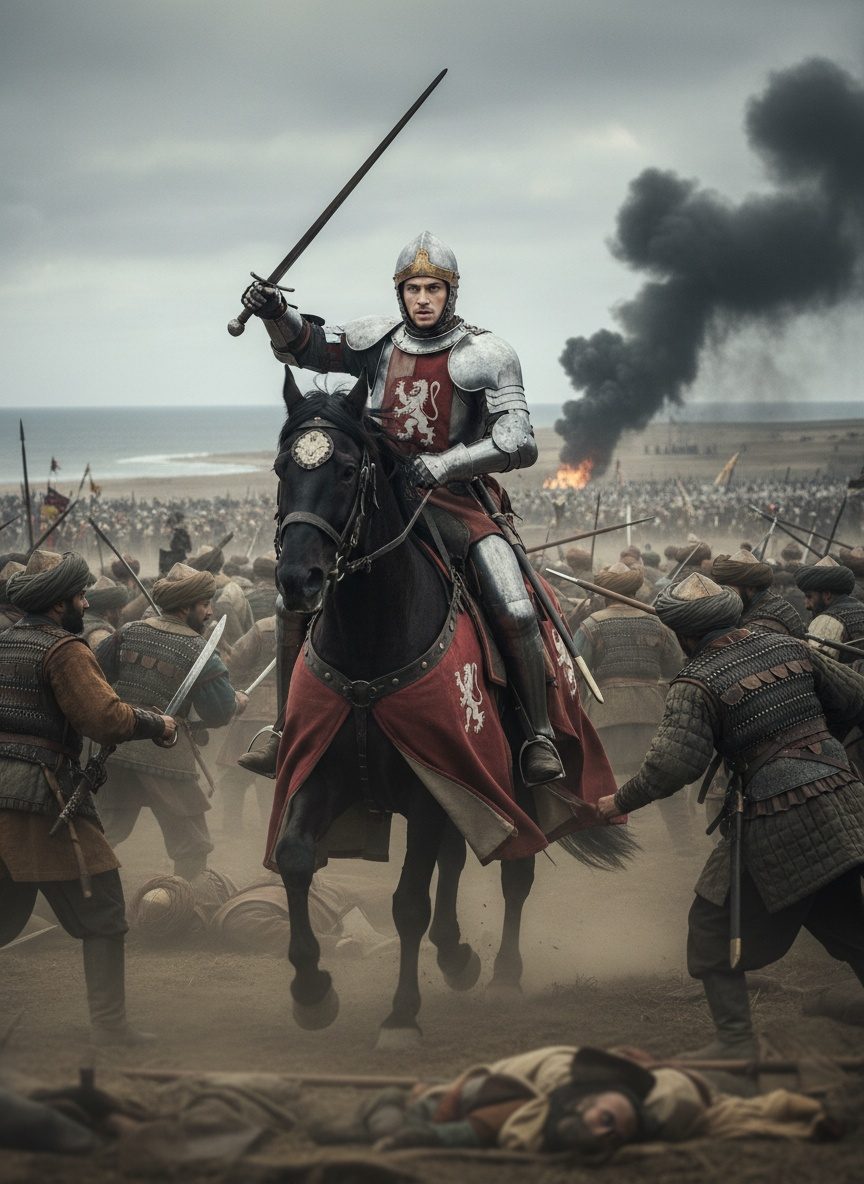
The ground trembled under the thunderous roar of hooves, and the air was thick with the clang of steel meeting steel. Amongst the chaos, a lone figure emerged, galloping towards the heart of the enemy line, his scarlet cape billowing like a flag of defiance. Władysław III, a young king barely two decades old, broke from his ranks and charged with singular resolve into the Ottoman forces at Varna. As he pierced the fog of war, the eyes of Christendom watched, their hopes tethered to the charge of a single man.
The Young King of Two Crowns
Władysław III was no ordinary monarch. Born into the storied Jagiellonian dynasty, he ascended to the Polish throne at just ten years old and became King of Hungary five years later. With youthful vigor, he carried the weighty expectations of two kingdoms on his shoulders. At the time, Europe was a patchwork of tensions and alliances, with the encroaching Ottoman Empire posing an existential threat to Christian realms. The Crusade of Varna was mounted as a desperate attempt to curb Ottoman incursions, and Władysław's leadership was pivotal.
While his age might have seemed a detriment, Władysław embodied the spirit of a crusader, fueled by chivalric ideals and eager to prove his mettle. Charismatic and courageous, he rallied a coalition of knights from across Europe under the banner of the cross, bringing together a force that hoped to rival the formidable army of Sultan Murad II. Yet, beneath the glittering pageantry and noble speeches lay an unsettling reality: they were vastly outnumbered, and the unity of the allied forces was tenuous at best.
The Calm Before the Storm
On the eve of battle, the Christian camp buzzed with a mix of anticipation and dread. As fires dotted the encampment under an expansive night sky, talks of glory and salvation danced on hopeful lips. Soldiers sharpened their swords, whispered prayers, and indulged in the somber rituals of men confronting their mortality. Władysław, amidst these preparative murmurs, was not exempt from the weight of the moment. Accounts suggest he spent the night in contemplation, aware of the high stakes.
The battlefield itself lay near the city of Varna, a crossroads of sorts between east and west, where grasslands met the Black Sea. In the dim light of dawn, a chill wind blew from the east — perhaps an omen of the coming clash. As the Ottomans unfurled in long, seemingly endless lines, their banners flapping in the cold breeze, the immense scope of the enemy became fearfully clear. Nonetheless, the Europeans stood resolute, their silhouettes drawn stark against the rising sun.
The Unstoppable Tide
When combat was eventually joined, it was a tempest of violence and valor. Archers rained arrows in deadly arcs; cavalry charged amidst cries of devotion and rage. Despite their courage, the Christian lines struggled against the methodical advance of the Ottoman forces, who appeared as untiring as the tides of the sea. It was into this cauldron that Władysław made his fated charge, cutting through the battle with a small retinue of loyal knights, a bloom of red amid the suffocating chaos.
Historians recount how Władysław targeted the elite unit guarding Sultan Murad II, a move that bespoke either extraordinary bravery or reckless despair. Legends sprouted in the aftermath, like the tale of Władysław breaking into the Sultan's camp, his sword a blur as he struck down guards with ferocious tenacity. Yet, just as sudden as his charge began, it ended. His horse caught in the thronging mass of the enemy, Władysław vanished, consumed by the presses of bodies, his banner swallowed by the fray. He did not emerge again, and all that remained were whispers of his valor.
A Memory Etched in Blood
The shocking absence of their king threw the European coalition into disarray. Bereft of their young leader, hope waned, and the united front faltered. In the wake of Varna, Europe was left to mourn a hero king felled by his pursuit of glory. Władysław’s body was never recovered; his final resting place is still a mystery, adding layers to a story already shrouded in mythos and mystery.
In the years that followed, Władysław Warneńczyk's last stand at Varna was invoked as a testament to noble courage and tragic loss. For centuries, bards sang of the King who charged alone, and in royal courts and humble taverns alike, stories abounded of his fateful ride, fueling the fires of both Christian valor and cautionary tales. His actions, caught in that fleeting charge, left an indelible mark on the annals of history, a brief but unforgettable tableau etched in the minds of those who dared to dream of turning back the tide of an empire.
As Christendom held its breath in those fleeting seconds of battle, the broader currents of history shifted. Władysław’s charge was a poignant reminder of the price of leadership and the thin line between heroism and folly. His story, enshrined in the collective memory, continues to echo through time, a reminder that sometimes, history hinges not just on vast movements or grand strategies, but on the courage — and the demise — of a single individual.