Cyrus the Great was a ruthless conqueror. Yet he wept for the king he had defeated.
The sweeping plains of Babylon lay conquered beneath the feet of Cyrus the Great in 539 BC. His triumph was nothing short of astounding. While many armies storm through cities, leaving trails of destruction in their wake, Cyrus had achieved something remarkable — the mighty city of Babylon fell without a single temple being burned. His strategic prowess and reputation for benevolence had spread across lands, earning him a place in the annals of history as one of the most consequential rulers of the Achaemenid Persian Empire. Yet, amidst the celebratory din of victory, Cyrus's next actions would etch themselves even deeper into the collective memory of his astonished generals. For a king who wielded power like a sword, it was his act of humility that would echo through time.
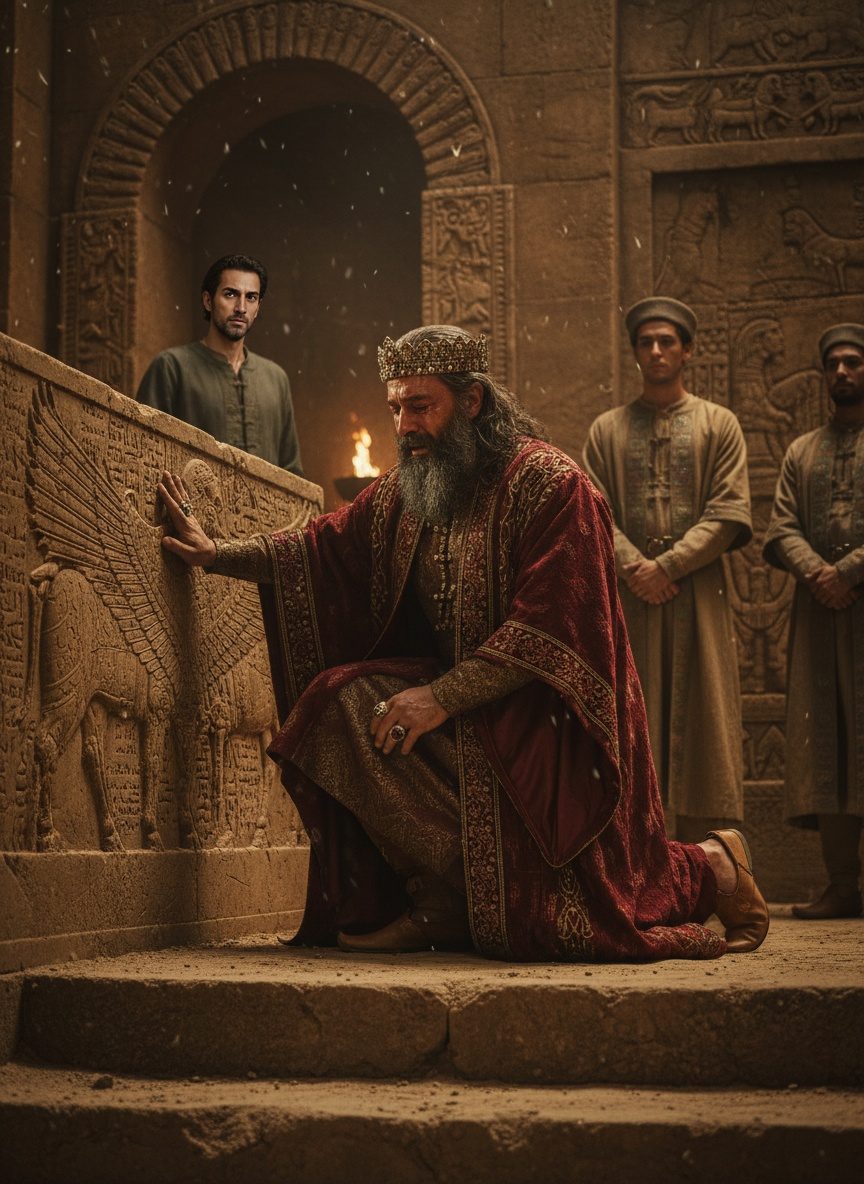
The newly crowned king of Babylon walked a path through the silent streets, flanked by his generals whose expressions ranged from reverence to confusion. Cyrus approached the resting place of the former king, the man whose city and throne now lay at his feet. It was before the tomb that Cyrus, the conqueror of Babylon, did the unthinkable. He knelt, his knees pressing into the dust of his new domain, before the tomb of his vanquished enemy. The great warrior let the silence absorb his command, for this was a moment beyond strategy or conquest. His gritty exterior gave way to a softer demeanor as tears coursed down his face, cutting through the dust of long campaigns like tiny rivers.
The spectacle of Cyrus weeping was enough to leave his generals speechless, yet it was not out of character for a ruler revered as wise beyond measure. His tears were not tears of joy for his victory; they were tears of respect for the dead king and the great city he once ruled. In silence, they stood, respecting their leader's quiet communion with mortality. His enemy had become a personality to mourn, a formidable adversary whose legacy intertwined with Cyrus's own.
This profound moment unfolded against a backdrop of towering ziggurats and lush gardens of Babylon, where Cyrus exhibited not merely the qualities of a forked-tongue diplomat but the sincerity of a man who had learned the costs of holding life in the balance. He had not sullied the sacred spaces, nor had he disrupted the daily life of its citizens, for Cyrus sought a legacy of unification rather than division. His actions toward the vanquished city's populace reflected an understanding of power that transcended traditional measures of brute force.
Behind the scenes of this tangible respect lay a broader strategy. Ancient inscriptions and texts tell us of Cyrus's efforts to present himself as the liberator. He was praised not just as a mighty ruler, but as a wise king who uplifted those he conquered, allowing local customs and religions to flourish. In Babylon, Cyrus restored local gods to their shrines and permitted captives, including the Jews famously displaced by Nebuchadnezzar II, to return to their homelands.
Yet, one cannot dismiss the complex duality in Cyrus's character. His tears might have dampened the Babylonian soil that day, but they were not the tears of an upstart messiah renouncing worldly power. They traced back deeper into a political pragmatism that understood the intrinsic value of respect and remembrance as tools as sharp as any sword. The Persian king transformed his legacy from that of conqueror to revered leader by acknowledging the true essence of Babylon — a cultural melting pot steeped in history and significance.
Even today, the silent weeping at the tomb of a vanquished king resonates across the corridors of history with an enigmatic dignity. It forces one to question the simple narratives of hero against villain, compelling us to ponder the nature of leadership and the burdens it bears. The political chessboard of ancient Persia demonstrates that a genuine respect for history, heritage, and humanity can grant a leader something more enduring than fleeting empire — the immortalisation in the hearts of those they ruled.
Cyrus the Great extended his empire across vast stretches of the known world, his name synonymous with unification, justice, and benevolence. As we sift through the sands of time, the image of Cyrus at the tomb, the king who knelt to mourn, plants a seed that might bloom anew among the myriad complexities of our modern world: power tempered by compassion, authority intertwined with humility. It is a testament to the silent victories won within, amidst the thunder of conquest and the celebration of vanquishing kings.