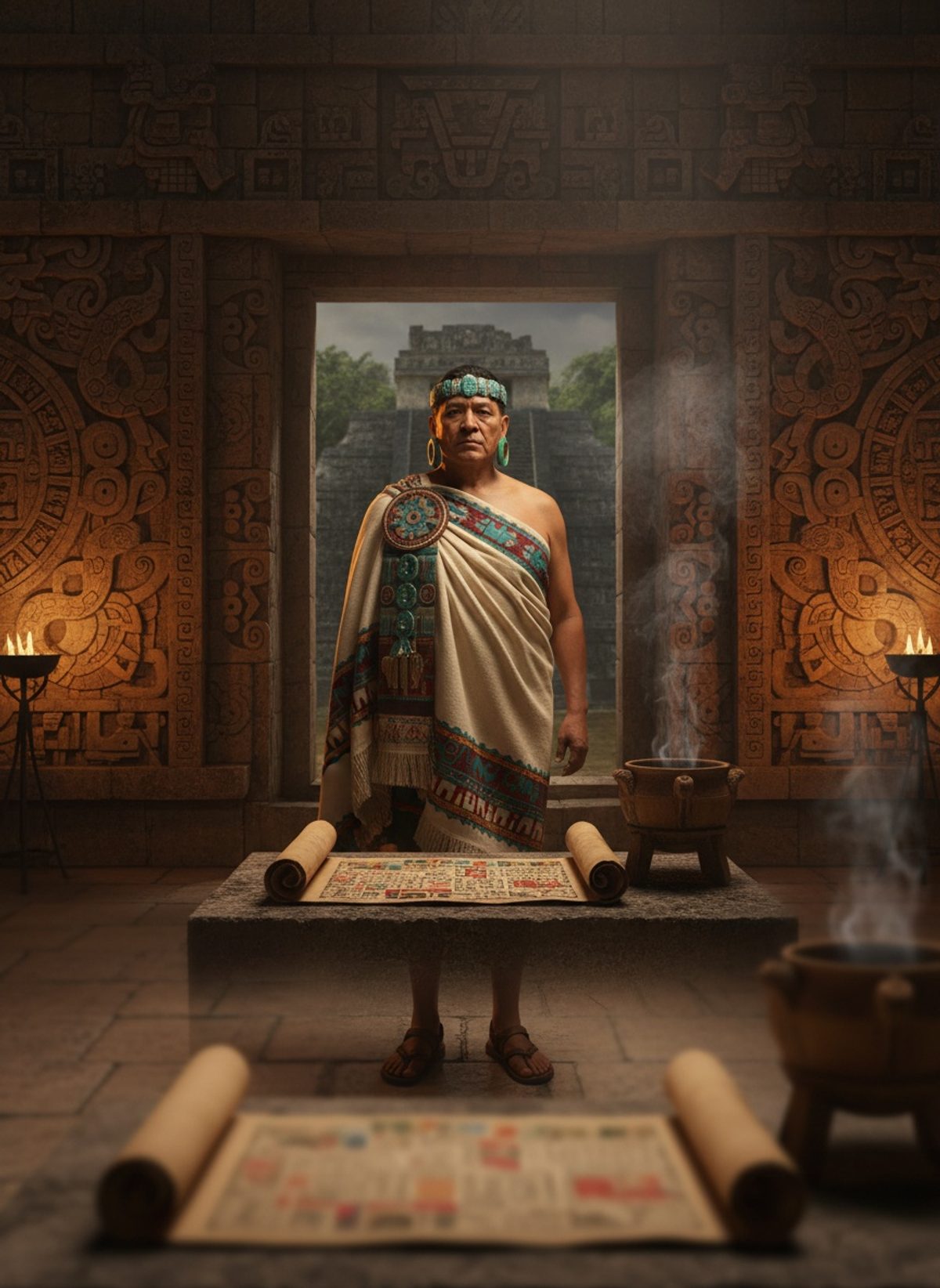
Flames crackled vigorously, consuming the ancient codices with a hunger that mirrored the ambitions of the man who orchestrated their destruction. Tlacaelel stood with a calm, unyielding countenance, his eyes reflecting the inferno that would erase centuries of memory. To some, it was sacrilege; to him, it was a necessary act of creation. The old stories were gone, and in their ashes, he envisioned a new narrative that would forever alter the trajectory of the Mexica people.
It was the early 15th century, and the Mexica, soon to be known as the Aztecs, were on the cusp of transformation. Barely a blip on the radar of Mesoamerican civilizations, they had scratched out an existence in the swampy lands of Tenochtitlan, surrounded by more powerful adversaries. Their path to greatness was unclear, impeded by both internal strife and external hostility. Yet inside the wooden halls of power, a master strategist was weaving a story so compelling that it would pull the Mexica together, elevate their ambitions, and change their destiny. Tlacaelel was not the man on the throne, nor did he ever desire its burdens; but his whispers in the ears of emperors would shape the Aztec Empire for generations.
Without a crown but wielding immense influence, Tlacaelel redefined the spiritual and political core of his people. Standing behind three emperors, he was the authority rewriting the rules and bolstering the Mexica's confidence in their divinely ordained mission. The traditional narratives he extinguished did not serve his vision. In their place, he enshrined the concept of the Mexica as the chosen people of Huitzilopochtli, the warrior sun god who demanded blood and sacrifice, a belief system that justified the imperial ambitions of the Aztecs and fueled their military conquests.
What transpired next was unlike anything Mesoamerica had ever witnessed. Tlacaelel's bold reforms could be felt in the palpable tension of the market square, where traders whispered of new victories and subjugated cities, as well as by the pounding of drums that filled the air during sacred ceremonies reinforcing the sun's journey. The ideology that Tlacaelel meticulously sculpted gripped Tenochtitlan with fervor and zeal. Chronicles were rewritten under his guidance, making the Mexica the centerpiece of the cosmic order, a destiny preordained and undeniable.
His influence extended beyond prophecy into pragmatic governance. Tlacaelel spearheaded the reorganization of tribute systems and military structures, knowing full well that the empire's expansion relied on a steady influx of resources and warriors. He understood the power of religion as a unifying force, drawing a connection between the Mexica's military might and their sacred duties. The famous Flower Wars, designed ostensibly for obtaining sacrificial captives, became a dual-purpose mechanism: blood to appease the gods and a training ground for warriors to keep the population honed and ready for military expeditions.
As Tlacaelel's influence grew, so did the grandeur of Tenochtitlan. The city blossomed into a metropolis, its streets bustling with life, its temples rising majestically into the sky. Canals crisscrossed the city, filled with vibrantly painted canoes ferrying goods and people to and from the market. Here was the proof of what Tlacaelel envisioned—the very center of the universe, a beacon of power and divinity radiating outward to the borders of their expanding realm.
Despite his achievements, Tlacaelel never coveted the throne itself, a fascinating testament to his character. Offered the crown not once but three times, he demurred, comfortable in his role as the power behind it. Every choice he made was a deliberate act to strengthen the empire, not aggrandize himself. His reluctance for kingship was matched by his profound dedication to the success of the people he served. It was the rarest form of leadership, one that sought no personal accolades but thrived on the achievements of the greater good.
As the years passed, each success seemed to validate Tlacaelel's manipulations more. Kings may have occupied the throne, but it was his vision that was omnipresent. And it was a gamble—scorching the old to build the new, betting on the fervor of belief, manipulating loyalty through religion, and balancing power with subtle precision. Under his unofficial guidance, the loose confederation of city-states transformed into a cohesive imperial power that commanded respect and fear throughout the land.
It's impossible to consider the legacy of Tlacaelel without pondering the dual-edged nature of power. By reshaping religion and culture, he ensured the Mexica's central role in the history of pre-Columbian America. However, the same ideological engine that propelled the Aztecs to imperial dominance also fostered the static rigidity that would eventually contribute to the empire's downfall. The narrative of invincibility was shattered when smallpox and Spanish forces introduced the Mexica to a different kind of enemy—a fatal opponent immune to the dangers of theological coercion.
Tlacaelel’s story is a profound reminder of the power of mythmaking in constructing—and deconstructing—societies. His ambition was not personal glory but the crafting of a national ideology so compelling that it transcended natural boundaries. Ultimately, it invites reflection on how truths are manufactured and the lengths leaders go to bind people to a common cause. Though less known today, his legacy endures in the annals of history, a testament to how whispering the right story at the right time can move empires.