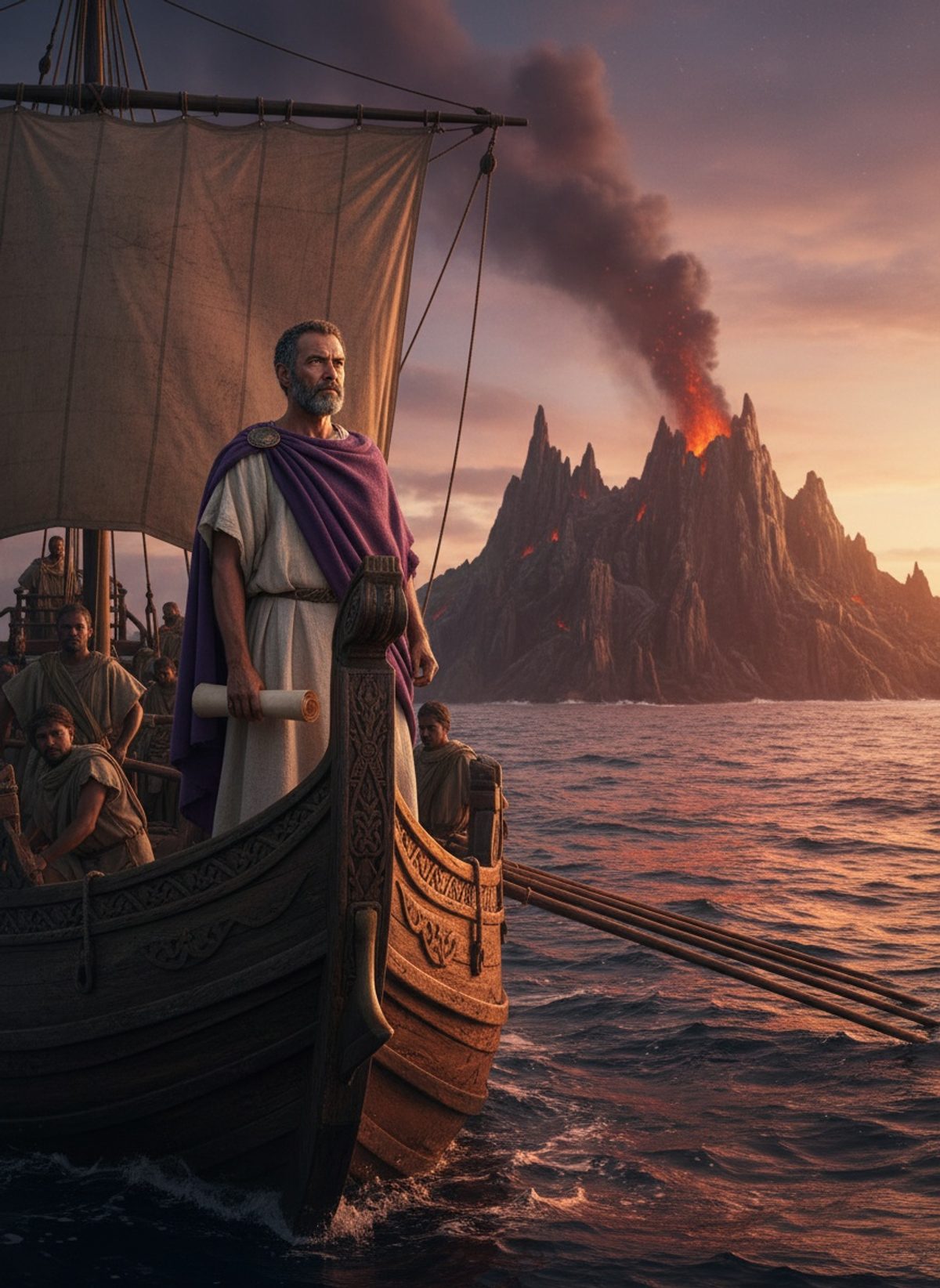
He was a navigator from a city renowned for its seafaring prowess. Yet, almost no one in his city, or anywhere else, believed his tale.
The Uncharted Horizon
In the bustling harbor of ancient Carthage, amid the clamor of trade and the salt-tinged air, a fleet of sixty ships prepared to embark on an epoch-defining voyage. At the helm was a man known simply as Hanno the Navigator, tasked with an ambitious mission by the city's ruling council. The horizon to the west stretched boundlessly, and his fleet was set to explore beyond the familiar waters of the Mediterranean, beyond the shadow of the daunting Pillars of Hercules. Today, these are known as the Strait of Gibraltar, often seen as the demarcation line between the known world and the impenetrable vastness of the Atlantic Ocean.
Entrusted with thirty thousand settlers, Hanno's mission was not just one of exploration but of expansion. Carthage, with its insatiable appetite for growth and resources, looked to establish a series of colonies along Africa's uncharted coastline. As the fleet ventured southward along the African coast, Hanno left behind a wake of burgeoning Carthaginian outposts. Together, these settlements would act not only as symbols of Carthage's rising influence but also as strategic footholds in lands littered with untapped potential.
The deeper into the unknown they sailed, the wilder and more untamed the lands became. Each dusk and dawn unveiled coastlines draped in mystery, territories untouched by the hands of any Mediterranean civilization. There were exchanges—some peaceful, others contentious—with local tribes who eyed these seascape travelers with a blend of curiosity and caution. To these tribes, Carthage's celestial-sailed galleys would have seemed as foreign and alien as the distant stars wandering the night sky.
Rivers of Fire and Fantastical Beasts
Legend has always danced on the fringes of human exploration, a tapestry woven with awe and disbelief. For Hanno, the voyage’s turning point came with the sighting of what he described as rivers of fire plunging into the ocean. Today, historians speculate that Hanno may have stumbled upon the volcanic islands of Cape Verde or even observed the volcanic eruptions along Africa's western spine. Yet, for those who eagerly awaited his return, such tales seemed ripped from Homeric epics rather than anchored in reality.
The journey extended to lands populated by creatures the Greek texts had never named—massive, silent beasts grazing the plains and towering above the thick jungle canopies. Did Hanno encounter elephants or gorillas on these shores? Perhaps. For a city engrained in the merits of commerce and warfare, the lush biodiversity of Africa held secrets that defied articulation, laden with unfamiliarity and marvel.
Among these tales, one narrative stood out in particular—a harrowing description of shadowy, hairy beings inhabiting the forested borders of these strange lands. To those who grasped onto familiar symbols, the creatures were understood as menacing "hairy women" or what later interpretations might label as gorillas. This enigmatic sighting would leave an indelible mark on those who read his accounts, haunting the margins of ancient texts with echoes of the fantastical.
Returning to Disbelief
Against the odds, Hanno and the weather-beaten fleet ultimately made their return to Carthage. Tired, sun-parched, and carrying the weight of tales that seemed to straddle the line between real and imagined, the sailors were greeted with a reception that was part triumphant and part skeptical. Hanno had his account inscribed onto stone—the famed Periplus of Hanno—detailing expansive beaches, bizarre wildlife, and fire-lit horizons. Yet, for all its precision, the account fell into a haze of incredulity.
Carthage, while possessing a remarkable heritage and a trailblazing spirit, was still firmly moored to the practical. Economics, politics, and military might held sway over fanciful narratives of far-off adventures. For Hanno, the pressing matter fell to the establishment of a tangible legacy—one cemented not in stone but in territorial expansions that the council could see and touch.
And so, his stories joined the annals of whispers and doubts, swallowed by the passage of time and overshadowed by the more immediate demands of Carthaginian dominance. We see the hand of history often rewards only those narratives that yield immediate power. Hanno’s journey teaches us that the boundary between myth and history ebbs with the tides of time. In his carved words, we glimpse the boundless curiosity that drives human exploration—forever seeking the edges of our world and daring to push beyond them, even when those edges are blurred by the shadows of disbelief.