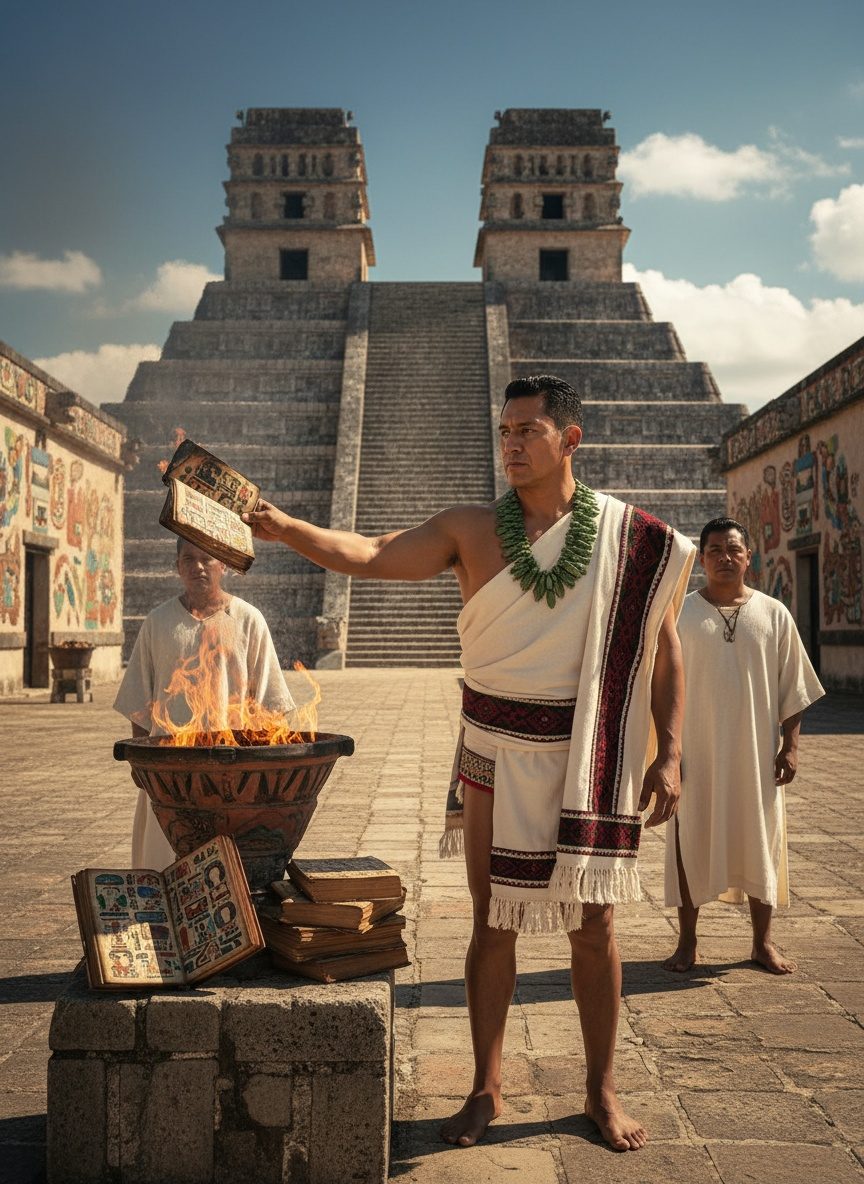
1430s. Flames licked the edges of the codices, painting the night skies above Tenochtitlan with a fiery glow.
Beneath the smoke that coiled towards the heavens, Tlacaelel stood resolute. As the burning pages turned to ash, whispers of a world being unmade floated into the air. These were no ordinary documents. They held the stories of his people — histories, myths, beliefs — the threads of memory sewn into the tapestry of the Aztec civilization. Yet, Tlacaelel, despite never wearing the crown, wielded power surpassing emperors, and he understood that to pave the way for a grander future, the past first needed to be rewritten.
Born into the influential Pilli lineage, Tlacaelel was deeply embedded within the heart of Aztec political life. Unlike his contemporaries who hungered for the throne, his ambitions were not to rule in name but to shape a destiny for his people that solidified their greatness. Three emperors rose to power under his counsel — his hands deftly guiding their reigns like strings pulling a marionette. His task was as daunting as it was visionary: to craft an ideology where the Aztecs stood as the chosen people, inherently destined for supremacy.
In the 1430s, Tenochtitlan had just successfully emerged from the shadow of nearby city-states. However, rather than rest on these laurels, Tlacaelel saw an opportunity to cement their newfound dominance. The surrounding regions teetered in a delicate balance of power, and Tlacaelel knew that only a unifying belief could transform his people into an unstoppable force. Thus began the process of rewriting history itself — metaphorically and quite literally.
Under Tlacaelel's direction, the ancient texts were reduced to ashes. The past they held painted an inconveniently modest picture of the Aztecs. In their place, new narratives were born. These tales were ones of divine favor and preordained glory, rewritten to enthrone the Aztecs as the rightful rulers of a civilization favored by the gods. This revolutionary vision forged the ideology that Aztec warriors would embrace — the notion that every successful conquest was not simply for territorial gain but an act of cosmic significance, perpetuating harmony between the mortals and their deities.
Tlacaelel reoriented the narrative around the sun and human sacrifice, with a focus that seemed boundless in its intensity. He promulgated that their chief deity, Huitzilopochtli, required human hearts to power his journey across the sky, thus making warfare not merely an act of expansion but a sacred duty. This escalating cycle of sacrifice and warfare solidified Tenochtitlan's status at the center of the Aztec universe.
Under his influence, the practice of the ritual “Flower War” further entrenched this ideology. These wars were not fought for territory but for captives, a reservoir to fuel the endless demand for sacrificial offerings. It was a psychological masterstroke — by turning each warrior’s death into a celestial offering, Tlacaelel instilled in his warriors a fierce loyalty and unyielding courage. The heart of an Aztec warrior, so it was now believed, was destined for the highest honor.
Tlacaelel’s enduring legacy was also etched into the architectural marvels of Tenochtitlan. Pyramid temples rose higher, their surfaces adorned with iconography that mirrored the rewritten histories. Each stone echoing narratives of divine election and martial prowess. The city itself became a living embodiment of Tlacaelel's vision — grand, unyielding, and destined for greatness.
Though Tlacaelel’s machinations were veiled in layers of political doctrine, his influence was unmistakable. He refined the Triple Alliance with meticulous attention. This confederation with the city-states of Texcoco and Tlacopan was cleverly structured to maximize both military might and political influence while casting Tenochtitlan as the unassailable epicenter. As this alliance solidified, so did the myth — the history he scripted rose not from the ashes, but from the very heartbeats of his people.
Yet, this grand reshaping came at a cost. The reliance on an ever-increasing need for captives led to relentless military campaigns and eventually strained Aztec resources and diplomacy. Tlacaelel's narrative of supremacy required constant validation — an inherent, unsustainable demand embedded within its very success. The continual conflict that his ideology necessitated set the stage for vulnerabilities that others, like Hernán Cortés, would later exploit.
Despite these eventual consequences, Tlacaelel's reshaping of the Aztec worldview proved to be nothing short of revolutionary. By the time of his death around 1487, the Aztec Empire had transformed into the premier power in Mesoamerica. It was Tlacaelel's narrative — his myth — that allowed them to envision and pursue a reality where their destiny was intertwined with the divine cosmos itself.
The heart of Tlacaelel's story lies in the power of ideation. He illustrated how the past can be molded to serve the future, and narratives can guide the course of empires. Centuries have passed, but his audacious act of rewriting not only defined the fate of his civilization but also left behind a profound lesson in the importance of carefully curated stories — a lesson that resonates in every culture even today.