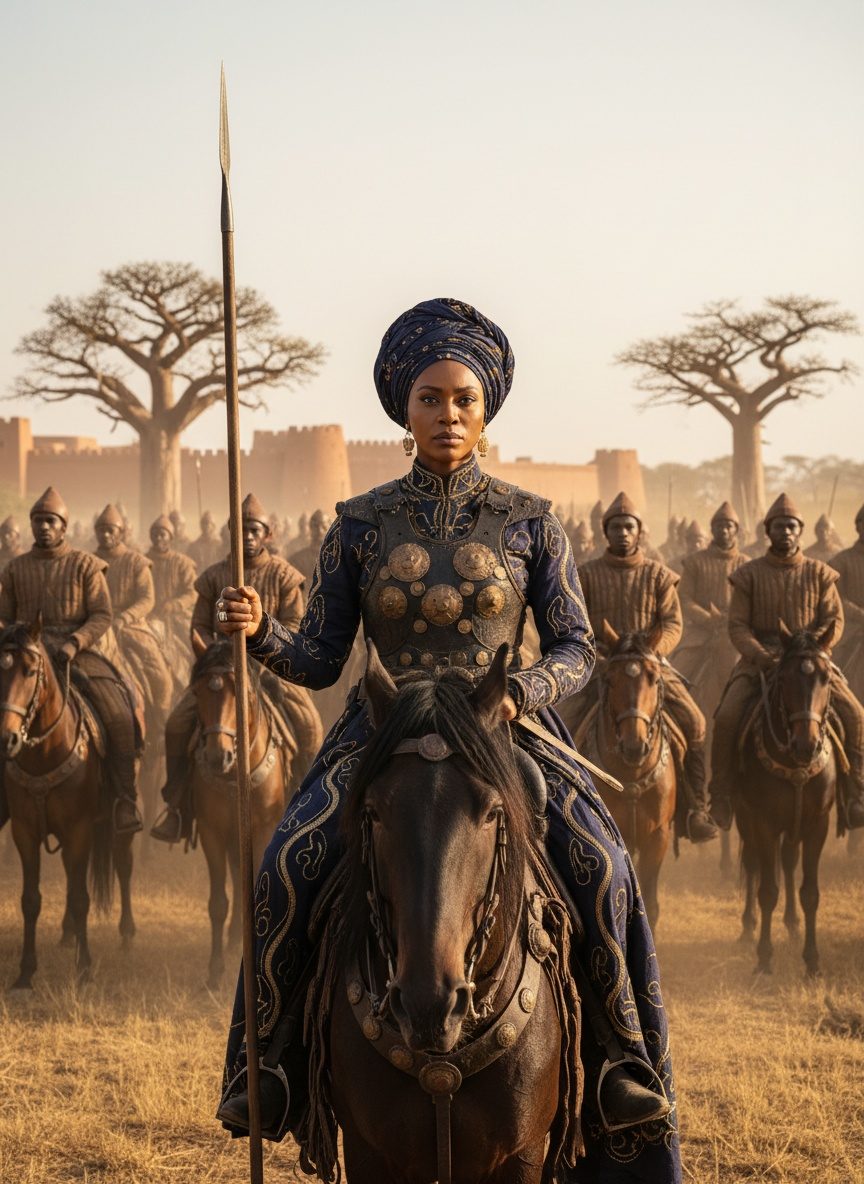
The clang of metal rang in the air as the horse beneath her surged forward, hooves pounding against the earth like rolling thunder. Dust rose in a fierce cloud behind Amina of Zazzau as she rode at the head of her army, her eyes fixed on the horizon where another kingdom awaited its fate. Each time she led her warriors into battle, she carried not only her own legend but the destiny of the Hausa states along with her. It was 1576, and the queen had never tasted defeat. Ahead lay the land she had vowed to bring under her rule, expanding her kingdom in a way none had before — or since.
A battle-hardened leader, Amina was an anomaly in her time: a warrior queen who refused to be confined by the traditional roles dictated by West African society. She ruled from Zazzau, one of the prominent city-states of the Hausa people, now located in modern-day Nigeria. While her peers limited their leadership to the safety of palatial walls, Amina's command extended to the open fields and the sharp edge of a sword. Often riding at the forefront of her cavalry, she led campaigns that would secure her realm's prosperity and elevate her status to that of legend.
In an era where power was measured by the ability to seize and hold territory, Amina harnessed the full might of Zazzau. Under her reign, the kingdom's borders extended further than ever before, creating a network of vassal states that acknowledged Zazzau's supremacy. Each victory added another bead to the string of her accomplishments, marking her not only as a military tactician but also as a realpolitik expert who could shape alliances as effectively as she wielded a blade.
Amina's ascension to power was steeped in the rich traditions of her people. The Hausa city-states, which included Zazzau, Gobir, Kano, Katsina, and others, were known for their unique blend of indigenous customs and Islamic influences. This cultural fusion became the backdrop against which Amina honed her skills. Born into a royal household, she was trained in the arts of governance and war from a young age. Her mother, Bakwa Turunku, was an influential leader in her own right, and from her, Amina learned the value of strength tempered by wisdom.
As the sun set over the boundless savannahs, casting a golden hue over the land, Amina would often pause to survey her domain. It was not just territories and wealth she accumulated; it was influence, a legacy cemented through daring maneuvers and unyielding ambition. She famously ordered the construction of intricate fortifications, the remnants of which whisper her story to this day across northern Nigeria. These were not mere defensive structures; they symbolized the permanence of her rule and her strategic foresight in securing trade routes that enriched Zazzau's coffers.
Stories abound of her unmatched prowess in battle, her army trained to a condition of near-invincibility under her watchful eye. Amina's cavalry was feared across West Africa, renowned for its speed and precision. It was said that she would personally direct the flow of battle from the field, her presence a talisman to her troops and a terror to her foes. With her hand firmly on the reins of her mount, she could effortlessly signal a shift in tactics, her warriors adapting with a discipline born of rigorous training and unwavering loyalty.
Despite the passage of centuries, five hundred years can often dim the memory of once-great figures. Yet, the tale of Amina of Zazzau persists, a testament to her lasting impact on the region's history. Through oral traditions and the enduring architecture of Hausa land, her feats inspire admiration and inquiry alike. Some tales even embroider her legend further, suggesting she remained unmarried, dedicating her life to the service of her kingdom, her only consorts the conquered cities that expanded her empire.
The image of Queen Amina wielding a sword astride a battle-hardened horse cuts a stark silhouette, challenging not only the enemies that rose against her but also the very expectations of her era. Her story reveals more than just a chapter in history; it offers a glimpse into the resilience and ingenuity of the human spirit. For those living in the shadow of her once-vibrant kingdom, Amina is a symbol of the potential for greatness that can emerge against the odds.
As the dust of time settles on her once-thunderous gallop, one might wonder about the powers that sustained such a formidable queen. Amina's reign is a scholarly focal point for understanding the dynamics of gender and leadership in pre-colonial Africa. She held the reigns at a time when women's roles were strategically defined yet often limited. Amina refused such constraints, writing her story with the bold strokes of a conqueror's pen.
Her legacy transcends the battlefield; it is woven into the very fabric of Hausa identity. Perhaps the greatest testament to her enduring influence is the reverence in which her life is still held. To speak of Amina is to evoke the spirit of a leader who could not be stopped, who carved her path and redefined what it meant to rule in an age of countless restrictions. Her exploits resonate as powerfully today as they did in the 16th century, reminding us that history's corridors are often shaped not just by men, but by the indomitable spirits of women like Amina of Zazzau.