The thick canopy of the Vietnamese jungle closed over like a living shroud, its humidity draping everything beneath it in a heavy, suffocating heat. Small slivers of sunlight fought their way through the dense foliage, reflecting off the sweat-soaked leaves and creating a mosaic of light and shadow on the ground below. Overhead, the ominous chop of helicopter blades cut through the thick afternoon air, a frantic echo that promised rescue yet delivered neither solace nor survival. For twelve American soldiers, their lives hung in the balance amid the cacophony of war—a desperate dance between life and death on May 2, 1968.
The jungle had become a crucible of fire and steel. The platoon was pinned down after having stumbled into the killing zone of North Vietnamese forces, and their calls for help crackled over the radio with an urgency that made hearts pound even miles away. Three helicopters had already attempted the rescue, only to retreat as molten metal pierced their fuselage. The situation seemed hopeless, the silence of the jungle punctuated by the stutter of enemy gunfire that claimed more American blood with each passing moment.
In the middle of this unfolding tragedy, a man named Roy Benavidez sat listening to the radio at a nearby base camp. His heart beat with the syncopated rhythm of determination and dread. Just 33 years old, Master Sergeant Roy Benavidez was not new to the horrors of war—an orphaned child turned soldier who had already earned his stripes in the fierce arenas of combat. Yet what compelled him now was something beyond duty; it was a bond shared by soldiers that transcended orders—a raw resolve to save lives no matter the cost to his own.
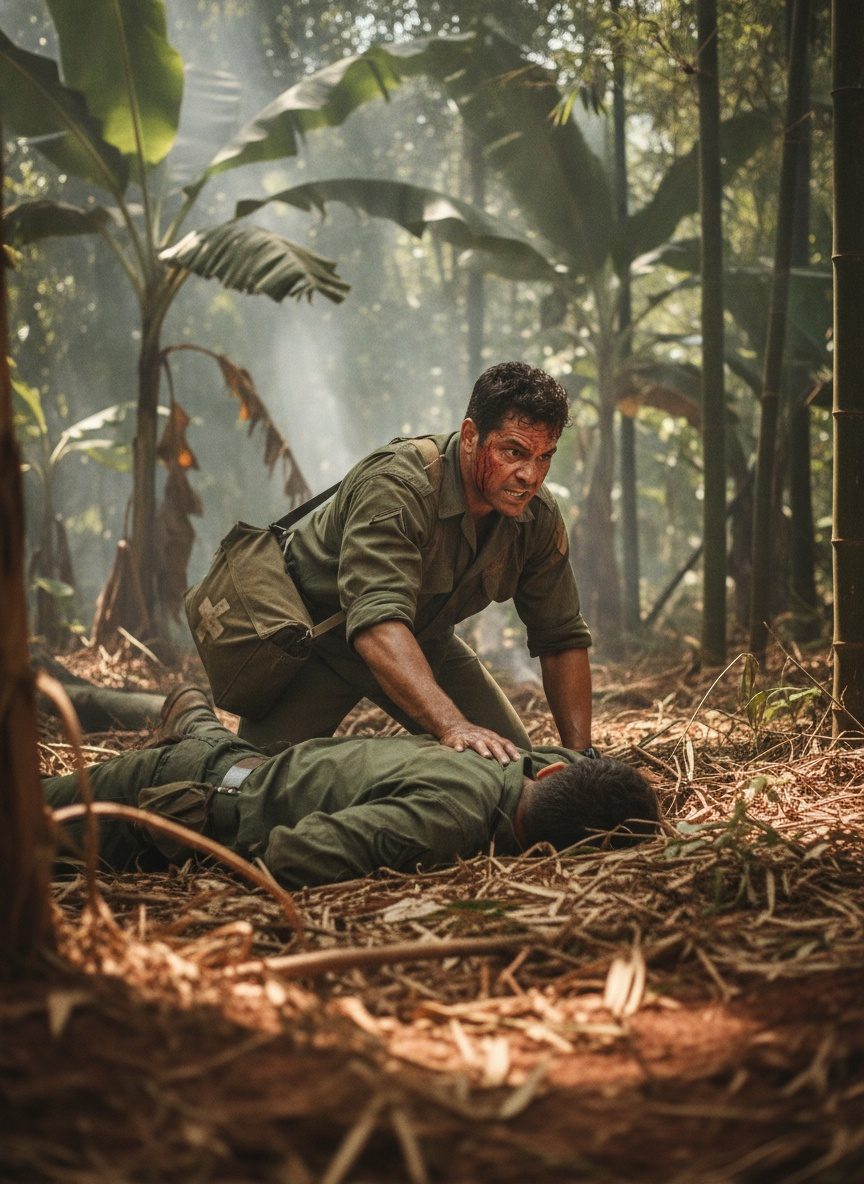
Without hesitation, Roy grabbed a medic bag, not even pausing to arm himself with more than a knife, and sprinted towards the Huey helicopter, his pulse dictated by the urgency of a heartbeat that blended singular purpose with a disregard for his own safety. As the helicopter rotors stirred the earth into a frenzy below, he leapt from the side, descending into the tumultuous jungle with only the thin comfort of his determination between him and the enemy waiting below.
He hit the jungle floor with resolve rather than caution, a soldier’s systematic approach kicking in even as the crack of bullets signaled his arrival to lurking foes. The underbrush was thick and unyielding, eager to ensnare and claim another lost soul, but Benavidez moved with the grace of practiced survival, knowing that every second spent on his own life meant perishing time for his comrades. He was struck down by enemy fire before even reaching the first wounded man, but trained instinct and sheer will turned pain into a mere impediment.
Over the course of six arduous hours, under relentless assault, Benavidez orchestrated a rescue operation that defied both logic and probability. The echoes of radio communications guided reinforcements as he called in airstrikes, directed helicopters, and delivered life-saving care amid the clatter of warfare. The air was thick with the acrid mixture of gunpowder and smoke, the thunderous explosions punctuating the cries of men caught between life and an indifferent jungle.
The stories of heroism emerging from those six hours read like a fabled epic—one where a man bears the burden of both destiny and duty. Benavidez dragged men from the jaws of death, moving them out of the line of fire with the relentless determination of a general commanding his troops in a battle fought upon a shifting frontline of flesh and jungle thorns. The stench of blood and sweat mixed with soil was pervasive, each life saved a testament not to the folly of war, but to the human tenacity to protect one’s brothers at any cost.
Benavidez fought hand-to-hand with a bayonet wound in his stomach, his mind a haze of determination as his body refused to yield. Knife in hand, each encounter with the enemy became deeply personal, as he faced gunfire with the proximity of breath, the jungle a claustrophobic witness to inhuman endurance. Engaged in the gritty dance of survival, the master sergeant seemed momentarily invincible, a human shield woven from the complexities of courage and desperation.
Even as the last helicopter ferried away the survivors, each face etched with a mixture of gratitude and horror, Benavidez’s ordeal was far from over. Mistakenly deemed a casualty, he was laid with the dead—an ironic fate for a man whose defiance kept death at bay for so many. But even as the universe seemed to have conspired against him, Roy Benavidez, bloodied yet unbeaten, summoned the last vestiges of his surviving spirit. His response was both simple and profound—a spit that struck the doctor trying to claim his life for regulation, a visceral punctuation to the legacy of his incredible day.
His actions on that historic day, strewn with blood and valor in equal measure, became more than just a testament to individual heroism. Beyond the shrouded perils of Vietnam, they reverberated through corridors of military history as a reminder of the profound and inexplicable connections woven amidst the chaos of war. Roy Benavidez’s courage illustrated the limitless depths of personal sacrifice—a reflection on the unwritten bonds that command stronger than orders, a pledge that outweighs fear and folly combined.
This story matters not merely because of a man who defied death, but because it reminds us of the countless untold tales of bravery and sacrifice hidden within the folds of history—stories of invisible heroes who pass through moments of seemingly inevitable loss and weave them into a tapestry of humanity’s enduring resilience. In the echoes of the Vietnamese jungle, beneath the haunted shadows of its trees and its silent testimony, echoes the heartbeat of valor, resonating still through the memory of Master Sergeant Roy Benavidez.