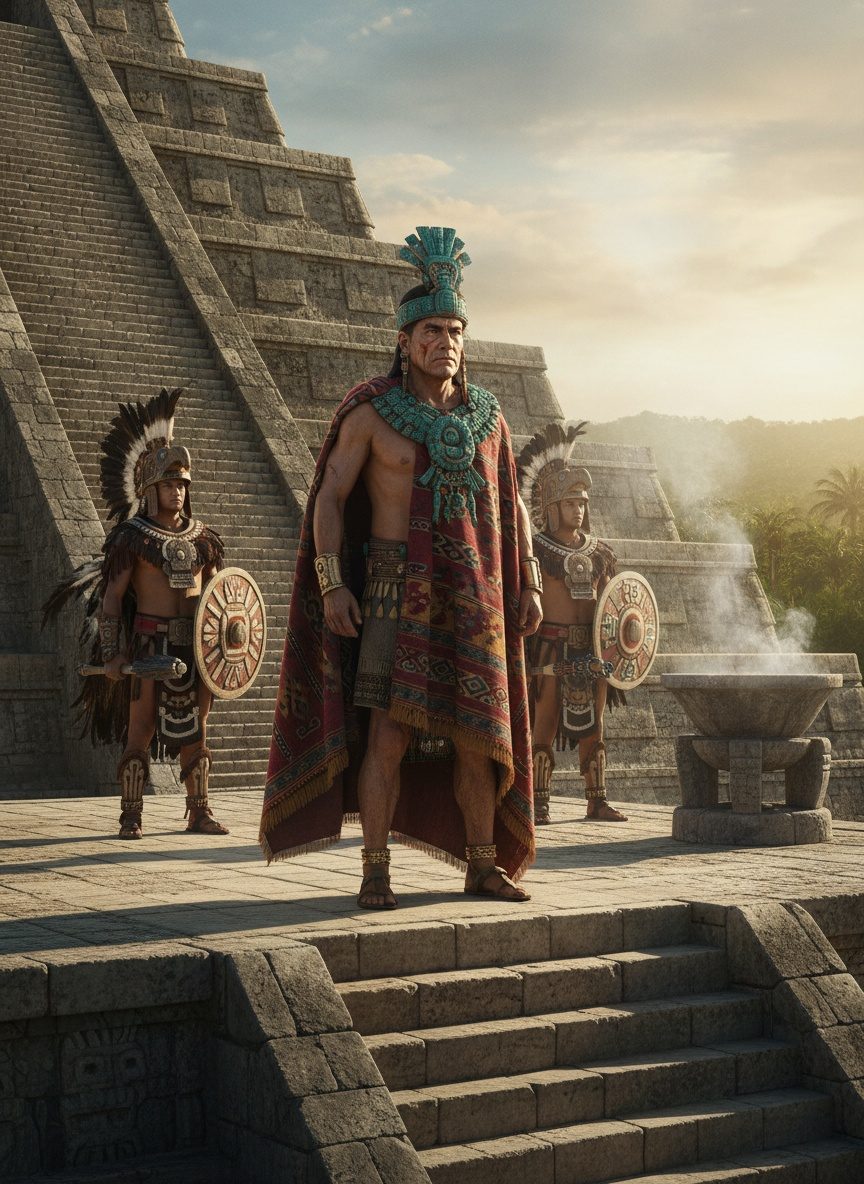
1481. The sun cast unforgiving shadows over the stone city of Tenochtitlan as the drums of war beat an ominous rhythm.
Blood and Sacrifice: A Coronation Imperative
Tizoc's ascent to the throne of the mighty Aztec Empire was steeped in tradition, both solemn and savage. As the seventh emperor, his power and legitimacy rested on a single, brutal truth: the need for a triumphant war to capture prisoners for sacrifice. Without this, the gods' favor might wane, and his rule could be undermined before it even began. The stakes were clear as the azure skies over the Valley of Mexico.
The Mexica people believed the sun required nourishment in the form of human blood, a concept deeply rooted in their cosmology. This belief identified the emperor as not just a ruler but a divine intermediary. Thus, the inauguration of Tizoc, like those before him, demanded a large-scale sacrifice — a ritual to affirm his divine right to rule and to imbue his mandate with celestial blessing.
Accompanied by the banner of Huitzilopochtli, the Aztec god of war and the sun, Tizoc set forth with an army skilled in the ways of warfare, accustomed to the taste of victory. Yet, the gods would prove unkind to him in return.
An Unexpected Defeat: The Emperor's Return
Tizoc's campaign, meant to display the empire's might and his own prowess, was an unparalleled humiliation. The battles, which the Aztecs usually fought with the flourish of trained performers, ended in defeat. The seasoned warriors returned home, their ranks scarcely filled with captives. The emperor's triumphant procession was overshadowed by whispers and eyes that averted.
His failure on the battlefield was a blemish on his coronation, casting doubt on his leadership and inviting whispers among nobles and priests alike. The emperor's attempt to rewrite the narrative was swift but telling.
Tizoc ordered the crafting of a massive stone, known to history as the "Tizoc Stone." On its face, images portrayed him as a conquering hero, gripping the hair of supposed captives in an elaborate dance of deception. The contrast could not have been starker: a monument to delusion built atop an unfulfilled promise.
The stone, with its intricate carvings, was more than propaganda. It served as a tool to mollify the spirits of the populace and the gods alike—a monument echoing the grandeur of past rulers who had filled temples with the blood of their enemies.
The Silent Conspiracy: Whispers of Treachery
As the rivers of Tenochtitlan flowed between its causeways, so too did rumor and dissent. Tizoc's unorthodox tactic of manipulating his narrative was barely enough to keep the wolves at bay. The discontent was palpable; the quiet skepticism from the noble houses along the city’s canals was a torrent waiting to burst through its reeds.
Two years after the debacle, Tizoc’s reign ended abruptly. The circumstances of his death were shrouded in mystery and suspicion. Poison, it was said, had found its way into his veins—a betrayal authored by those closest to his throne. Venom became the muses' song, echoing amid the city's stone and water. Yet, facts remain elusive, tangible as smoke drifting across Lake Texcoco.
Was it an orchestrated assassination borne of his failures? Or perhaps the act of a lone conspirator seeking vengeance for the bloodless sacrifices? The truth died with those who wielded the poison, leaving only shadows in its place.
The Propaganda That Echoed Through Time
Despite the ignominy marking his rule, Tizoc's legacy lived on, not as a failed ruler but as an expert manipulator of perceptions. His stone carved a mismatch of truth and fiction for posterity to unravel—a rare insight into the nature of Aztec rule and its focus on divine narratives. This epic propaganda prefigured the perennial conflict between state narratives and underlying truths.
Other emperors might have filled their own inscriptions with tales of conquest and blood, smoothing over mistakes with a mix of truth and embellishment. Yet, none had dared weave a legend whole cloth from the fibers of defeat.
The fabric of Tizoc’s propaganda remains a visual proclamation of his reign—a testimony that still holds its place in the annals of history. The tale it tells is one of aspiration, hubris, and a ruler’s struggle to keep his grasp on power amid the cards history had dealt.
What Remains: The Battle for Truth
The saga of Tizoc is not just a forgotten chapter in the storybook of empires but a compelling narrative on the human condition. The fabrications etched into his stone—a cautionary whisper from the past—serve as a timeless reminder of the precariousness of power and the lengths to which leaders will go to shield it from the precipice's edge.
Though centuries have since drifted by like the mists over Tenochtitlan, the questions raised by his rule still resonate. Examining Tizoc's reign sheds light on the recurring patterns of history wherein truth is malleable and the written word can be both weapon and shield.
The lessons hidden in the shadows of his stone offer a glimpse into the Aztec heart and remind us today of the complex dance between myth and reality—a story cyclical and eternal, where the quest for truth is both our greatest tool and most formidable challenge.