In the cool, dim light of the Roman dawn, the city of Rome lay enveloped in a quiet haze. The air was brisk, carrying the faint scent of olive wood smoke from the early morning fires of shopkeepers preparing for the day's trade. The cityscape unfolded in hues of deep orange and soft pink, painting the lofty facades of ancient temples and the marbled walls of the Roman Forum. As the first rays of sunlight spilled into the streets, illuminating dust motes suspended in the air, something profound was about to happen within the republic's throbbing heart—a conversation that would forever change the life of one remarkable man.
The Slave Behind Cicero's Voice
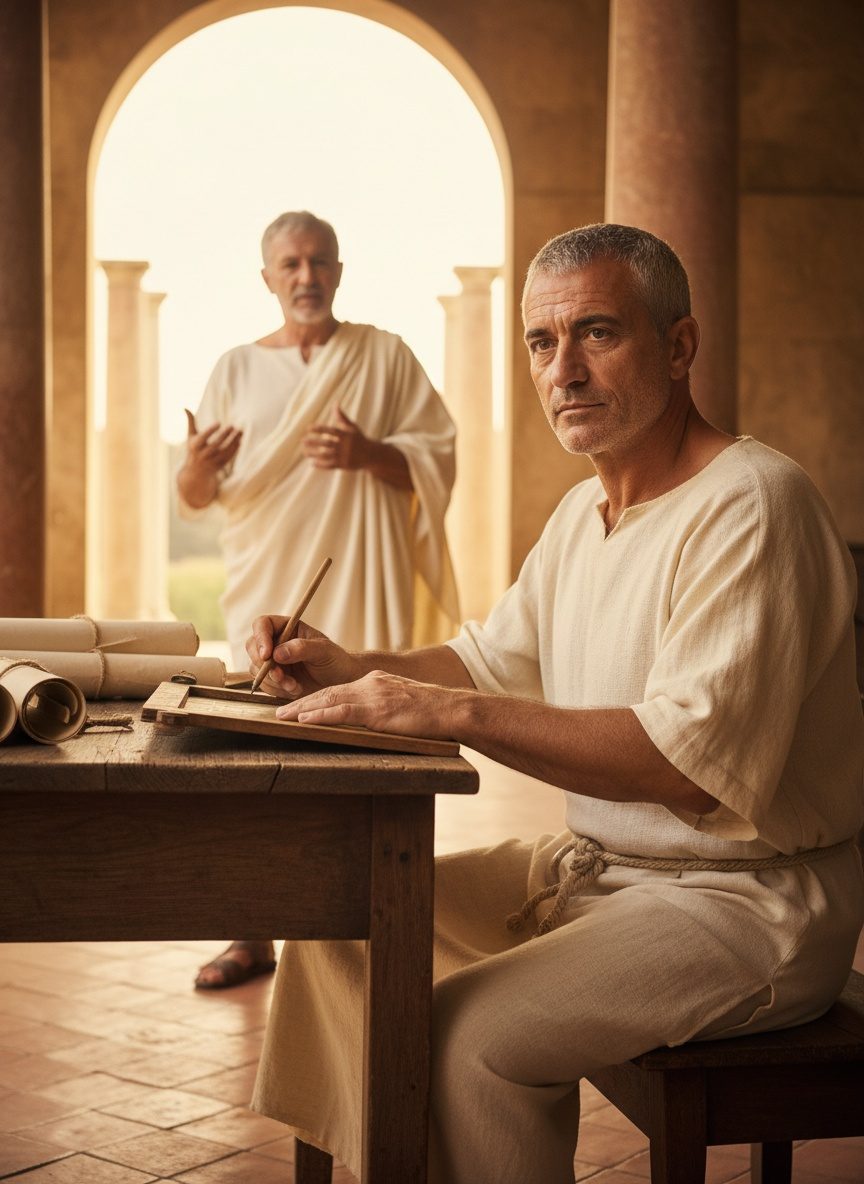
Marcus Tullius Tiro was a man whose name history nearly forgot, yet his contributions echo even into the modern era. Born into slavery in the bustling household of the esteemed orator Cicero, Tiro displayed an aptitude for learning and an unmatched acumen for written word. Cicero, recognizing Tiro’s extraordinary talents early on, entrusted him with the monumental task of transcribing his speeches—a duty both demanding and pivotal.
The Rome of the 1st century BC was a cauldron of political fervor. The senate floor was a battleground where ideas clashed audibly, and the stakes could shift the republic's future. Cicero’s words, vibrant and potent on such occasions, required precise documentation—no small feat in a time when standard writing was a laborious process. Tiro faced the herculean task of capturing these speeches with accuracy and speed, leading him to develop what would become one of his most significant legacies: a system of shorthand unlike any before it.
Known as Tironian notes, this groundbreaking method enabled Tiro to record dialogues and orations with unprecedented efficiency. Utilizing a series of swift strokes and symbols, Tiro’s invention captured the fluid essence of spoken language, allowing him to commit to parchment every nuance of Cicero’s rhetoric. This system, born from necessity, assisted in preserving countless speeches and debates, making them accessible long after the echoes of the orators’ voices had faded from the assembly halls.
A Gift of Uncommon Freedom
The relationship between Cicero and Tiro was indeed unique. In a time when the institution of slavery was the backbone of Roman labor, rarely did slaves find themselves in positions of influence or intellectual authority. Yet, as Cicero’s esteemed secretary and confidant, Tiro was indispensable—his skills critical in maintaining the integrity and persuasiveness of Cicero’s political and philosophical output.
Then came an act of magnanimity that startled Roman society to its core. In 53 BC, Cicero did something almost unthinkable for a man of his status. Cicero emancipated Tiro, granting him not only the freedom to dictate his own path but also maintaining a close personal bond thereafter. It was a testament to the deep respect and mutual esteem between the master and his former slave, an acknowledgment of Tiro’s invaluable contributions to Cicero’s successes.
Even upon securing his freedom, Tiro remained irrevocably connected to Cicero’s legacy. The letters the two exchanged are an enduring testament to their friendship, a rare glimpse into the camaraderie between a formerly enslaved man and one of Rome’s greatest statesmen. For Tiro, freedom was not an end but a redefinition of his role in society—one where he continued to wield his knowledge and skills unconstrained by the shackles of servitude.
Tiro's Echo Through the Ages
Tiro's intellectual prowess did not fade after his emancipation; instead, it blossomed further. As a freedman, he devoted himself to the curation and publication of Cicero’s works, diligently preserving the corpus that would later become a cornerstone of Western philosophy and rhetoric. Tiro's efforts ensured the replication and dissemination of Cicero's teachings and thoughts across the Roman Empire and beyond, influencing generations long after both men had passed.
In his later years, Tiro didn’t confine his talents solely to preserving Cicero's words. Accounts suggest he penned notable works of his own, including a comprehensive biography of Cicero—a profound testimony to the man who had shaped his life's course. Though much of his writing has been lost to history, Tiro’s intellectual spirit is immortalized in the swirling pen strokes of his shorthand system, which bears his name to this day.
Legacy of a Freedman's Light
The story of Marcus Tullius Tiro is one that transcends his era, offering insight into the character of the society in which he lived while revealing the timeless aspiration for knowledge and freedom. His creative genius and enduring loyalty not only changed the way thoughts were captured and communicated in Rome but also illuminated a path to freedom in an age when such paths were few and far between.
Today, Tiro's legacy isn't just in the system of Tironian notes that laid the groundwork for modern shorthand. It's in the very idea that the power of the written word can transcend boundaries and redefine societal roles. Tiro’s journey from the confines of slavery to intellectual immortality serves as a poignant reminder of every human's potential to influence history—a narrative too important to forget, even among those stories they never taught you in school.