He was a conqueror feared across three continents. Yet, in the heart of Central Asia, Timur found himself undone by tears.
The Conqueror's Paradox
Timur, also known as Tamerlane, was a man of contradictions. As a conqueror, his campaigns left a trail of destruction from Delhi to Baghdad, his name whispered in fear among the echoes of collapsing civilizations. But in the year 1404, as he approached the city of Samarkand, something shifted in the brutal calculus of his ambitions. Samarkand was not just another conquest, another feather in the cap of his relentless empire-building; it was home. Though he had the power to obliterate it as he had done elsewhere, Timur chose instead to elevate it to the zenith of grandeur.
A Canvas of Dreams
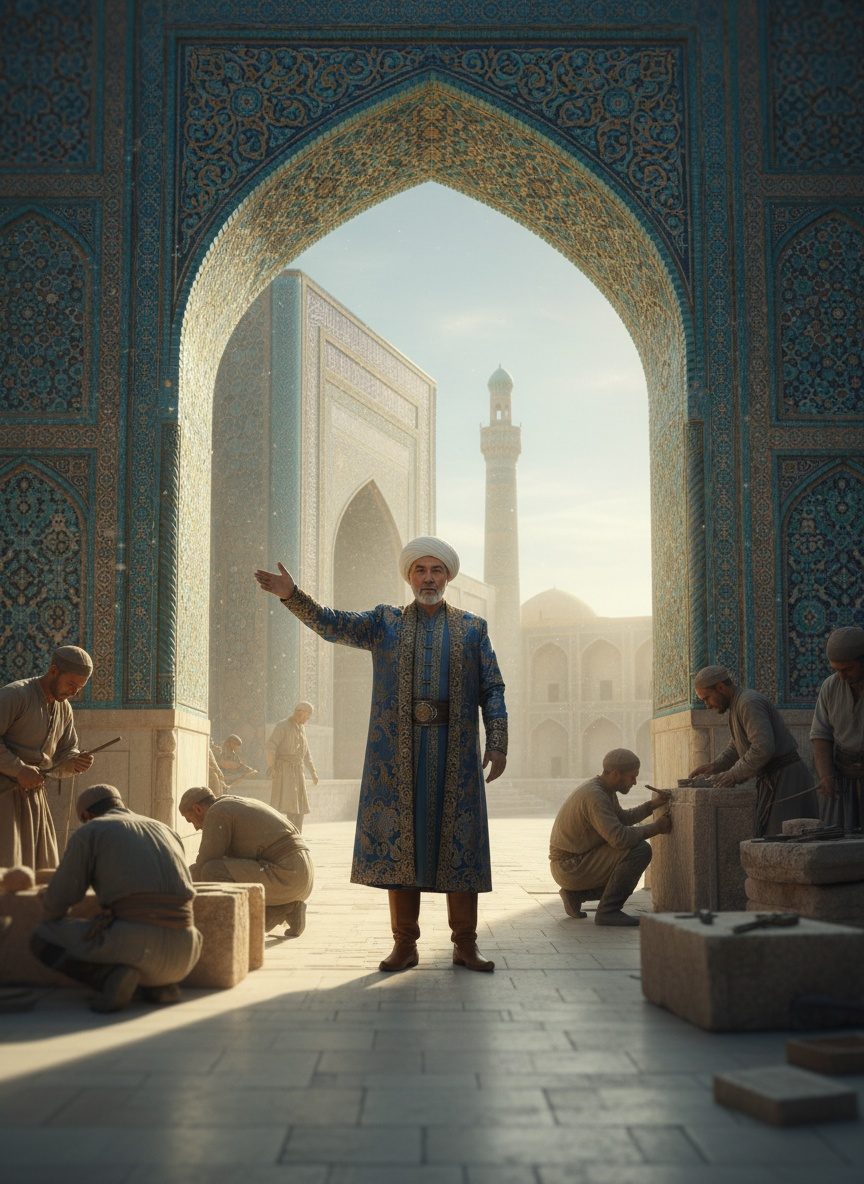
Standing amidst the ruins of cities scattered across the lands he had conquered, Timur had gleaned lessons that he would channel into the rebirth of Samarkand. He envisioned the city not just as the heart of his empire, but as a cultural beacon — a place where art, science, and architecture would come together in an unparalleled tapestry of human achievement. To this end, he summoned the greatest talents of his age. Artisans from conquered lands received royal summonses, their skills required for an unprecedented project. Architects from Persia, builders from India, scholars from Arabia — all were drawn to Samarkand by the magnetic pull of Timur's vision.
A Living Canvas
As the city rose from the arid plains of Central Asia, it took on an otherworldly quality, a gem set amidst desert sands. Majestic madrassas, mosques, and spaces of learning adorned the skyline, each edifice narrating stories of diverse cultures and styles. The bright blue domes and intricate tile work, for which Samarkand would become famous, seemed to reach the heavens, their lattices of color and light reflecting Timur’s ambition and longing for legacy. Among these marvels stood the Bibi-Khanym Mosque, a structure so grand that it would command reverence across centuries.
But it was not just the stones of Samarkand that spoke of its grandeur. Within its maze of streets and bazaars, the air buzzed with the fervor of intellectual exchanges and artistic expressions. Scholars debated ideas that would shape the known world, while merchants brought goods and ideas from the farthest reaches of Timur’s empire and beyond. The city’s vibrancy extended beyond its physical beauty into a living, breathing testament to the complexity of Timur’s mind. Where once destruction lay in his wake, he now sought creation and inspiration.
A Weeping Visionary
Timur’s devotion to Samarkand was both personal and celestial. Legend has it that the sight of Samarkand in ruins brought tears to his eyes — not of sorrow, but of the profound determination to resurrect it. It is a paradoxical image: a man who had razed so much, now a visionary builder, driven by a dream of immortality through beauty rather than conquest. This transformation was not just an act of sentimentality but also a strategic maneuver. By turning Samarkand into a cultural and artistic jewel, Timur hoped to ensure his empire's unchallenged preeminence in the annals of history.
The rebuilding of Samarkand was as much about legacy as it was about leadership. Timur recognized that the power of an empire was not solely in its ability to conquer, but also in its capacity to captivate and to inspire. In some ways, this was his most strategic conquest of all — a conquest over time, committing his legacy not to the annals of empires and wars, but to the cultural memory of civilization itself.
The Lessons of Samarkand
Timur’s transformation of Samarkand stands as a narrative of redemption that challenges the oversimplified image of conquerors as mere destroyers. It suggests possibilities beyond the battlefield, where architectural beauty and intellectual vitality become instruments of enduring influence. Today, Samarkand is celebrated as an architectural and cultural treasure on the Silk Road, its bustling history stitched into the fabric of every structure, every alleyway. Through the tears he shed and the dreams he realized, Timur left a double-edged legacy: a city that rose from rubble to epitomize transcendent achievement.
This story of reconstruction and renaissance resonates down the ages, offering a poignant reflection on the dual nature of power — the ability to destroy juxtaposed against the capacity to create. In recognizing the significance of Samarkand's resurrection, we are reminded of the profound impact of vision, the enduring allure of beauty, and the possibilities of transformation and legacy.