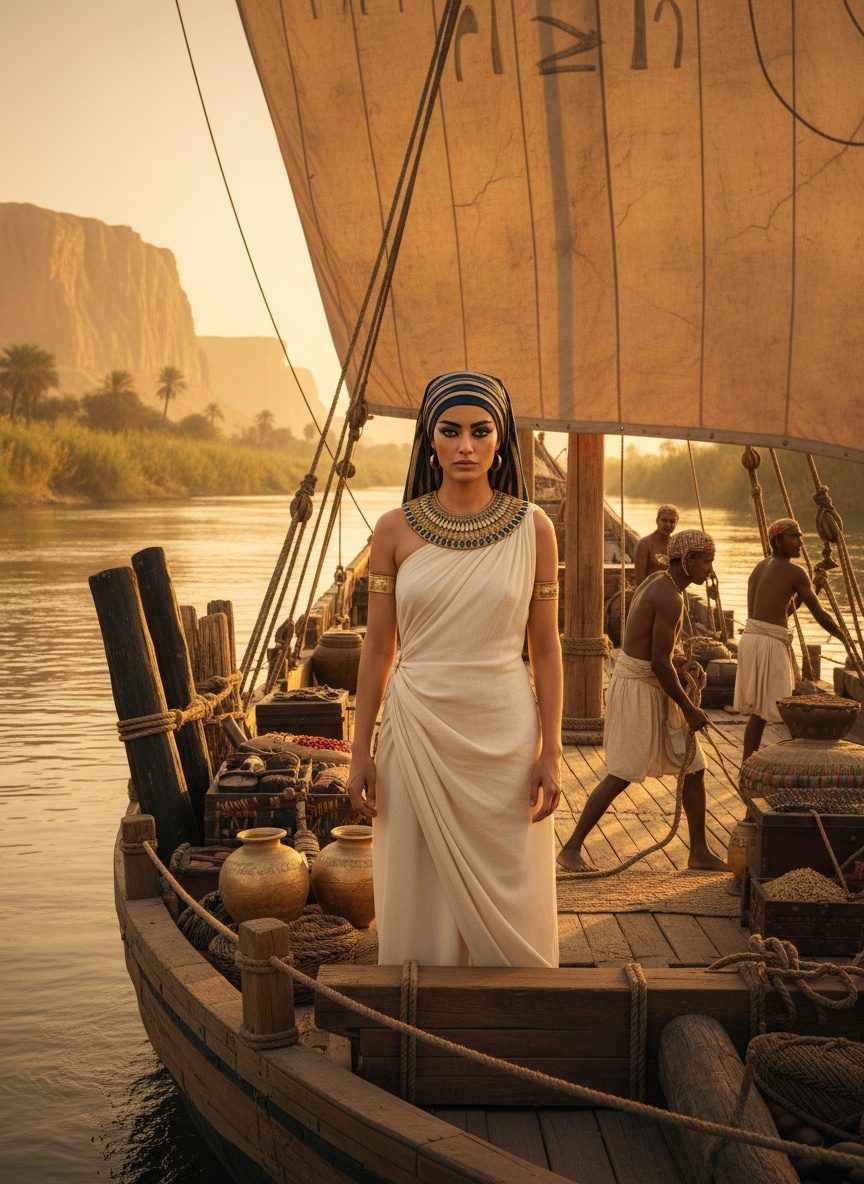
Salt clung to the air, mingling with the cries of seabirds as Hatshepsut stood resolute on the dock, watching her newly built fleet—sleek and imposing against the dawn sky—set sail for Punt. The ships groaned and creaked as sea breezes filled their sails, guiding them toward the exotic lands that promised untold wealth. This was no mere maritime expedition; it was her bold declaration to a realm hesitant to embrace a woman’s reign.
The Rise of an Unexpected Pharaoh
In the grand palaces of Egypt, names like Thutmose were spoken with reverence. Yet, it was Hatshepsut, a name that should have faded into obscurity, that whispered rebellion by daring to crown herself Pharaoh. From the sandstone reliefs that graced her mortuary temple at Deir el-Bahri to the bold architectural endeavors she commissioned, Hatshepsut wove herself into the tapestry of Egypt’s history—not merely as a queen but as a king.
Hatshepsut’s ascent was unconventional. She was thrust into power as regent to the infant Thutmose III, but instead of coddling a kingdom, she seized it. When conventional wisdom demanded she fade into the shadows, she donned the regalia of a Pharaoh, complete with false beard and kilt. This audacious act of self-promotion was not one of usurpation but stewardship—a guardianship over Egypt’s burgeoning Golden Age that flourished under her innovative rule.
She had no army to march at her back nor victories on distant battlefields to secure her legend. Instead, she wielded diplomacy and trade with unparalleled fervor. The great expedition to Punt wasn’t merely an economic maneuver; it was a bold reaffirmation of Egypt’s prowess under her rule.
The Fleet that Could Change Destiny
In an age when the seas were a mystery as vast and unfathomable as the sky, building a fleet was an act of hubris or genius—or both. Hatshepsut’s naval endeavor was meticulously planned. Her craftsmen carved vessels sturdy enough to brave the uncertain Red Sea, inspired by the imaginations of a nation that had forever looked to the Nile.
The wooden decks were scented with cedar, polished underfoot by barefooted sailors whose faith lay in the pharaoh that entrusted them with Egypt’s fortune. Richly adorned with banners, the fleet set forth under the watchful eyes of the gods graven into their bows, promising protection and safe passage to Punt—a realm shrouded in luxury and legend.
Punt was not a new discovery. Chroniclers had spoken of its bounty long before Hatshepsut, yet no one could haunt the shores successfully like she did. Gold, ivory, incense, and exotic treasures piled high upon her ships as proof that her reign was bounded only by the horizon.
The Return of Treasures
The months of anxious waiting, gazing toward the water’s edge, finally yielded to triumph. The returning fleet loomed into view, its decks bowing under the weight of its precious cargo. The Puntite bounty had enriched Egypt beyond imagination, carving out lanes of trade and affluence across the Red Sea.
Among the treasures, wonders that would be sung of in the stories of her people's descendants: myrrh trees, planted in the arid soil of Egypt to grace the sacred temple grounds, filled the air with their sweet fragrances tied to divine rituals.
The arrival of this cargo wasn’t merely an economic boon; it was an assertion of Hatshepsut’s indomitable spirit. She had challenged the status quo, wielding gold rather than swords, diplomacy over militarism, in a dazzling display of monarchy. Her people’s prosperity validated her reign, as did the ornate murals that would soon adorn the halls of her temples, capturing the grandeur of her reign for eternity.
A Legacy Almost Lost
Even as prosperity flowed like the Nile itself through her kingdom, history nearly robbed Hatshepsut of her rightful place among Egypt’s legends. Following her death, the sands of time, stirred by political motivations, conspired to erase her memory. Statues stood defaced, inscriptions chiseled into oblivion, and her name was depleted from king lists—an ancient practice meant to obliterate her impact. Yet, ironically, these acts highlighted her influence, for no one sought to erase one without great deeds.
Today, the story of Hatshepsut’s bold reign reminds us of the unpredictable qualities of leadership and legacy. Her decision to construct a fleet, ushering in wonders from Punt rather than war, challenges the traditional metrics of power and control. Through the scent of myrrh trees and the weight of shining gold, she defied the expectations of what a Pharaoh could be. Hatshepsut lingers on not only in stone and papyrus but also in echoes, reminding us of the audacity required to claim your destiny, even when the world tells you to stay silent.