The early Athenian morning stretched lazily over the ancient city, the sun casting long, warming rays over a throng assembled at the foot of the Acropolis. An early autumn breeze, carrying the scent of olives, rustled through the stones, giving life to the figures gathering for a celebration that had been performed countless times before. Yet today, the air crackled with a charge that was about to ignite a revolution in the world of art. Could any of them have foreseen the gravity of what was about to happen? One man's daring move was about to birth a new form of expression, one that would resonate through millennia.
The Festival of Dionysus: A Chorus in Unison
The Theater of Dionysus, nestled on the slopes of Athens' Acropolis, stood as a seat of tradition, of joyful rites conducted to honor the god of wine and fertility. Here, the earthen smells of the open-air space mingled with the anticipation of a crowd eager for the spectacle. To celebrate Dionysus, these gatherings featured a chorus singing dithyrambs—lyric hymns devoted to the god. Their collective voice was a sonic wave washing over the audience, a shared experience where individual identities fused into one.
In these passionate homages, the performers swayed together, embodying divine ecstasy and earthly sorrow. The chorus represented harmony with the divine order, and the stories told were always collective, never singling out an individual within the narrative. It was a sacred dialogue with the gods—a tradition entrenched in unity and reverence.
Stepping into the Spotlight: Thespis's Bold Move
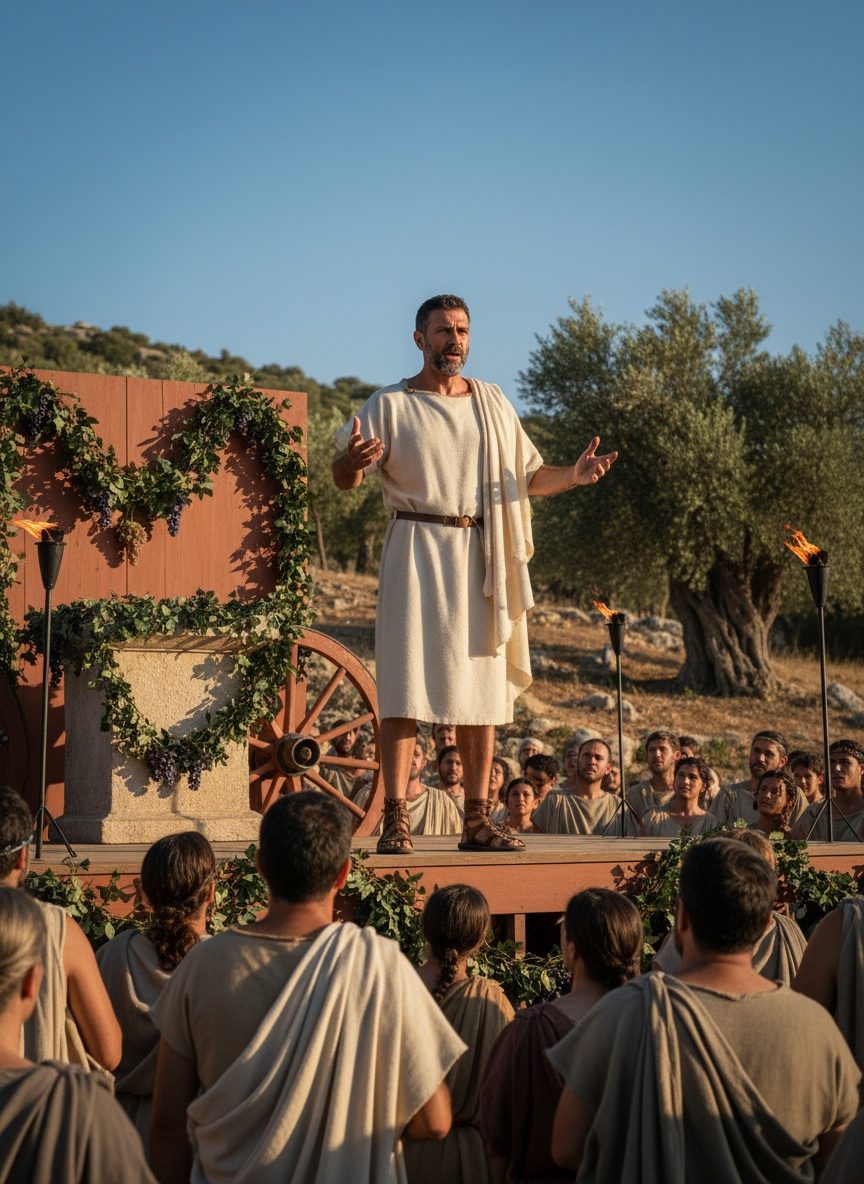
But on this day, something unprecedented was about to unfold. Thespis, an unassuming figure by appearances, was ready to break from tradition. Tales of his talent had circulated through the city, marked by his unique approach to storytelling. As the chorus performed, a singular tension permeated the air, an energy keenly awaiting release. His moment arrived, with intoxicating uncertainty.
Thespis stepped forward, parting from the embrace of the chorus. He paused, letting silence reign, a silence so profound that it seems to echo still. Then he spoke, not with the voice of many, but his own singular presence. Here was a new kind of oratory—a narrative not just told, but embodied by a solitary actor engaging directly with the crowd. There was a hush as viewers leaned in, spellbound, as much a part of this innovation as the performer himself.
A New Dimension in Storytelling: The Birth of Drama
What Thespis achieved was nothing short of revolutionary. His interaction with the chorus turned static chants into dynamic episodes of conflict and dialogue. In a moment, the chorus's unified voice was complemented by a singular perspective, injecting the narrative with complexity and depth. This transformation marked the nascent form of what we now know as drama.
The integration of an individual character gave the audience something human, something relatable, on the stage—not just larger-than-life stories or divine narratives, but emotions and experiences that spoke directly to the human condition. This marked the beginning of drama as an art form, a lasting contribution to culture that transcended its religious roots, evolving continuously throughout history.
Beyond the Curtain: Thespis's Impact and Legacy
The world that followed Thespis's innovation saw the growth of Greek drama, as playwrights like Aeschylus, Sophocles, and Euripides expanded on his daring departure. The medium became a powerful tool to discuss politics, ethics, and humanity in complex layers. The role of the "thespian" became central in theatrical arts—a nod to the man who inspired individuals to embody narratives, thus enabling a broader exploration of dialogue, character, and storytelling.
Amidst the marble remnants of ancient theatres, Thespis's audacity echoes. His role as the first actor became a figure for those daring enough to challenge conventions. From Shakespearean stages to modern cinemas, the art of acting owes a great debt to this singular step forward from a man ready to split from tradition and open a dialogue with spectators.
A Reflection on Thespis’s Giant Leap
In our world, where art frequently intersects with societal norms to challenge, inform, and transform, the legacy of Thespis is a beacon of inspiration. What began in a humble Athenian theater was the spark that ignited the vibrant tradition of drama—a tradition that continues to hold a mirror to society, illustrating our triumphs, vulnerabilities, and stories. In understanding Thespis's courage to step forward alone, we appreciate the power of the single voice amidst the chorus—a testament to human creativity's endless capacity to evolve and redefine its narrative.