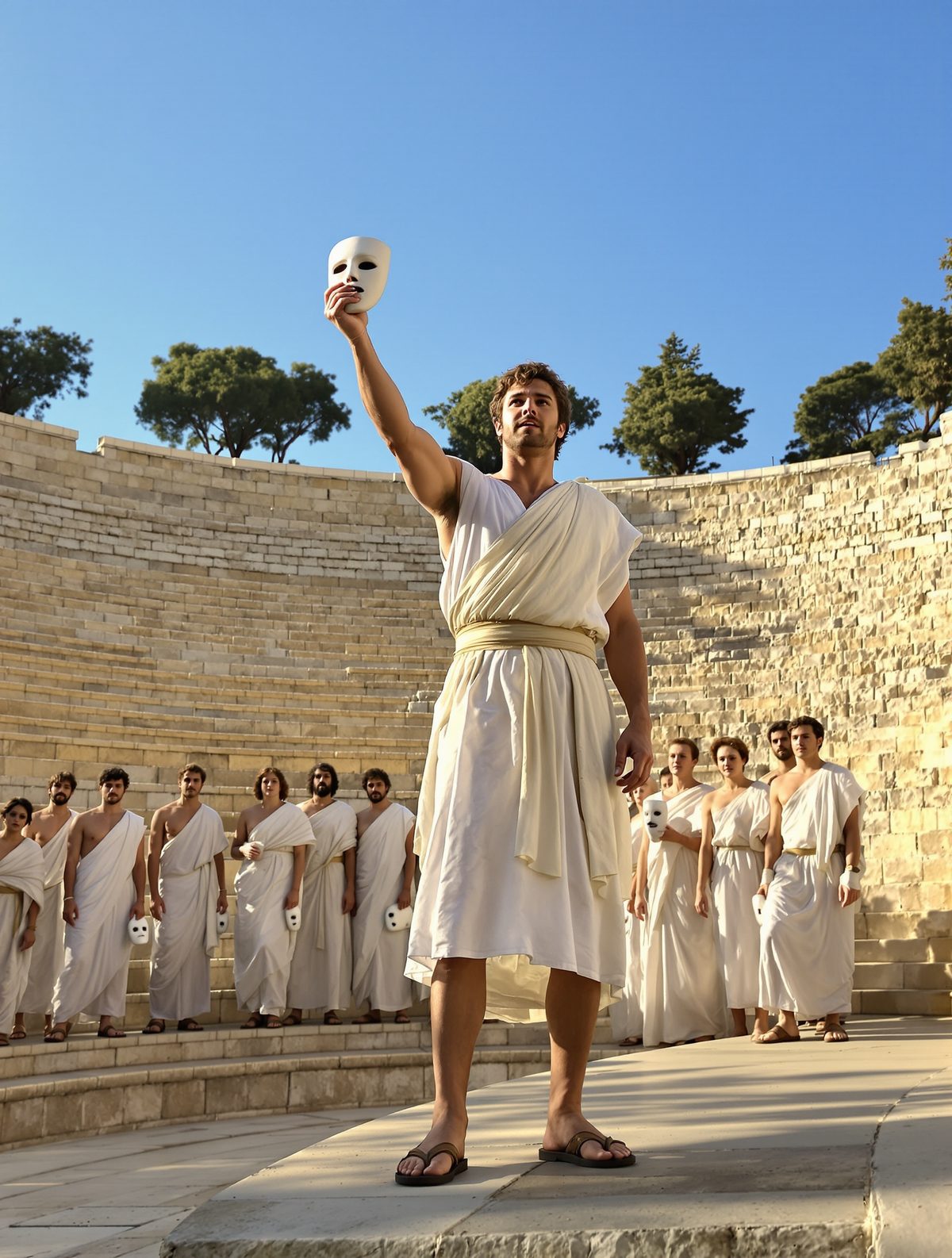
In the dusty agora of Athens, amidst the cacophony of merchants and citizens, the air felt different. It was the first year of the 61st Olympiad, 534 BC, and a singular event was about to unfold. A man named Thespis, cloaked in the garb of a performer, was about to change the world of storytelling forever. For centuries, storytelling in Greece echoed in a chorus — a collective symphony of voices masking the individuality within. But here, beneath the watchful gaze of Dionysus, the god of wine and festivity, one man would step forward, forever marking the birth of theater as we know it today.
The Chorus: Voice of the Many
The roots of Greek theatre are entangled with its religious rituals, especially those honoring Dionysus. Long before Thespis emerged from the shadows, Athens thrummed with the sounds of the chorus — groups of men whose synchronized movements and harmonized voices carried tales of gods and heroes through the streets. Costumed and sometimes masked, they sang and danced as a single entity, their narratives flowing as a seamless collective consciousness. For the audience, the chorus was both narrator and participant, a living tapestry of sound and rhythm.
In these early days of the Great Dionysia, an annual festival celebrating the god of wine, choral performances were more than entertainment; they were spiritual rituals binding the community to its mythological roots and to each other. Yet, despite its grandeur, the chorus had its limitations. It painted a broad stroke but lacked the personal intricacies that intimate human experience on stage now holds.
A Step Forward: Thespis Dares to Dream
On that fateful day, Thespis dared to break away from the homogeneous sea of voices. With applause resonating in the background, he did the unthinkable; he donned a mask and stepped out from the chorus. Taking on the persona of a character separate from the narrative voice of the group, Thespis engaged directly with the audience. His voice was singular but filled with multiple personalities — a dialogue with the unseen but present forces of imagination. The moment was electric, charging the air with a sense of the unprecedented.
Equipped with just a mask, Thespis transformed himself into different characters, breathing life into them with a scope and depth previously unimaginable. Thespis didn't just step forward physically; he advanced the scope of human expression. By engaging in a dialogue with the chorus, he introduced the concept of mimesis — imitation of real life, a cornerstone of drama that would inspire countless generations of playwrights and actors.
Thespis's Legacy: More Than Just a Man
The ripple effect of Thespis's actions was immediate and profound. Athens, a city already fostering the seeds of Western democratic thought, now became the epicenter of another critical cultural evolution. Within decades, playwrights like Aeschylus, Sophocles, and Euripides began crafting plays that would outlast empires, threading complex human emotions and divine interventions into the mythological and current-day issues of their societies.
Thespis’s invention of acting not only paved the way for tragedians but also informed the burgeoning art of comedy. The layers of meaning became richer, and storytelling evolved beyond narration and song; it was now a visceral, personified reflection of the human condition. This leap from choral ensemble to individual actor birthed a veritable revolution in the arts, eventually giving rise to complex character-driven narratives that filled amphitheaters across Greece.
Behind the Masks: Costumes, Identity, and Innovation
The masks used by Thespis and those who followed him were more than mere props. They were stylistic symbols representing deities, satyrs, or common men and women, their exaggerated features visible even from the back rows of vast theaters. Each mask, meticulously crafted, was a window into a character’s soul, offering both disguise and revelation. Behind these artistic creations, actors found their identities imbued with radical transformation, lending nuanced authenticity to their performances.
Costuming and the utilization of stagecraft burgeoned alongside this. As Thespis laid the groundwork, subsequent dramatists and thespians embraced and expanded it. Scenography evolved, with painted backdrops and ingeniously devised stage machinery adding visual substance to the stories that now burst forth with greater vigor and vibrancy than ever before.
Why It Matters: The Echoes in Modern Times
So why does the solitary step of Thespis matter today? What does a single man's audacity in 534 BC mean to us in the frenetic cadence of 21st-century life? It matters because Thespis incited a revolution of empathy and perspective. Through theater, humanity learns to dissect its complexities, celebrating our strengths and scrutinizing our failures. By daring to be someone else, if only for a moment, audiences and actors alike are invited into worlds beyond their own — lessons in compassion and understanding woven into the fabric of storytelling.
Modern theater, film, and television are all branches growing from the seed planted by Thespis when he first assumed the mask, stepped into another's shoes, and spoke aloud alone. Without Thespis, there might be no Hamlet who contemplates his existence, no powerful heart-wrenching monologues on the silver screen, nor any compelling narratives that resonate through the annals of modern fiction. In every performance, whether on a Broadway stage or a neighborhood playhouse, rest the echoes of Thespis’s daring step forward.
The legacy of Thespis invites us to another realization: across millennia, culture and storytelling are never static; they are vibrant, living entities continually molded by courageous individuals willing to step beyond the known and embrace the possibilities of what could be. In this way, a single man from an Athenian chorus beckons us, across centuries, to step forward and embrace our narratives, both individual and collective.