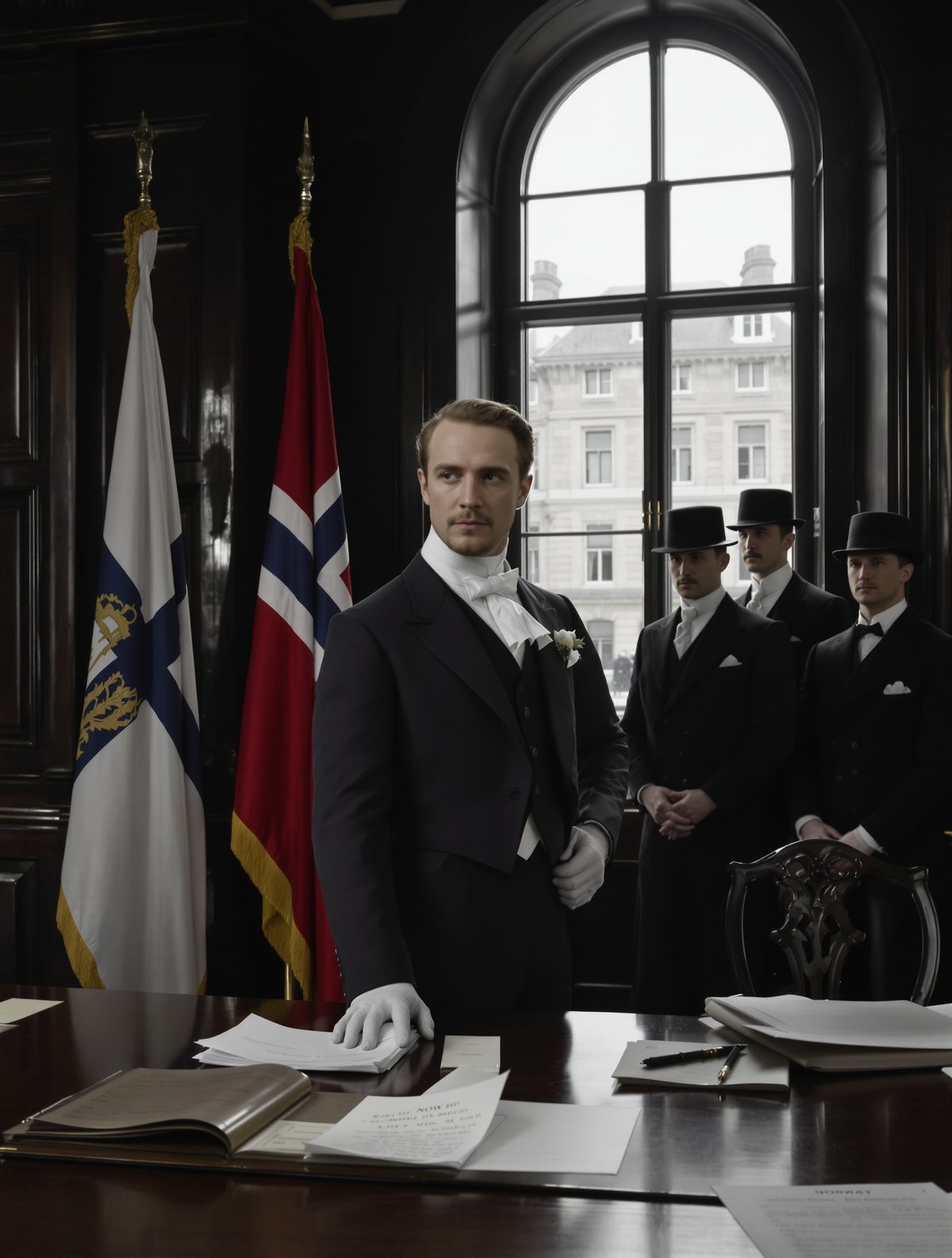
In the annals of royal history, offers of crowns are typically met with predictable responses: acceptance, sometimes with suspicion lurking in the eyes or humility veiling ambition. However, in 1905 Norway, a different kind of drama unfolded. The scene was tranquil yet charged with the future of a nation. Norway stood on the threshold of independence, seeking a new sovereign to guide its own destiny. But when a Danish prince was presented with this gilded opportunity, he didn’t accept by tradition. Instead, he demanded something revolutionary for a monarch and a nation — the voice of the people.
From Union to Independence: Norway's Critical Juncture
For much of the 19th century, Norway had been yoked in a union with Sweden, sharing monarchs but chafing under policies that favored the latter. By 1905, the desire for self-governance had reached a crescendo. On 7 June, the Storting, Norway’s Parliament, made the historic decision to dissolve the union. But for a nation unaccustomed to self-rule, a symbolic and stabilizing figure was essential. Enter Prince Carl of Denmark, a man with the credentials but not the immediate claim or desire to assume kingship without consent.
As Norway charted its path, it faced a decision: should the nation be a monarchy or a republic? The choice of Carl was deliberate, a bridge between democratic ideals and monarchic tradition. On a pivotal afternoon, an emissary approached the prince with an offer that could reshape Nordic history. Yet instead of the eagerness one might expect, Carl's response was a remarkable request for legitimacy.
Prince Carl: A Reluctant Monarch
Born on 3 August 1872, the second son of Prince Frederick of Denmark, Carl was raised amidst the cobblestones and spires of Copenhagen. His life was typical of royalty, filled with privileges and surrounded by courtly life. However, beneath the regalia lay a man who valued principles over position. Married to Princess Maud of Wales, daughter of King Edward VII of the United Kingdom, Carl understood both the power and the responsibility of the crown.
When approached to become Norway's first king in centuries, Carl insisted that the Norwegians must first decide their nation’s fate. He proposed a referendum, a bold departure from tradition where monarchies often assumed sovereignty by divine right or ancestral claim. This was not just political acumen; it reflected Carl's belief that a monarch’s legitimacy must be grounded in popular support.
A Vote for the Future
The referendum took place under the crisp autumn skies of Norway on 12 and 13 November 1905. Across the rugged Norwegian landscape, from Oslo’s bustling courts to Northern hamlets nestled against fjords, the Norwegian people cast their votes. It was a question not just of governance, but of national identity. The stakes were high, and the world watched intently.
When the ballots were counted, 259,563 Norwegians had voted in favor of monarchy, an overwhelming 79% in support of Carl as their king. The mandate was clear: the people had spoken, and they had chosen a path that intertwined democratic elements with the stability of constitutional monarchy. The people's decision to invest their trust in a new monarch underlined their hope for both tradition and progress.
From Carl to Haakon: A New Reign Begins
With the Norwegian people's blessing, Prince Carl ascended to the throne, adopting the reign name Haakon VII. On 27 November 1905, he formally accepted the crown. His coronation on 22 June 1906 in Nidaros Cathedral, Trondheim, a site steeped in royal history, marked an epoch of modern monarchy. The name Haakon itself was symbolic, harking back to the medieval kings of Norway, asserting continuity with the past even as a new era dawned.
Haakon VII’s reign became a testament to the ideal of a monarch as a people's servant. He navigated Norway's development with a democratic sensibility rare for his position and time. His role during both World Wars, unwavering in the face of Nazi Germany’s invasion, cemented his legacy as a symbol of national integrity and resolve.
A Crown Shaped by Consent: Legacy and Lessons
The decision of 1905, when Norway chose its king through a referendum, remains a powerful testament to the potential harmony between monarchy and democracy. It was not just a constitutional formality; it represented an ideal that sovereignty and legitimacy must arise from the consent of the governed. For Haakon VII, it was a principle that defined his life and reign.
In today’s context, as the world grapples with questions of governance, authority, and democratic representation, the story of Haakon VII resonates profoundly. It challenges rulers to seek legitimacy through the people’s voice, to ground leadership in service rather than entitlement. In choosing a king through a vote, Norway exemplified how traditional systems could adapt to modern aspirations.
The story of Haakon VII isn’t just history. It’s a reflection on how past decisions echo into the present, challenging us to re-examine our definitions of power and legitimacy. It reminds us that sometimes, the most powerful thing a leader can do is step back and listen to the will of the people.