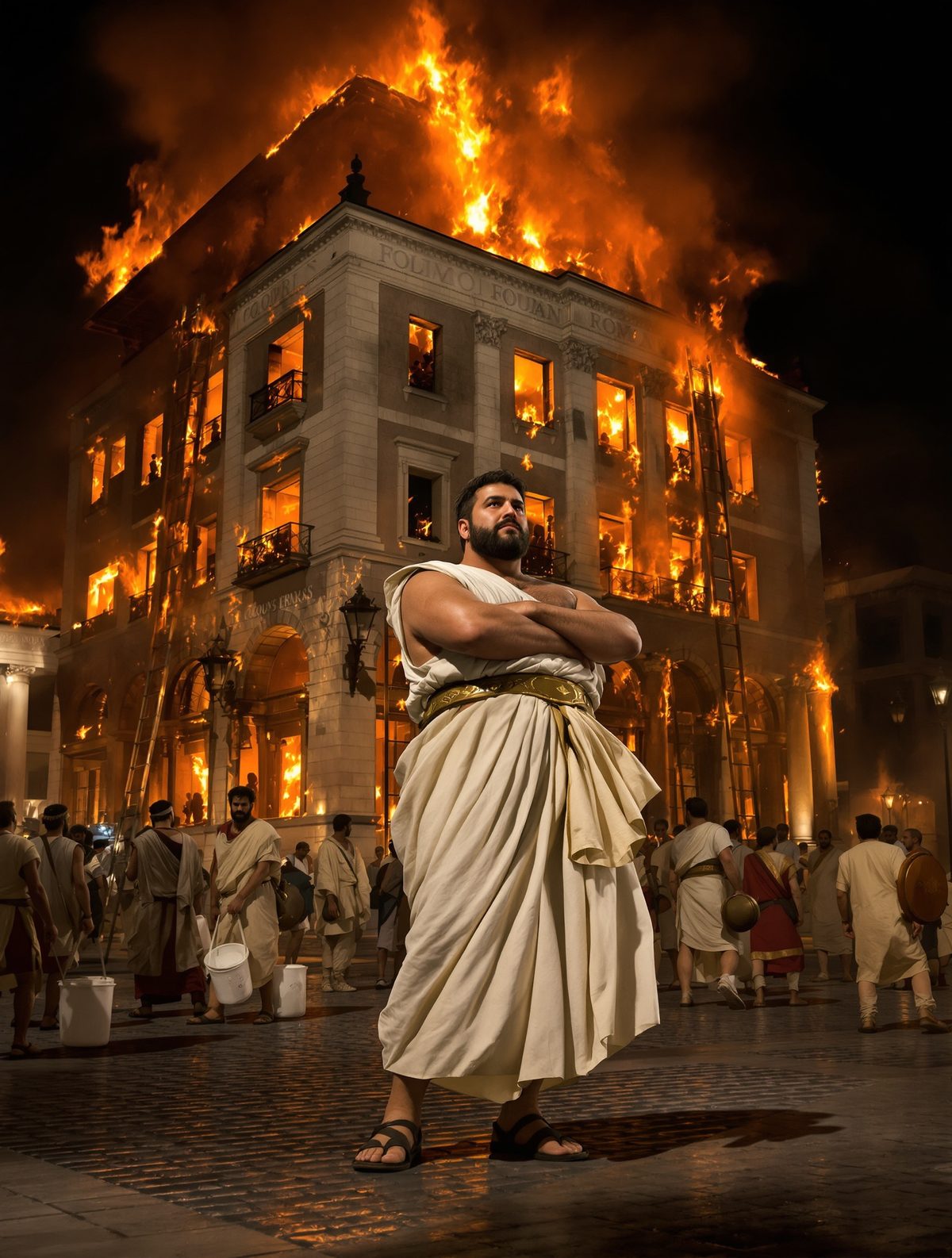
Picture this: the faint aroma of smoke wafts into the hot Roman air, and the distant cries from your neighbor's villa shatter the afternoon calm. As the flames lick ever greedier at the wooden beams and the thick black smoke begins its rise, your heart races. Suddenly, with an air of detached authority, Marcus Licinius Crassus strides onto the scene. The richest man in Rome surveys the chaos as a swarm of 500 slaves stand at the ready with axes, hooks, and buckets. Crassus makes his proposition, and it's as cutting as it is simple. Sell him the property at his price or watch it incinerate to dust. In that crackling moment, a hard bargain burns brighter than the fire itself.
The Rise of Roman Ambitions
Born in 115 BC to a family of wealth and political influence, Marcus Licinius Crassus was destined for greatness. His father, Publius Licinius Crassus, had been a renowned general and a figure steeped in Roman politics. However, in the wake of the political turmoil and civil unrest of the Sullan era, the Crassus fortunes were nearly obliterated. This decimation spurred young Marcus on a mission — not only to restore his family's lost status but to redefine personal wealth in the Roman world.
Crassus's genius lay not merely in acquiring wealth but in spotting opportunities others missed. In spite of endless political machinations and military duties, it was real estate that truly called to him. Harnessing his acute astuteness for business, he identified fertile ground for his burgeoning empire: Rome's perennial threat of fire. Housing infrastructure in Rome was notoriously susceptible to conflagration. Designed with close quarters in mind, the city was a teeming mass of cramped alleyways and wooden tenements. It was a disaster waiting to happen — and for Crassus, an opportunity cloaked in smoke.
A Pyro-Profit Model
So, Crassus established Rome's first — and at the time, only — private fire brigade. Staffed by 500 of his own slaves, this cohort was not a true emergency service but rather a harbinger of capitalistic gain. When the cries of "domus flagrat" (the house is burning) echoed through the streets, it was a time not just of panic, but of transaction.
Upon arrival at a blaze, Crassus would coolly negotiate with the homeowner, offering a nominal fee for the property. If the owner refused, the flames were left to devour the home completely. Accept, and the fire brigade would spring into action, salvaging what they could for its new master. The offer had a sinister brilliance, playing upon fear and urgency. As the embers claimed more of the city, so too did Crassus's grasp on its real estate. Within years, he had amassed estates and properties numbering in the hundreds, spinning fortunes out of the very ashes of Rome.
A Colossus of Wealth
By 70 BC, Crassus's wealth had snowballed into truly legendary status. Lauded as the richest man in Rome, his assets were estimated to be around 200 million sesterces — an astronomical sum even by today’s standards. His portfolio included not only whole neighborhoods but silver mines, extensive farms, and funds from lucrative slave trade ventures. Such wealth permitted him the singular luxury of influence and patronage. For instance, he is said to have bankrolled the military campaigns of a rising star in Roman politics — one Gaius Julius Caesar.
Crassus's insidious investment in fires was not limited to economic gain. It won him populist support and solidified his economic supremacy, creating a robust network of dependents bound by debt and allegiance. This wealth-enabled authority became a keystone in his political maneuverings, forming the bedrock of the First Triumvirate with Pompey and Caesar.
The Legacy of Larceny
While his role as a pyromancer of profits astonishes us today, it must be noted that Crassus's actions foreshadowed a rudimentary form of disaster capitalism. He epitomized the shadowy ethics of predatory acquisition, leveraging desperation as his most powerful tool. Predating modern insurance scams and monopolistic schemes, his fire brigade stands as a dark satire on emergency response.
Yet, Crassus's fate serves as both a parable and a paradox. His insatiable hunger for glory ultimately led to a tragic downfall during the ill-fated campaign against the Parthians. At the Battle of Carrhae in 53 BC, his forces were annihilated, and Crassus himself met a grisly end. According to lore, his mouth was filled with molten gold — a grim symbol of his avarice.
Lessons Engulfed in Flames
The legacies of history's morally ambiguous figures often hold cautionary tales wrapped in their folds. Marcus Crassus epitomizes the perils of unchecked greed, playing the game of Rome's vast social inequities to his advantage. His exploits remind us of the ethical vulnerabilities inherent in wealth and power, mirrored in familiar patterns across the ages. So too do they reflect the flames of ambition that smolder beneath the grand empires of today.
As we examine the modern policies and industries built on similar foundations of profit-before-people mentalities, Crassus’s tale urges introspection. What's the true cost of exploiting crisis for gain? How do we balance enterprise with empathy? In the embers of history lies a challenge — can we learn from our blazing past, or will we stand, like Crassus, watching the world burn as we make our offer?