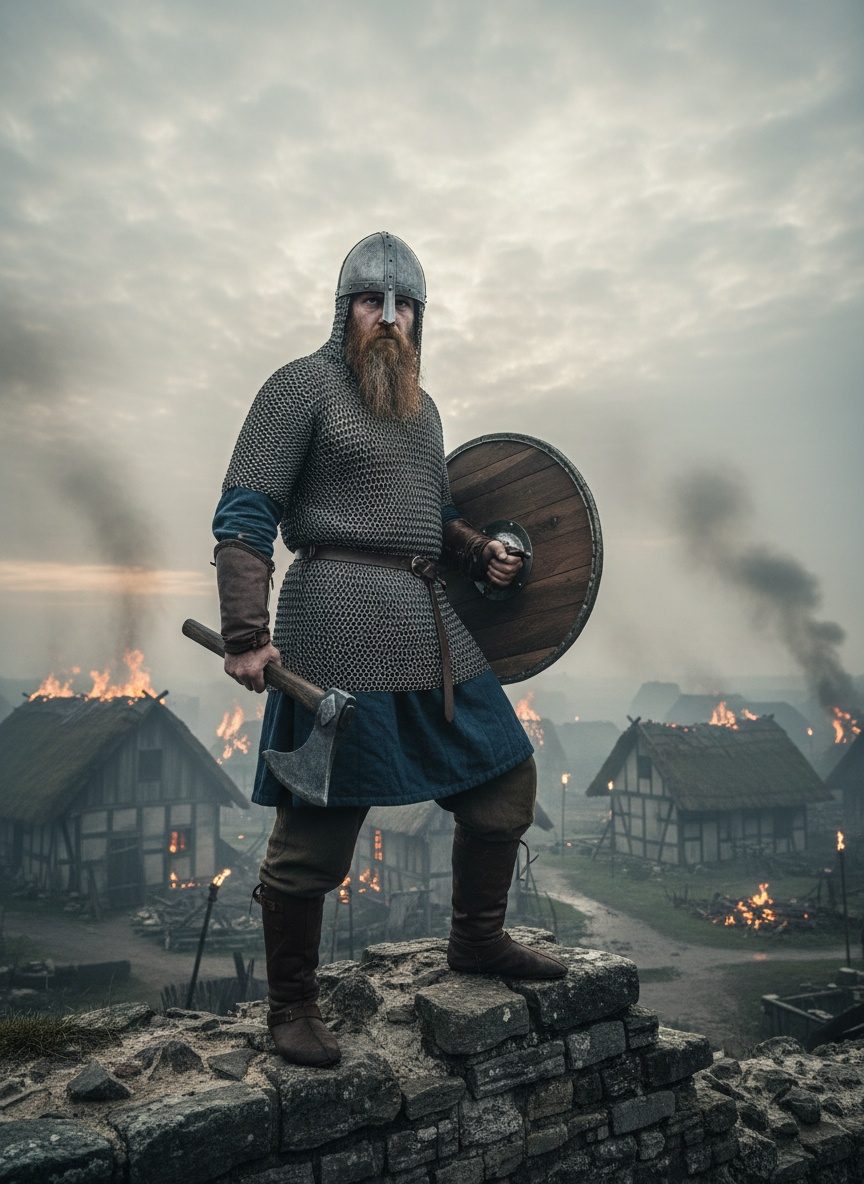
The air was crisp and biting under the grey October sky of 866 AD, as if even the earth knew that a great change was afoot. Outside the formidable stone walls of York, the muted clinks of steel echoed through the mist as warriors prepared for an assault that would alter the course of English history. As dawn broke, revealing a landscape of frost-laden grass and partially hidden by the rising mist, the cries of ravens overhead seemed almost to herald the chaos to come. By the end of that day, York would fall to the Great Heathen Army, and the power dynamics of Britain would begin an irreversible transformation.
York, known as Eoforwic to its Anglo-Saxon rulers, was more than just a city. It was a symbol of Northumbrian strength, a critical hub of commerce and culture, dense with the interweaving roots of past empires — from mighty Rome to the bellicose Saxons. This storied city had long stood resilient against the backdrop of an often turbulent England. Positioned along key trade routes, it had grown wealthy and populous, with its architecture a testament to the influence of Roman engineering and Anglo-Saxon fortitude. Yet on that fateful autumn morning, it became the prize in one of the most audacious Viking campaigns.
The Great Heathen Army, formidable in its size and intent, loomed like a shadow over the North English landscape. This coalition of Norse warriors, driven by a mix of vengeance, conquest, and ambition, had sailed from the Danish homelands to the shores of England, bringing with them a new era of warfare. The motivating force behind their campaign was as compelling as it was complex, fueled by the desire to carve out new territories, exact retribution for past killings, and perhaps settle in the lush, fertile lands that England offered. Their assault on York was swift, relying on surprise and aggression, and it quickly resulted in overwhelming the city’s defenses. This bold and cunning strike not only secured a significant victory but also sent a resonant message across the English kingdoms.
In the wake of this swift conquest, the rulers of Northumbria, kings Ælla and Osberht, remnants of a dynastic dispute that had split the kingdom, found themselves reluctantly united by necessity. This fragile alliance was spurred into action, driven by the desire to reclaim their capital and their honor. Before long, they mustered their forces for a desperate counterattack. The plan was audacious and fraught with peril. Little did they know, this would be their final stand. The two kings, who had been adversaries in life, faced their end side by side in the ferocious battle to retake York, both falling in this effort — a grim testament to the implacable Viking might and strategic prowess.
The death of Ælla and Osberht signaled more than just the loss of two rulers; it marked the end of an era for Northumbria. The defeat fractured the very core of its leadership, leaving it vulnerable to further incursions. The balance of power in England began to skew, shifting inexorably away from fragmented Anglo-Saxon rule towards the ascendancy of the Norse invaders. From the newly christened Jorvik, the Vikings held a dominant position in Northern England, establishing a foothold that they would expand into a thriving Norse kingdom.
This burgeoning Norse presence in northern England was a transformative cultural exchange, introducing new elements of Scandinavian culture, governance, and societal norms. The resulting amalgamation was evident in everything from art to law, each culture influencing the other in myriad, subtle ways. However, the Vikings did not merely integrate; they also served as catalysts for unification among their Anglo-Saxon rivals. In the wake of York's capture and the continued Viking campaigns, the English kingdoms began to see the need for greater solidarity. The seeds for a more cohesive English identity, one that transcended regional ties, were planted in the wake of this chaotic era.
Amidst the bloodshed and upheaval lay the tale of a city and a nation forever transformed by the ambitions of a foreign force. The Viking hold on York did not just alter political allegiances; it reshaped the very landscape of England’s future. The formidable Scandinavian warriors, though invaders, were also traders and farmers who enriched the lands they conquered, leaving a lasting legacy on the fields of England, poised at the crux of history both agriculturally and culturally.
The story of York's fall to the Great Heathen Army is more than a chapter in a history book; it's a narrative of conquest, transformation, and adaptation. It challenges the notion of cultural homogeneity and illustrates how chaotic incursions can guide societal evolution. The events of 866 AD under the tumultuous skies of York set in motion a chain of events that heralded the end of the old world and the dawn of another. They remind us that change, while often forged in the crucible of conflict, is an echo that shapes the future in ways we can scarcely predict. As the Vikings planted their roots, they unknowingly sowed the seeds of a united England. The past, much like their ancient battle cries that once echoed over the embattled walls of York, continues to resonate through the ages.