King Arthur rests at Glastonbury Abbey. At least, that's what the monks in 1191 wanted everyone to believe.
The Burning of Glastonbury and the Monks’ Desperation
In 12th-century England, Glastonbury Abbey was a beacon of religious significance and wealth, nestled in the heart of Somerset. However, in 1184 disaster struck when a devastating fire ravaged this venerable institution, reducing much of its wooden structure to ashes and crippling its financial stability. In an era where reputation and relics spelled prosperity, the monks found themselves in dire straits. They needed a miracle, a beacon to restore not just their treasury but their status as a spiritual epicenter.
The abbey, once the seat of Christian learning and pilgrimage, lay vulnerable. Its infrastructure needed rebuilding, and more urgently, its prestige had to be recovered to attract the necessary donations from patrons and nobility. These medieval monks, deeply entwined in political and theological discourse, turned not just to prayer, but to the earth beneath their feet in search of their salvation.
During their excavations, guided perhaps by desperation more than divine insight, they made an announcement that echoed across the land. It was the sort of discovery that transformed the ordinary into the extraordinary, the mundane into the mythic. They claimed to have unearthed the remains of none other than King Arthur, the legendary ruler of Camelot, a figure shrouded in mystery and romanticism, whose legend had been immortalized in the tales woven by the likes of Geoffrey of Monmouth.
The Discovery of a Legend
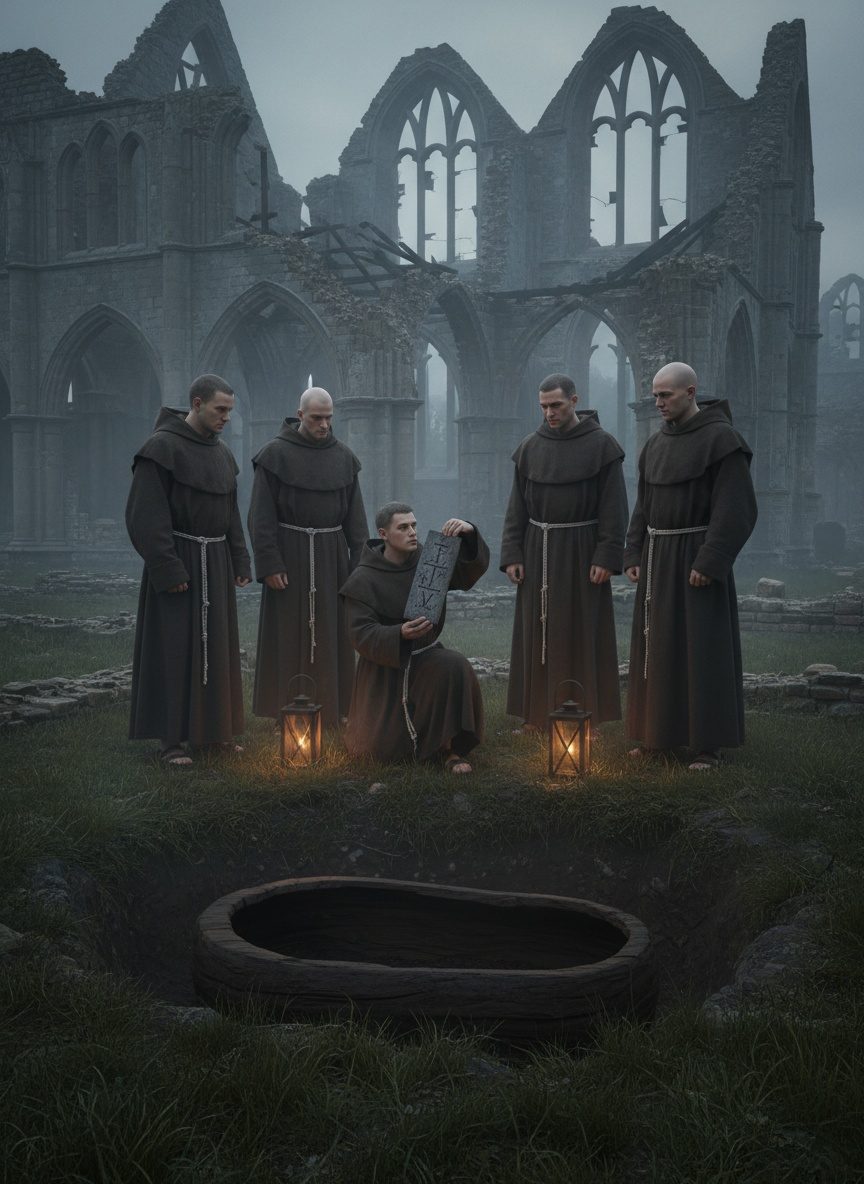
It was in 1191 when the monks of Glastonbury made their unparalleled claim. Beneath the once hallowed grounds, they had stumbled upon a stone slab resting atop a leaden cross. Inscribed upon this cross were the words: "Here lies Arthur, King of Britain," words that ignited imaginations and stirred passions from nobles to commoners. The rhetoric of this relic was simple yet powerful, imbuing the find with an aura of authenticity and sacredness, for who would dare question such a declaration?
The site they unearthed was said to contain two skeletons, that of a man and a woman, the male figure slightly taller than most, befitting the legendary King Arthur known for his stature and might. The remains were claimed to belong to Arthur and his queen, Guinevere, intertwined for eternity. This announcement suggested that Arthur was no longer a king destined to return but rather a ruler laid to rest. It tapped into the existing currents of Arthurian legend, which told of a king who would rise again to save Britain in its time of need.
To the medieval mind, steeped in lore and longing for heroes, these bones offered a tangible connection to an age of chivalry and valor. Pilgrims thronged to the abbey, eager to behold the relics, and in doing so, they filled the abbey’s coffers once more. The timing, many speculated, couldn't have been more convenient. The monks had not only reclaimed their place in the world but had done so through a narrative that seamlessly interwove faith and folklore.
Was It Truth or the Greatest Medieval Hoax?
The story that unfolded at Glastonbury Abbey quickly came under scrutiny. Skeptics pondered the implausibility of the claim, noting the lack of prior evidence and the curious timing of the discovery in relation to the abbey’s financial woes. Was this truly the resting place of King Arthur, or an elaborate medieval gambit designed to restore the former glory and economy of a desperate abbey?
The authenticity of the discovery hinged on dubious archaeological practices by today’s standards, relying heavily on narrative and legend rather than empirical evidence. Medieval society was one where myth often masqueraded as history, where stories passed through oral traditions could embellish truth with imaginative flair. Nevertheless, the discovery had its intended effect, breathing life and prosperity back into Glastonbury.
This legendary find also spoke to the broader narrative of Britain’s self-identity. In a time of political unrest and uncertainty, the return of Arthur, even as a relic, promised a sense of continuity and shared heritage. For the medieval mind, the story of the greatest king who ever ruled resonated with aspirations and ideals that transcended the political machinations of the present. In attempting, perhaps, to conjure the spirit of a once and future king, the monks of Glastonbury wove themselves into a story that was greater than their abbey, capturing the imagination of a nation.
In today’s lens, the question remains whether the Glastonbury monks were the architects of a fraud or innocents serving a higher purpose of narrative. The legend’s grip loosens, but its echo still resonates through Britain’s cultural landscape. What stands undoubted is our enduring human desire for symbols and stories larger than life, a testament to the potency of belief over doubt. As long as history is written by those with vested interests, the tale of Arthur’s tomb will continue to blur the line between reality and myth, reminding us of the profound influence that storytelling holds within human society.