April 10, 1821. The morning sun spilled golden light over the cobblestone streets of London, where a sense of anticipation hung heavy in the spring air.
The Stage of Curiosity
In the heart of Piccadilly, an eager crowd gathered outside the Egyptian Hall, an architectural wonder of intricate columns and hieroglyphs, echoing the mysteries of an ancient civilization. They came for a spectacle that promised to unveil secrets of the pharaohs, to unlock the echoing voices of Egypt’s past. This was the very building where Giovanni Belzoni, the exuberant Italian adventurer and pioneer of Egyptology, had displayed his treasures from the Nile—artifacts that stirred the Victorian imagination.
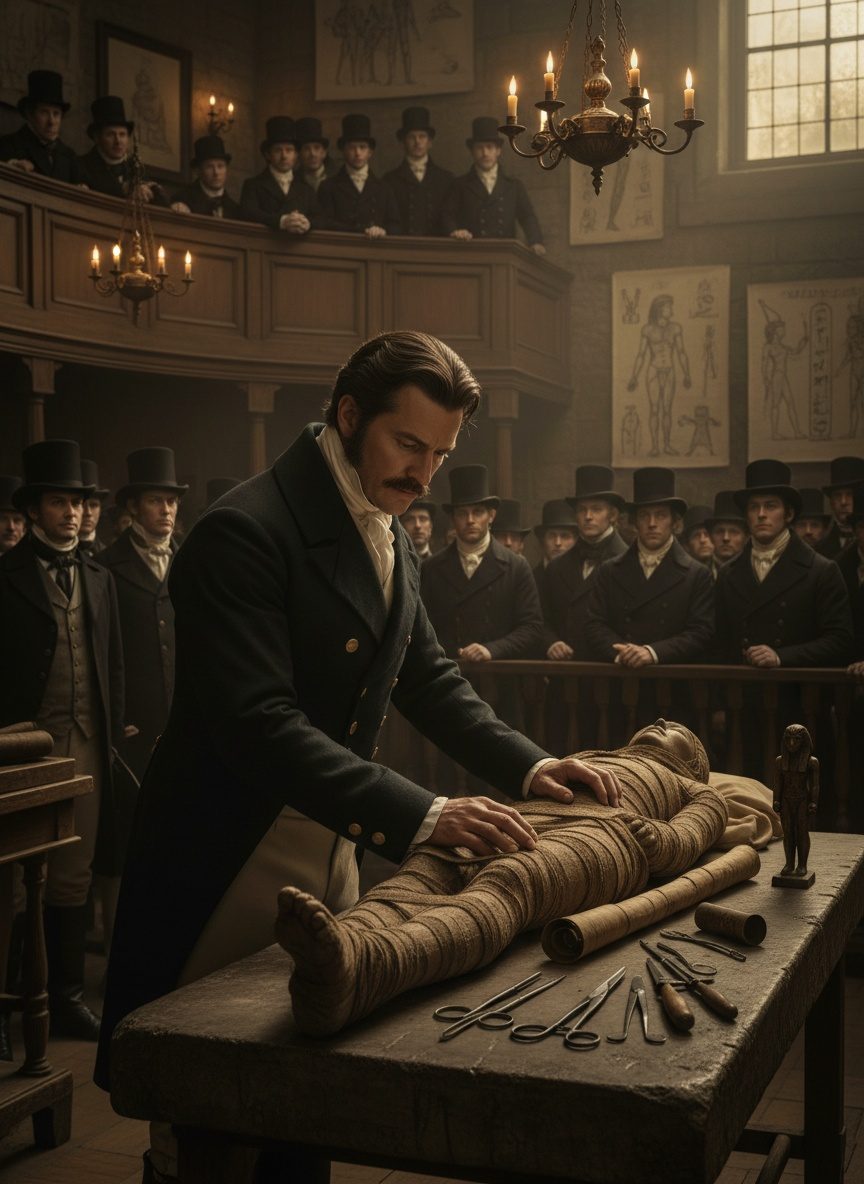
Among the crowd, well-dressed gentlemen and bonneted ladies murmured in excited tones, their breaths visible in the chill of a spring morning. They were drawn not only by the allure of ancient artifacts but by the promise of seeing a mummy, not just as a silent sentinel of time but as the subject of a daring and novel scientific exploration. It wasn’t Belzoni who would take the stage, but a British surgeon named Thomas Joseph Pettigrew, a man whose pursuits veered boldly between medicine and the macabre.
The crowd followed him into the dimly-lit interior where, beneath the gaze of curious spectators, a wooden platform stood ready. On it lay the linen-swaddled form of a 3,000-year-old mummy, its stillness capturing centuries of silence. As Pettigrew approached the ancient figure, the room fell silent, the only sound a faint rustle as he prepared to peel away the layers of history.
Unwrapping the Veil of Time
The meticulous task at hand was one of both precision and daring. Pettigrew’s hands moved with the deftness of a seasoned surgeon unfurling history itself. He didn’t simply cut through the wrappings; he unraveled a narrative spun millennia ago. The linen strips, aged to an ochre hue, were removed one by one, releasing a dust-laden aroma that conjured imaginations of the dry desert air from which they came.
As he worked, Pettigrew engaged the audience with a running commentary, each observation painting a vivid picture of ancient Egyptian mortuary practices. This was more than mere spectacle; it represented a marriage between scientific enquiry and public education. The crowd no longer saw the mummy as an object of mere curiosity; through the surgeon’s storytelling, it became an embodiment of a lost culture’s beliefs, fears, and hopes regarding death and the afterlife.
With each revelation—a necklace, a scarab, a fragment of papyrus—the audience was drawn deeper into the narrative Pettigrew delivered, one that transcended centuries. The surgeon’s discoveries weren't merely physical remnants; they were portals into discussions about the ancient Egyptians’ profound medical knowledge and their practices that bore uncanny resemblances to modern medical thinking.
A New Dawn for Medicine and History
This public unwrapping housed in the bustling core of London delivered more than dissection; it instigated a paradigm shift. The techniques and observations shared by Pettigrew spurred British society to rethink ancient medicine. Questions arose: Could these ancient people have understood more about the human body than anyone in Pettigrew’s modern world had previously dared to consider?
Through his thorough examination, Pettigrew sparked dialogues that extended beyond the walls of the Egyptian Hall, challenging Europeans to reconsider their narratives about knowledge, civilization, and progress. What the learned surgeon showcased was astounding—traces of medicinal herbs, intriguing signs of surgery, and embalming techniques demonstrating a sophisticated understanding of the human body.
Acts such as these few could grasp then represented the dawn of scientific Egyptology, a movement where surgeons like Pettigrew became unlikely pseudo-archaeologists, blending disciplines in new and enlightening ways. The enthusiasm for unwrapping mummies grew into a Victorian obsession, a cultural phenomenon that bridged the gap between the ancient and the then-modern world, prompting reflection on human progress and shared legacies.
Even as the dust settled back into history and the layers of time were rewound, Pettigrew's legacy continued, serving as a reminder of how curious minds and fearless explorations could challenge existing paradigms. This intersection of science and history, of curiosity and understanding, represents a pivotal moment. It reminds us that the past, like the body of a mummy, bears stories—complex, intricate, and waiting to be told. As the specters of Egypt's past nudged the boundaries of contemporary thought, they beckoned each to question how deeply they dared to look into the wrappings of their own time.