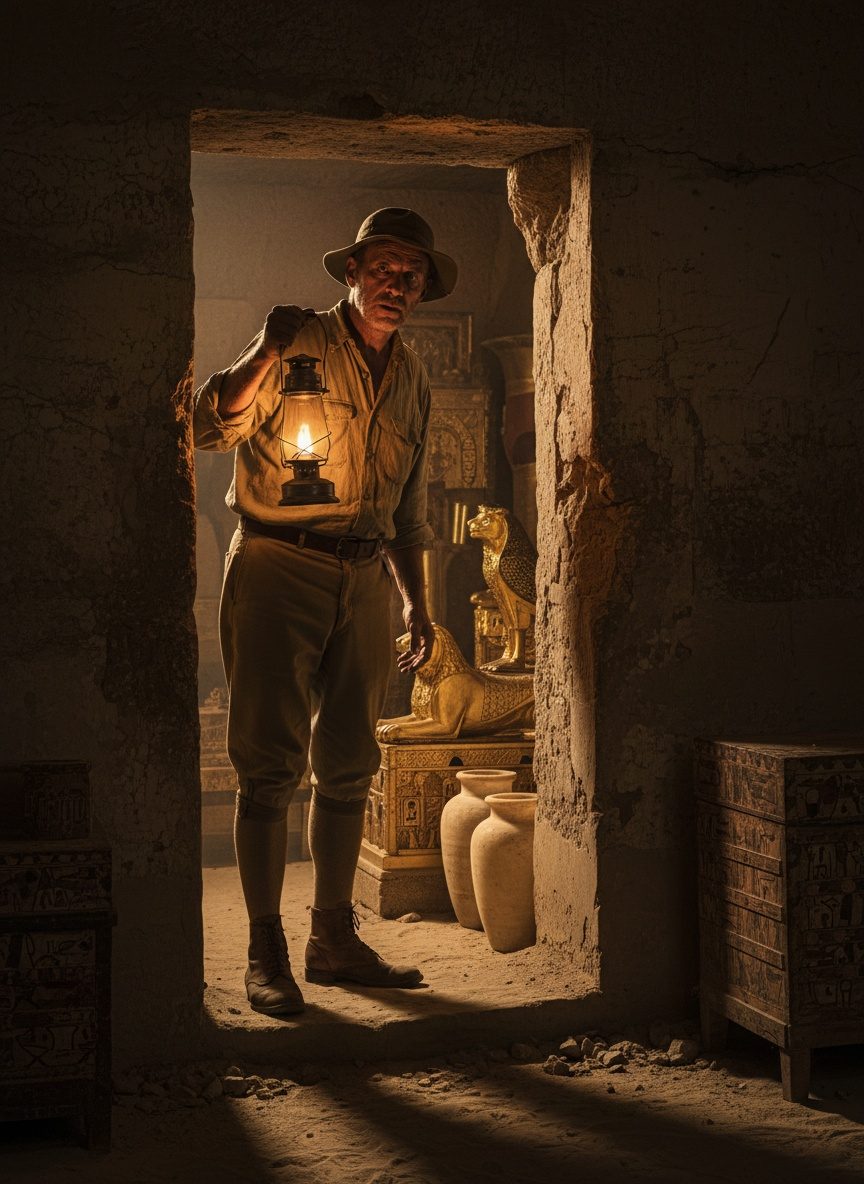
The lamp flickered in the stony darkness, casting an uncertain light across the cramped tunnel. Howard Carter's heart pounded as he chiseled away at the ancient plaster sealing. Sweat trickled down his neck despite the November chill, the anticipation suffocating. He leaned closer, peering through the newly made hole. "Can you see anything?" his patron, Lord Carnarvon, breathlessly asked. "Yes," Carter whispered, his voice tinged with awe. "Wonderful things."
Guardians of a Sleeping King
As the dust settled, the world marveled at what lay beyond the door Carter had breached. Inside, a young pharaoh had rested in silence, surrounded by treasures unimaginable to the living. Yet, amidst the storied wealth, another figure emerged, whose story would intrigue and mystify just as much as the tomb's golden mask—the British soldier tasked with guarding Tutankhamun's tomb.
This unexpected chapter began with the British authorities' need to ensure the safety of the historical treasures uncovered in the Valley of the Kings. Among the soldiers stationed in Egypt, one particular serviceman, whose name was lost to obscurity, became an incidental guardian of a centuries-old secret. His presence there was both mundane and monumental—a duty born not of an archaeologist's passion but of military assignment.
The Silent Sentinel
The soldier's role was as straightforward as it was crucial. Stationed outside the excavated tomb 24 hours a day, his duty was to prevent looting and ensure that none but the privileged few—a chorus of archaeologists and dignitaries—crossed the threshold of the hallowed tomb. With nothing but the arid desert landscape and silence as his companions, he spent long hours pondering the dark entrance that concealed the boy king's world.
This unassuming guardian witnessed the parade of dusty boots trudging to peek at the treasures within, from photographers capturing images for awestruck audiences worldwide to Egyptologists eager to unravel the mysteries of the past. Yet, beyond the excitement and wonder surrounding him, the soldier stood testament to the interplay of modernity and antiquity, his rifle slung carelessly at his side.
A Night by the Tomb
The nights were the hardest. As the desert temperature plummeted, he wrapped himself in his military-issued blanket, casting occasional glances at the moon-illuminated stones. With each rustling sound carried by the wind, his grip tightened—a reflex from prior battlefields, now misdirected at nothing more than the rustling of papyrus shrubs.
It was in that eerie quiet that legends of the pharaoh’s curse began to take shape. Whispers of strange occurrences—flickering lanterns, distant echoes—spun tales around the campfire. Though skeptical, a seed of doubt may have taken root. As he paced the sands, faint shadows seemed to dance against the tomb's entrance, the result of superstition woven with the night’s solitude.
Summoned by the Great Beyond
The guard’s service ended before the excavation did, returning him to more familiar duties as an empire's protector. Yet, the ghostly specter of what lay inside the tomb followed him. The echo of an ancient civilization had briefly intertwined with his modern life, blurring the line between the two ages of empire, bringing the past vividly into the present.
Years later, stories of those who came close to Tutankhamun and suffered misfortune added an oddly romanticized layer to his recollections. Did he ponder his good fortune in escaping such a fate, or did he dismiss these tales with a soldier's pragmatism? Perhaps he, like many who brushed against history's grand sweep, preferred to remember the more mundane elements of the experience—the dullness of duty rather than the haunting legacy and whispers of curses.
A Living Connection to the Ancient World
Though history may never fully remember the British soldier who first guarded Tutankhamun's tomb, his brief role bridges the distant reign of a boy king and the modern world's relentless fascination with the past. His presence reminds us that extraordinary events often unfold amid ordinary circumstances, where history and the present day share fleeting glances.
The guardian's story, much like the treasures within the tomb, emerges from the shadows as a reminder of the human touch in the grand narratives of archaeology. Just as Carter's discovery redefined our understanding of ancient Egypt, so too does the soldier's humble post speak to the intertwining of human century and ceaseless curiosity. In the end, he served not just as a protector of gold and trinkets, but as a silent witness to humanity's eternal tale: its quest to uncover and understand itself.