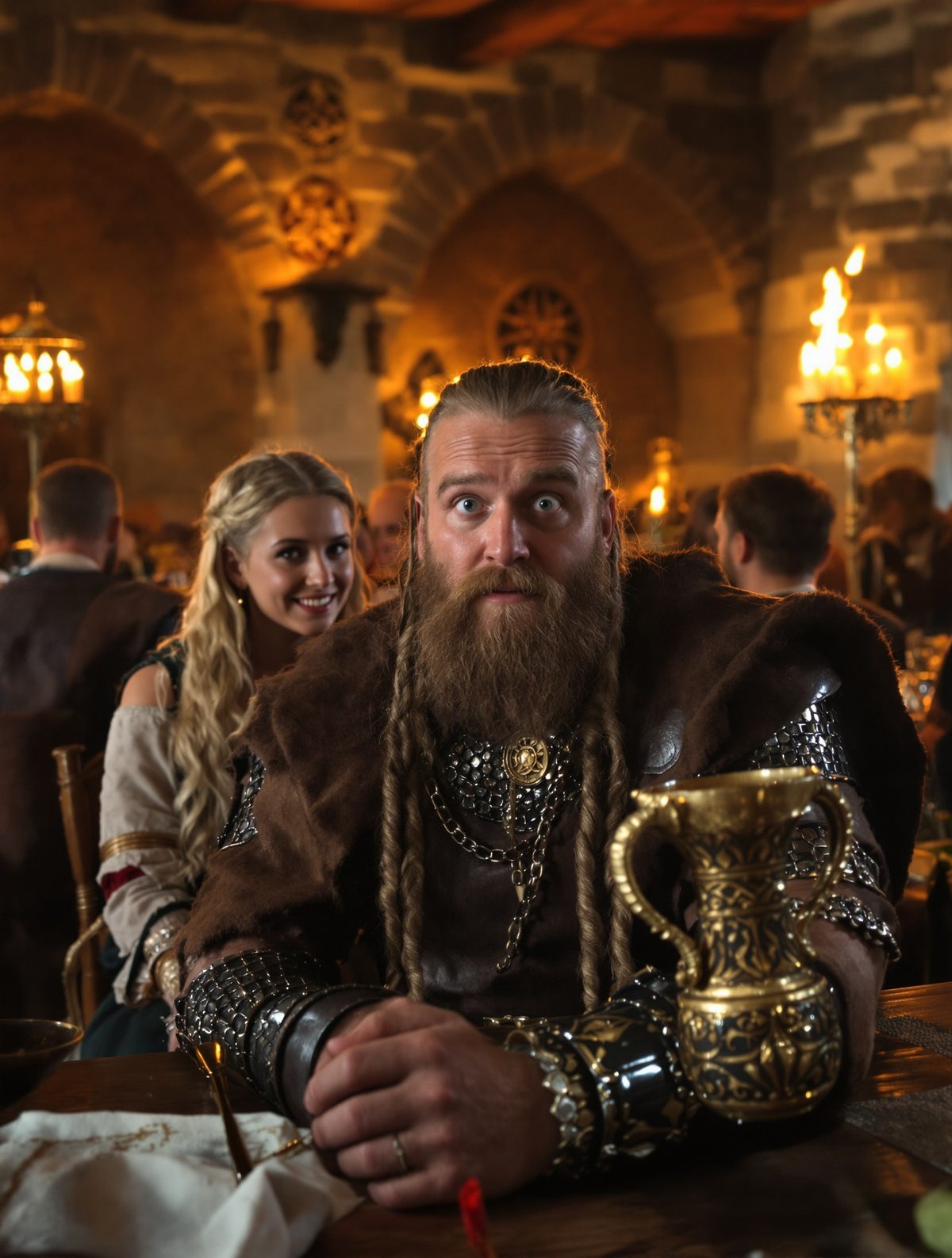
Picture this: you're sailing through the fog-shrouded waters of the North Atlantic in 985 AD. Ice floes drift like silent killers around your wooden longship, while hidden reefs wait to tear open your hull. One wrong turn means death for you and your entire crew. But the man standing at your bow doesn't consult any map or compass—because neither exists yet. Instead, he closes his eyes, feels the rhythm of the waves, tastes the salt spray, and somehow knows exactly where you are in this trackless wilderness of sea.
His name was Thorvald Eriksson, and inside his mind lay the most valuable treasure in the Viking world: a perfect mental map of every navigable route between Iceland and the mysterious new land his father, Erik the Red, had discovered and named Greenland. For thirty years, Thorvald accumulated maritime secrets that would make him the most sought-after navigator in the North Atlantic—and ultimately, the most tortured.
The Mind That Mapped an Ocean
In 980 AD, navigation wasn't a science—it was closer to magic. Viking navigators like Thorvald relied on an almost supernatural ability to read the sea's moods and remember thousands of tiny details that meant the difference between safe passage and watery death. They called this skill hávamal—the "high speech" between sailor and sea.
Thorvald began his apprenticeship at age twelve, sailing with his father Erik the Red during the latter's three-year exile from Iceland. While Erik focused on finding new lands to plunder and settle, young Thorvald was quietly memorizing everything: the way certain waves broke over submerged rocks, how the color of the water changed near hidden shoals, the precise angle of certain mountain peaks that could guide ships through narrow fjords even in heavy fog.
What made Thorvald extraordinary wasn't just his memory—it was his method. He developed a unique technique of associating each landmark with a story, often starring the Norse gods. That jagged rock formation where the current swirled dangerously? That was where Thor's hammer had struck the sea floor. The spot where icebergs always gathered? Loki's ice palace, where unwary sailors would be trapped forever.
By weaving navigation into mythology, Thorvald could remember not just where things were, but exactly how to approach them safely in different weather conditions, seasons, and tides. His mental map wasn't flat like the charts we know today—it was four-dimensional, including time and conditions that changed everything about how you sailed these waters.
The Routes That Built an Empire
Between 985 and 1010 AD, Thorvald's knowledge made the Greenland colonies possible. Erik the Red's settlement at Brattahlíð housed nearly 3,000 Vikings at its peak, but they depended entirely on supply ships from Iceland for iron, grain, and other essentials they couldn't produce in Greenland's harsh climate.
The journey was absolutely treacherous. Modern oceanographers have mapped the Denmark Strait between Iceland and Greenland and found over 200 underwater hazards that could sink a ship. The Irminger Current creates unpredictable eddies and standing waves, while the East Greenland Current carries massive icebergs south at speeds that could crush a longship in minutes.
Yet Thorvald knew seven different routes through this maritime maze, each one optimized for different seasonal conditions. His spring route hugged the Iceland coast before cutting northwest near Akureyri, riding a warm current that melted ice flows early. His autumn route swung far south to avoid winter storms, adding 200 miles to the journey but nearly guaranteeing safe arrival.
Ships guided by Thorvald had a remarkable 90% survival rate on the Iceland-Greenland run—compared to roughly 60% for other navigators. In an age where losing a single cargo ship meant starvation for entire settlements, Thorvald's mental maps were literally worth their weight in silver.
The Secret That Made Enemies
By 1005 AD, Thorvald's reputation had spread throughout the Viking world. But fame can be dangerous when your knowledge threatens other people's power. Rival Viking clans, particularly the powerful Sturlung family from Iceland, realized that controlling Thorvald meant controlling trade with the lucrative Greenland settlements.
The Greenland colonies were economic goldmines. They exported walrus ivory, seal oil, polar bear furs, and most valuable of all—live polar bears and Arctic falcons that European nobles paid astronomical sums to own. One healthy polar bear could buy a fully-equipped longship. A trained Arctic falcon was worth more than most men would earn in a lifetime.
But all this wealth flowed through routes that existed nowhere except in Thorvald's memory. He had deliberately never trained a successor, and he kept his navigational stories secret from everyone except his most trusted crew members—who were bound to him by blood oaths and shared profits.
The Sturlung clan tried everything: they offered Thorvald massive bribes, political marriages for his daughters, even a percentage of their own trading profits. He refused every overture. Some accounts suggest they tried to seduce his secrets from him using a beautiful Frankish slave woman trained in the arts of memory. Thorvald apparently enjoyed her company for several months but revealed nothing.
Three Days in Hell
In the spring of 1010 AD, Thorvald set sail from Brattahlíð with a cargo of ivory and furs bound for Iceland. His ship never arrived. For months, his fate remained a mystery—until a captured Sturlung raider, facing execution, revealed the truth in exchange for a quick death.
The Sturlungs had intercepted Thorvald's ship in the Denmark Strait using inside information from a bribed crew member. But they had underestimated their captive's resolve. According to the raider's confession, they tortured Thorvald for three full days and nights, using techniques learned from Byzantine prisoners-of-war.
They started with "the sea eagle"—cutting through his ribs and pulling out his lungs while he was still alive, a sacrifice to Odin that was supposed to make him speak truthfully. When that failed, they tried crushing his fingers one by one, then breaking his legs with hammers. Finally, they attempted to extract information by threatening his crew—binding his men to the ship's mast and slowly lowering them into the ice-cold water.
Through it all, Thorvald revealed nothing. Not a single route, landmark, or navigation secret. On the third night, he finally died from his wounds, taking with him the mental maps that had guided dozens of successful voyages across the most dangerous waters in the known world.
The Navigator's Last Voyage
Thorvald's death had immediate and devastating consequences. Without his knowledge, the supply route to Greenland became far more perilous. Ship losses increased dramatically—some estimates suggest only one in three vessels successfully completed the round trip in the years following 1010 AD.
The Greenland colonies began their slow decline almost immediately. Cut off from reliable resupply, the settlements struggled to maintain their population. By 1350 AD, the last Vikings had either died out or been absorbed into Inuit communities. Archaeologists have found evidence of increasing malnutrition and desperation in the final decades—including signs that the colonists may have resorted to cannibalism.
But Thorvald's story raises fascinating questions about how knowledge was preserved and transmitted in the pre-digital age. Recent research by cognitive scientists suggests that his memory techniques—using narrative and mythology to encode spatial information—were remarkably sophisticated. Modern GPS navigation systems actually use similar principles, layering different types of information to create robust, redundant positioning data.
In an age where we back up our digital lives to the cloud and assume important information will always be available, Thorvald's death reminds us how fragile human knowledge can be. The routes he had memorized represented decades of accumulated wisdom, passed down through generations of Viking navigators and refined through countless dangerous voyages. When he died, that entire tradition died with him.
Perhaps most remarkably, Thorvald chose to die rather than betray the trust placed in him by his fellow colonists. In our modern world of leaked secrets and digital espionage, there's something almost incomprehensible about a man who would endure torture and death rather than reveal information that could benefit his enemies. His story challenges us to consider: what knowledge would we die to protect, and what does our answer say about who we really are?