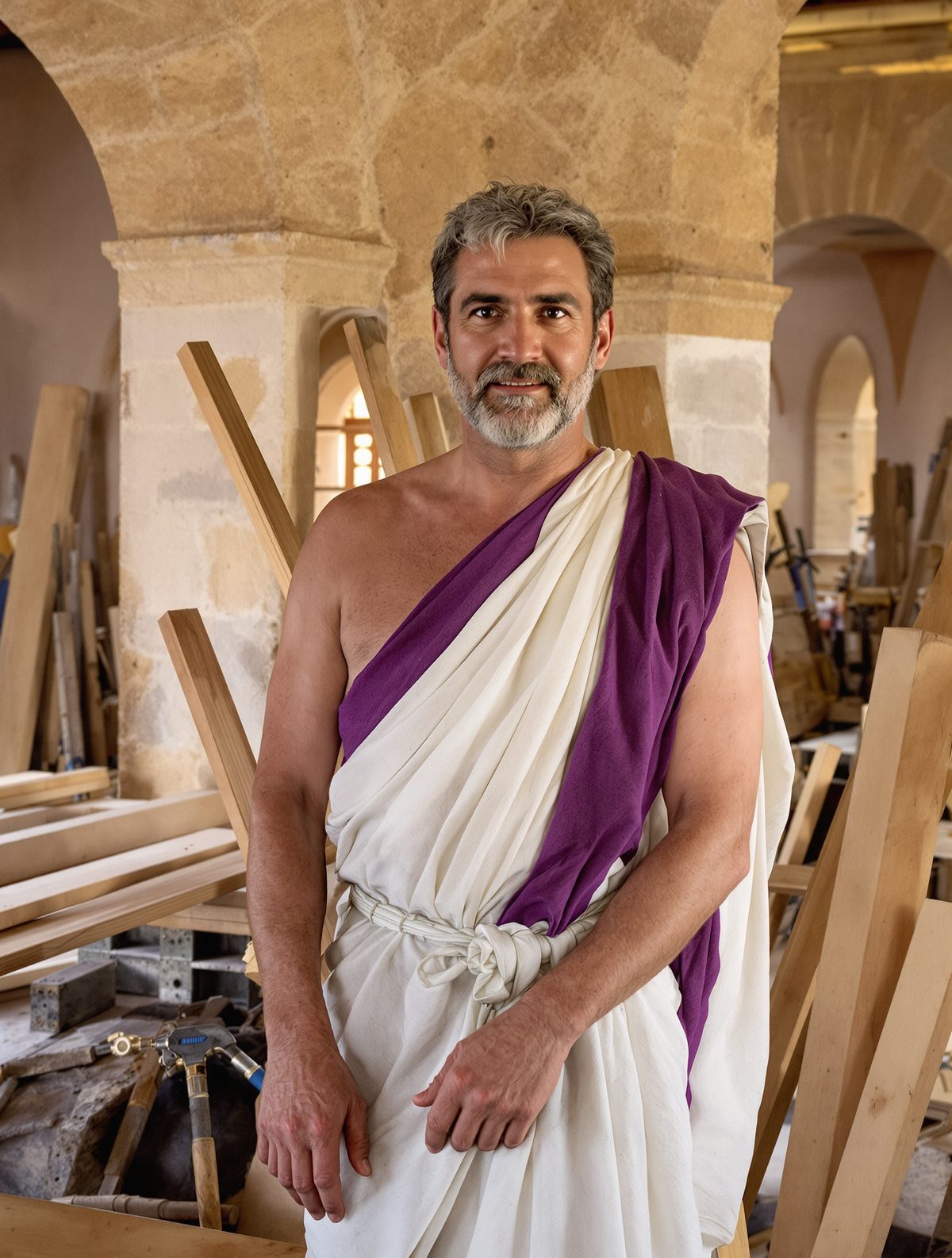
The jade-inlaid observatory tower of Yaxmuul cast long shadows across the limestone plaza as dawn broke on March 15th, 830 AD. High above the rainforest canopy, a figure hunched over intricate stone tablets covered in glyphs that mapped the movements of celestial bodies with mathematical precision that wouldn't be matched in Europe for another 600 years. Itzamnaaj B'alam—whose name meant "Jaguar God of the Sky"—had spent three decades perfecting calculations that would make him the most feared astronomer in the Mayan world. But today, on his 60th birthday, he would use those same calculations to orchestrate his own death.
As the court scribes gathered below, whispered prayers carried on the humid morning air. Everyone knew what was coming. Their royal astronomer had announced it months ago with the cold certainty of a man reading tomorrow's weather: when the sun disappeared from the sky at precisely midday, so too would his life force abandon his body. The eclipse would arrive exactly as predicted. The question that haunted every soul in Yaxmuul was whether Itzamnaaj B'alam's final prophecy would prove as accurate as all the others.
The Mathematical Genius of Yaxmuul
To understand the magnitude of what Itzamnaaj B'alam accomplished, you need to grasp just how sophisticated Mayan astronomy had become by the 9th century. While Europe languished in what they called the Dark Ages, Mayan astronomers were calculating planetary cycles with an accuracy that puts some modern amateur astronomers to shame. They tracked Venus with an error rate of just one day over 500 years. They predicted lunar eclipses centuries in advance. And they did it all without telescopes, using only naked-eye observations and mathematical models carved into stone.
Itzamnaaj B'alam represented the pinnacle of this tradition. Born during a rare conjunction of Mars and Jupiter—an event his court astrologers interpreted as a divine sign—he demonstrated an almost supernatural ability to perceive patterns in the sky from childhood. By age 15, he was correcting errors in eclipse tables that had stood unchallenged for generations. By 30, he had calculated the precise length of the solar year as 365.2420 days—just 19 seconds off from our modern measurement.
His masterwork was a series of astronomical tables known as the "Serpent Star Codex," inscribed on 47 jade tablets that tracked the movements of celestial bodies across vast spans of time. These weren't simple observations but complex mathematical models that could predict eclipses, planetary alignments, and other astronomical events with stunning precision. European astronomers wouldn't develop comparable accuracy until the Renaissance, nearly 700 years later.
When Gods Speak Through Shadows
In Mayan cosmology, solar eclipses weren't mere astronomical curiosities—they were cosmic battles between the forces of light and darkness. The sun god Kinich Ahau was being devoured by the celestial jaguar of the underworld, and only through proper ritual and sacrifice could the natural order be restored. For the Maya, predicting these events wasn't just science; it was a form of divine communication that could determine the fate of entire kingdoms.
Itzamnaaj B'alam understood this better than anyone. His ability to forecast eclipses had made him indispensable to three successive rulers of Yaxmuul, each of whom relied on his predictions to plan military campaigns, schedule religious ceremonies, and maintain their divine legitimacy. When he announced that a total solar eclipse would occur on his 60th birthday—the sacred completion of three 20-year cycles in the Mayan calendar system—the court recognized it as more than coincidence.
What made his final prediction so extraordinary was its precision. Using calculations inscribed on the Serpent Star Codex, he declared that the eclipse would begin at precisely 11:47 AM, reach totality at 12:34 PM, and end at 1:21 PM. He specified the exact path of the shadow, which would sweep across Yaxmuul's ceremonial center with the trailing edge passing directly over his observatory. Most chilling of all, he announced that his own death would coincide with the moment of maximum totality, when the shadow was deepest and the cosmic battle at its fiercest.
The Final Calculation
Modern archaeoastronomers have reconstructed Itzamnaaj B'alam's calculations using fragments of the Serpent Star Codex discovered in the 1970s. What they found defies easy explanation. His eclipse prediction was accurate to within minutes—remarkable enough for any ancient astronomer. But the mathematical methods he used suggest knowledge that shouldn't have existed in 9th-century Mesoamerica.
The codex reveals that he had calculated not just the basic lunar and solar cycles necessary for eclipse prediction, but also subtle variations caused by the elliptical shape of planetary orbits. He had somehow identified and corrected for the gradual slowing of the Earth's rotation—a phenomenon that wasn't officially recognized by modern astronomy until the 20th century. Most remarkably, his calculations incorporated what appears to be an understanding of gravitational perturbations that wouldn't be formally described until Newton's work 850 years later.
Dr. Linda Schele, the renowned Maya epigrapher who first decoded portions of the codex, described the mathematical sophistication as "almost impossibly advanced." The precision required to predict not just the eclipse but its exact timing and path suggests either an extraordinary individual genius or access to observational data accumulated over many centuries—perhaps both.
The Day the Sun Died
Contemporary accounts carved into temple walls describe March 15th, 830 AD in vivid detail. As the predicted hour approached, the entire population of Yaxmuul—estimated at over 8,000 people—gathered in the great plaza surrounding the observatory. Itzamnaaj B'alam appeared at the top of his tower wearing the elaborate jade and obsidian regalia of his office, carrying the ceremonial bloodletting tools that would mark his transition from the world of the living to the realm of the ancestors.
At exactly 11:47 AM, as he had predicted, the moon's edge touched the sun. A murmur rippled through the crowd as the master astronomer raised his arms and began the death chant traditionally reserved for warriors fallen in battle. The temperature dropped noticeably as more of the sun disappeared. Jungle birds fell silent. Even the howler monkeys, whose calls normally echoed constantly through the forest, seemed to sense the cosmic significance of the moment.
As totality approached, the astronomer's chant grew more intense. At 12:34 PM—precisely as calculated—the sun vanished completely behind the moon. Stars became visible in the darkened sky. The temperature plummeted. And in that moment of perfect darkness, Itzamnaaj B'alam collapsed. When the sun emerged from eclipse 47 minutes later, Yaxmuul's greatest astronomer was dead.
The Mystery That Science Cannot Solve
Modern analysis of the surviving historical records raises more questions than it answers. The timing of Itzamnaaj B'alam's death coinciding so precisely with maximum totality could, theoretically, be explained as suicide—a calculated final act designed to cement his legacy and demonstrate the ultimate connection between astronomer and cosmos. Some scholars point to evidence of poisoning found on ceremonial cups discovered in the observatory.
But other details suggest something more complex. Multiple independent sources describe physical signs that began appearing weeks before the eclipse: the gradual graying of his hair, the slowing of his movements, the way his eyes seemed to turn inward as if watching some inner celestial dance. Court physicians noted that his pulse had begun following the rhythm of the approaching eclipse cycle, speeding up and slowing down in sync with the orbital mechanics he had spent his life studying.
Perhaps most intriguingly, the codex contains calculations that extend far beyond the March 15th eclipse. Itzamnaaj B'alam had mapped astronomical events reaching 2,000 years into the future, including several calculations that correspond precisely with eclipses observed and recorded by modern astronomers. His final entry, made apparently just days before his death, predicts a total solar eclipse that will cross North America on April 8, 2024—a prediction that NASA has confirmed to be accurate to the minute.
When Ancient Wisdom Illuminates Modern Mysteries
The story of Itzamnaaj B'alam challenges our assumptions about the relationship between knowledge, power, and mortality. In our age of digital precision and satellite astronomy, we sometimes forget that understanding the cosmos has always been as much about understanding ourselves as mapping the stars. This Mayan astronomer achieved something that no modern scientist has attempted: he used his mastery of celestial mechanics not just to predict the future, but to choreograph his own exit from the world with perfect timing.
His legacy reminds us that science and spirituality weren't always separate domains. For the Maya, astronomy was simultaneously mathematics and theology, prediction and prayer. Itzamnaaj B'alam embodied this integration so completely that he became, in his final moment, both observer and observed, the astronomer who transformed himself into a celestial event as precisely timed and carefully calculated as any eclipse.
Today, as we face our own questions about the relationship between human knowledge and cosmic forces, his story offers a haunting reminder: the universe we study so carefully is studying us right back. And sometimes, for those who look deeply enough, it reveals not just when eclipses will occur, but when shadows fall across the human heart with equally mathematical precision.