The Mechanical Turk was nothing more than a clever trick. But to those who witnessed its prowess, it was the dawn of a new era.
The Enigma Arrives in Europe
In the year 1770, Europe was abuzz with a peculiar spectacle: a wooden automaton dressed in an Ottoman turban, seated at a wooden box, its gaze affixed on a chessboard. This assemblage of wood and fabric was no ordinary machine. It was known as "The Turk," and it bewildered audiences from Vienna to Paris with what appeared to be an unthinkable feat — the power to think and strategize. Baron Wolfgang von Kempelen, a Hungarian inventor in the court of Empress Maria Theresa, was the mastermind behind its creation. He introduced this enigmatic automaton at Schönbrunn Palace, captivating the court with its seemingly miraculous ability to contend with Europe's finest chess players.
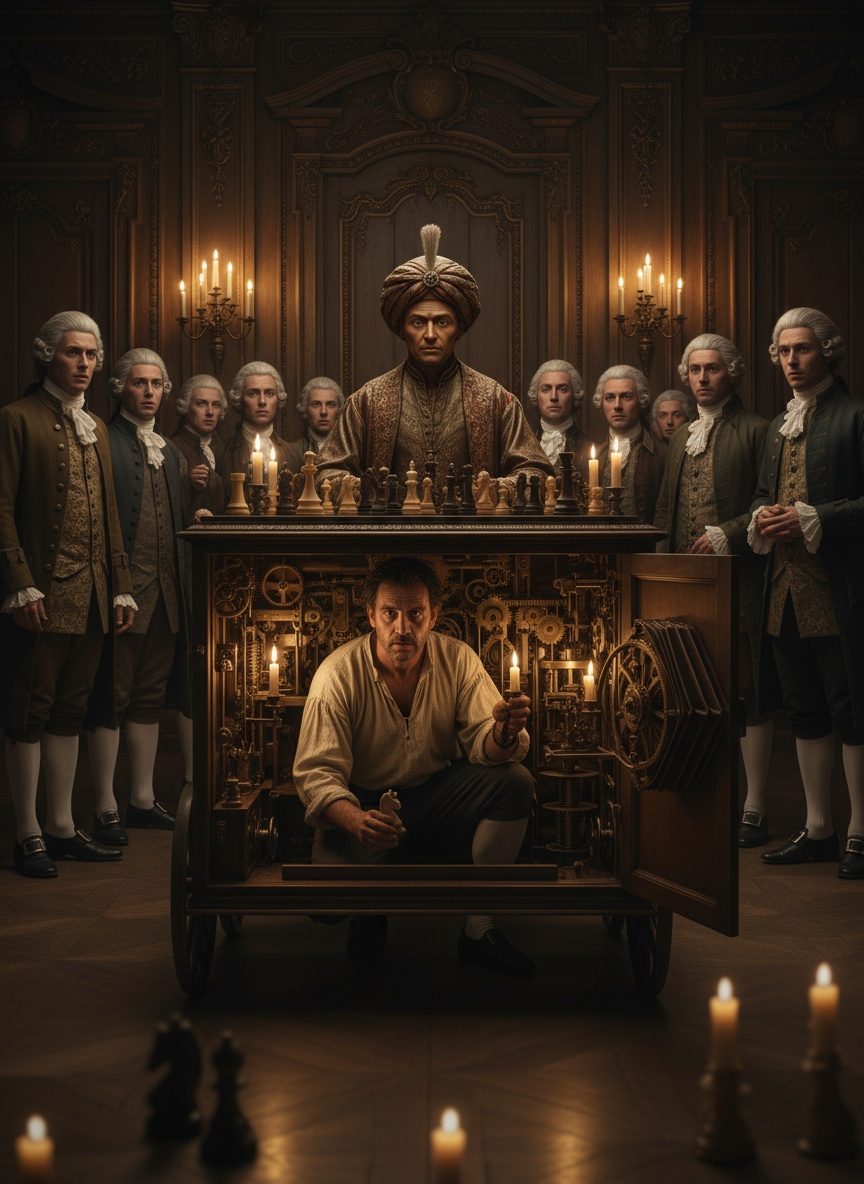
With each match, The Turk astonished onlookers as it moved its pieces with remarkable precision. It played and won against human competitors, leaving audiences agape and whispering about the possibility of mechanical cognition. Before every game, von Kempelen would open the cabinet doors, revealing the spinning cogs and mechanisms, allowing spectators a glimpse inside. Yet, despite the scrutiny, none saw what hid just out of sight — the very human intelligence guiding its hand.
The Human Brain Beneath
What made The Turk extraordinary was not the gears that mesmerized the audience, but who was hidden within. As the unsuspecting public viewed the machine’s inner workings, a skilled chess player, cramped in the cabinet's tight confines, worked the controls. This player ingeniously maneuvered the pieces via magnets or mechanics, depending on the version of the machine at times. At one point, reports surfaced that these hidden maestros included notable chess players of the era, although their identities were fiercely guarded secrets.
The deception was both simple and brilliant, relying on the notion that the simplest explanation was too unbelievable to accept. Audiences latched onto the idea of a machine capable of thought because the alternative was something they could not imagine was so elaborately concealed. To reveal the truth of the matter would have deflated the grandeur of the illusion — the very illusion that allowed The Turk to cross the threshold not just of chess and the parlor but of what humanity considered possible.
Across Borders and Battlefields
The Turk became a mysterious celebrity, crisscrossing the continent to command the attention of not just the elite of salons and parlors but also the powerful and strategically inclined. Even Napoleon Bonaparte, the era's formidable general and eventual emperor, engaged in a chess game with this mechanical marvel. The story goes that The Turk called out the general’s illegal move by sweeping the piece off the board, a rebellious act hinting at a cunning human judgment beneath the wooden facade.
From its inception until the mid-1800s, The Turk remained an object of perpetual fascination. It traveled and performed broader tours, enrapturing diverse kinds of crowd with the enigma of artificial intellect bound in wood. Each performance renewed debates and discussions about the possibility of artificial thought, striking awe and fear in equal measure. Eventually, the delusion proved too much for some, who devoted themselves to exposing the truth behind the wooden curtains.
The Illusion's Enduring Legacy
By 1854, the secret of The Turk had been unraveled. Its final days came not through a chess defeat but by a fiery conflagration that consumed it in a Philadelphia museum. However, The Turk's role in history was far from extinguished, as it harbored a dual legacy — a brilliant demonstration of human ingenuity and a poignant reminder of our readiness to believe in the fantastic. It served as a prelude to the inexorable march toward the age of machines we find ourselves in today.
Why does The Turk matter? It was a brilliant deception, yet it illuminated profound insights into the burgeoning relationship between humanity and technology. It straddled an era when the human imagination began to contemplate the potential of machines beyond mere tools. The willing suspension of disbelief it commanded foretold a future where automata would grow from novelties to necessities — shifting our perspective yet again, from marveling at what they mimic to utilizing what they achieve. The Turk stands not only as a relic of past wonders but as a mirrored reflection of our ongoing quest to unlock thinking in non-human forms. Perhaps, what truly sat motionless was not just The Turk, but our underestimation of the horizons technology may eventually surpass.