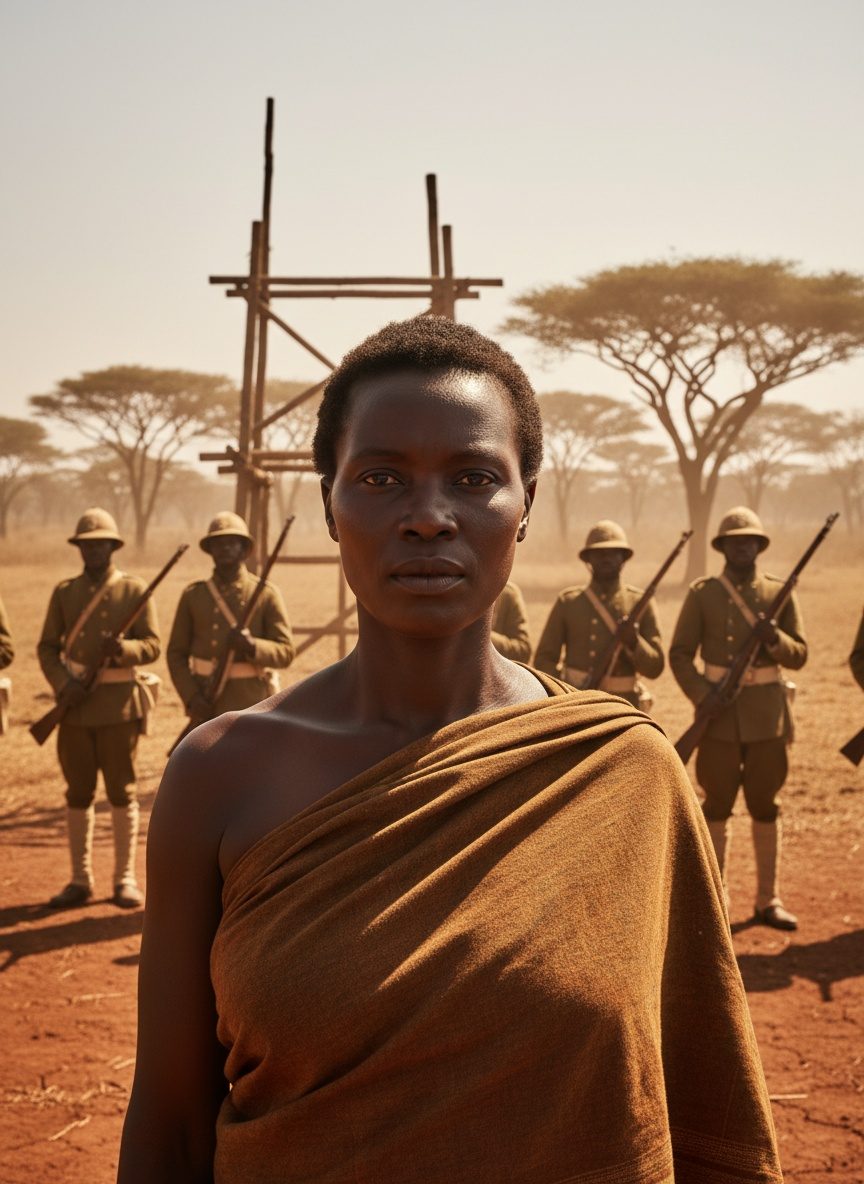
The rope swayed slightly in the morning breeze as Nehanda Charwe Mkodzi, spirit medium and leader, walked steadily toward it. Her chained feet shuffled over the dusty ground, heavy, yet her heart was unyielding. Around her, the gathered British colonial officials and their native conscripts formed a tense circle. She heard the clink of their rifles as they shifted uneasily, perhaps disarmed by her calm presence. Nehanda did not blink. She refused the blindfold, meeting her destiny with open eyes.
A few years earlier, the land now known as Zimbabwe was in upheaval. Colonial forces under British rule sought to seize control, exploiting resources and imposing laws foreign to the indigenous Shona people. As disruptors of a sacred balance, they disregarded the ancestral connections tied to these lands. Paramount Chief Chirundu was dead, and the imposition of taxes and forced labor had stirred resistance. In this crucible, Nehanda emerged as an unwavering voice and a conduit for the revered spirit of the ancestral mother, Mbuya Nehanda. Her figure became synonymous with rebellion, weaving spiritual authority into the fabric of resistance.
Nehanda did not simply lead from the spiritual realm; she was a figure of action. Her call was clear, her determination etched in every word she spoke to her people. "This is your land," she insisted, "given by God." Her influence rallied many, like sorghum growing after fertile rains, to take up arms, guided by her visions and prophecies. She became central to the First Chimurenga, the war of liberation in 1896-1897, against the encroaching settlers and their rule of subjugation.
The British authorities who ensnared her comprehended her influence's true extent—a potent fusion of belief and resistance. For them, Nehanda was not just a dissenter but a dangerous adversary whose spirit they sought to extinguish. Her trial, therefore, was more than a mere judicial proceeding; it was an attempt to sever her connection with the people. Despite this, Nehanda stood resolute, declining to convert to Christianity, refusing to be cowed by their proclamations of her guilt.
The scaffolding where her fate was sealed echoed with histories untold. Executing a woman who was more than mortal to her people was a dire affair, colored by the inevitability of her words echoing through the generations. Her prophecy before her execution—that they would rise again—reverberated memorably, imbued with the strength of her spirit’s belief. The British could not understand, maybe even fear, the depth of her conviction, the breadth of her influence. It was more than just a woman they were concerned with; it was the potential upheaval, the spark in the minds of the colonized, she perpetuated.
As the noose was placed around her neck, Nehanda's presence filled the air, leaving an indelible mark on all who bore witness. She became a martyr, a perpetual symbol of defiance against subjugation. Her prophecy was fulfilled decades later, as her spiritual descendants rallied once more in the long struggle for Zimbabwe's independence. The First Chimurenga laid dormant for many years but resurfaced in 1965 with the advent of the Second Chimurenga, eventually culminating in Zimbabwe's independence in 1980.
Nehanda Charwe Mkodzi's execution was an attempt at erasure that ultimately backfired, igniting the very spirit the colonizers sought to quell. Her undeterred resolution, her final words—"My bones will rise again"—seemingly spoken not just to the gathered colonizers but whispered through the winds of time, have forever intertwined her legacy with that of her homeland. Her voice became the dirge and charge of independence; her story, a testament to resilience and the power of spirit over force.
Today, amidst the hustle of a nation still reconciling its complex history, Nehanda's memory is more than a reminder of past injustices—it is a powerful force for unity and continued vigilance. Her life defies the confines of text, painting the tapestry of colonial resistance across the broad canvas of time, a vivid portrayal of invincible spirit. As we step back from the scaffold, the rope swinging in testimony—the tale of Nehanda Charwe continues to echo, urging those who hear it to remain vigilant and resilient, forever on their guard against the shadows of oppression. Her legend reminds us that the spirit of resistance can never be truly imprisoned, paving the path toward lasting liberation. The world may change, names and treaties may fade, but a resilient spirit is timeless, shaping history's course for those destined to follow.