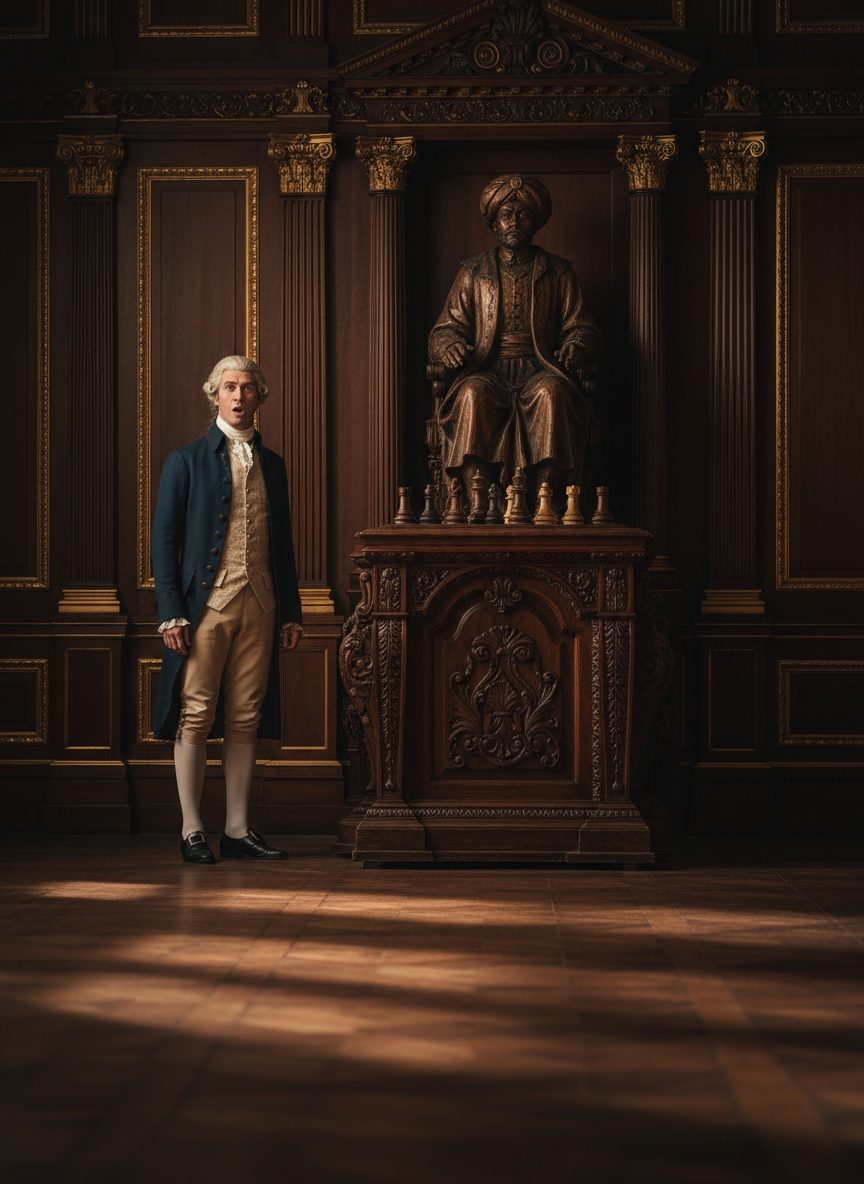
The dimly lit parlor was filled with expectant murmurs as candlelight flickered, casting shadows that danced across the ornate wallpaper. The air was thick with both intrigue and the bitter scent of tobacco smoke. Among these hushed conversations and the clatter of finely made boots on wooden floors was an anticipation that seemed almost tangible. This was no ordinary evening of socializing among the European elite. Seated on one side of a grand chessboard, draped in Ottoman robes and crowned with a turban, was a figure of mystery — the Mechanical Turk. An enigmatic automaton that for over eighty years had invited challengers from the furthest reaches of intellectual and political power to engage in the cerebral battle of chess.
Constructed in the late 18th century, the Mechanical Turk was the brainchild of Wolfgang von Kempelen, a Hungarian inventor. Birthed from a fascination for mechanical wonders and perhaps a touch of absolute audacity, the Turk was a sophisticated clockwork marvel designed to enthrall anyone who dared challenge it. Inside an elaborately carved wooden cabinet, the illusionist's art came to life. From its framework emerged an arm that moved with impossible precision, its wooden fingers delicately grasping chess pieces as it laid its claim over the board. No one saw the truth that sat hidden in the shadows of its chest. Like a fantastical tale of legends past, the machine's secret was delightfully human.
Among its challengers was none other than the indefatigable Napoleon Bonaparte. In a dimly lit French salon, amid the soft rustling of skirts and the whispers of strategists, the General bowed to his wooden adversary. His calculation, an infamous trait on the battlefield, faltered before the seemingly soulful stare of the Turk. Move after calculated move, the match resulted in a defeat that left onlookers agape. Likewise, across the Atlantic, in the burgeoning heart of the American Enlightenment, Benjamin Franklin himself sat across the mechanical enigma, only to find his intellectual prowess challenged by the automaton's deft movements.
Yet, the real genius was the one concealed. Inside, deftly crouched within the magnetic gloom and invisibility of the cabinet, was a human operator. These operators were skilled chess players, artisans of the game, chosen for their cunning and dexterity. They would manipulate the arm with subtlety, responding to their opponent’s strategies with silent finesse. The complexity of this charade went unnoticed as the Turk mesmerized audiences, the clink of metal gears drowning out any doubts. Eyes fixed on the board, its towering presence projected an illusion of an infallible machine, a mirror to the mechanical dreams of the Enlightenment where man could build wonders beyond imagination.
Journeys of the Turk took it to courts and cities across the globe, from Vienna to London to Boston. Everywhere it went, it collected the souls of defeated opponents, adding to its legend. As it traveled, questions rose and fell with the tides of fascination and skepticism. How could such a machine exist without flaw or recompense, asking not for rest, time, or mortality? Speculations resounded in quiet thresholds, fancifful tales and conspiracies beyond reason. It was said the Turk might have been guided by mystical forces unknown to mankind, its wisdom drawn from centuries of hidden lore.
Centuries passed with no unveilings; the secret of the man within remained unspoken until von Kempelen's creation journeyed to the American shores in the 1820s under new ownership by Johann Nepomuk Mälzel. Here, the dim beginnings of truth began to form. An enterprising impresario and inventor, Mälzel enhanced the Turk's fame, yet he mistook the power of innovation. The invention continued to dazzle, but speculation grew—suspicious theatre-going minds refusing to take its skill on faith alone. Reveals and confessions crept into discourse, the hushed whispers congealing into clarity when, in the mid-19th century, the revelation finally emerged—the Turk was no more than human genius clothed in mechanics of beautiful deception.
For decades, the Turk had confounded and amazed, becoming a symbol of the superhuman abilities owed to human ingenuity channeled through mechanized form. Ultimately, the machine combusting within the halls of its theatrical last stand in North America marked the end of its legendary sojourn. Still, whose defeat really went unsung—those tempered by its chess mastery, or the subterfuge crafted by its creators? This is where history finds wonder—not in the defeat of kings, but in curious victory of craft and imagination.
Though the Mechanical Turk's truth lay bare, its legacy reaches out beyond time, speaking to an age-old fascination with the melding of human and machine. The tale of the Turk is not merely of deception, but a dance of mankind with its creations—a forward glance to the dependence and bond with the mechanized servants of tomorrow. It echoes still today in a world where the line between human intellect and artificial intelligence blurs, inviting us to ponder: Where does the soul of a machine reside, if not in the human heart that creates it?