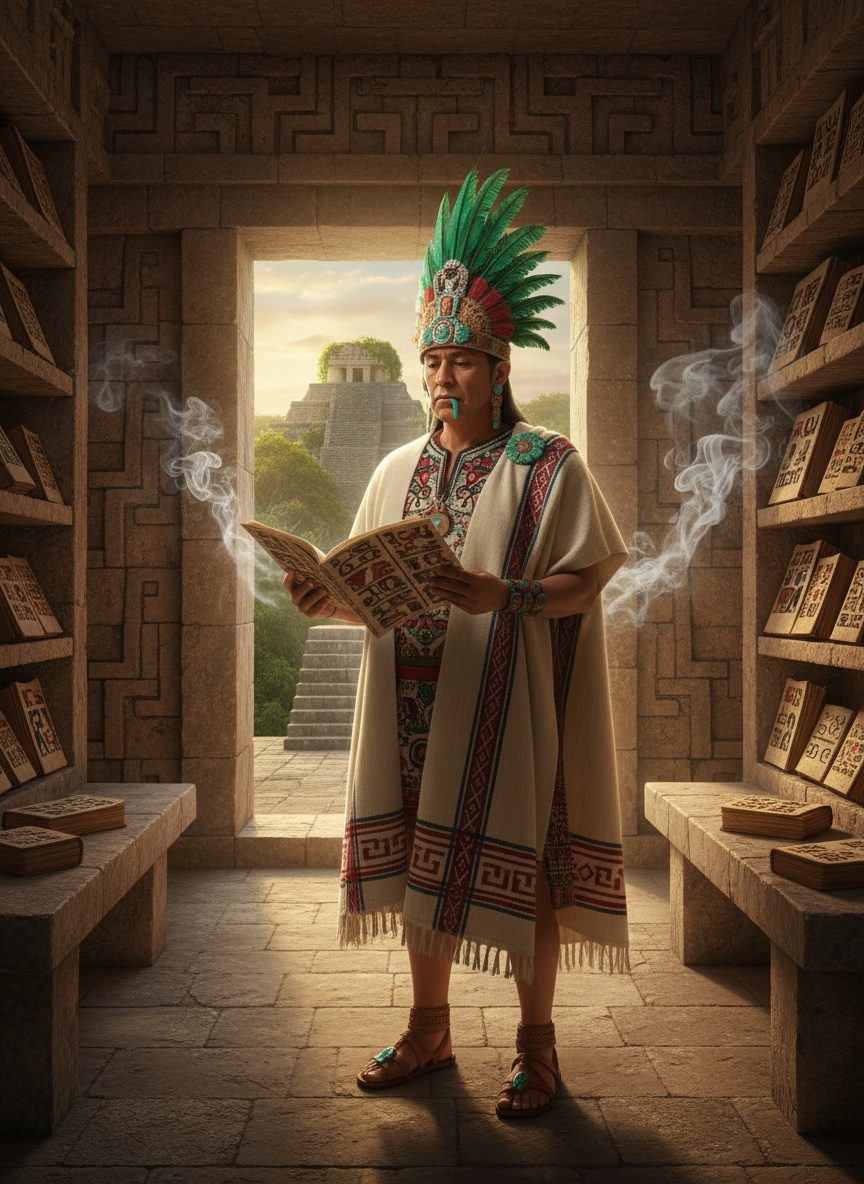
The air was thick with the scent of wet earth, the evening rains having settled the dust that rose from the teeming streets of Texcoco. The sun dipped below the horizon, casting an amber glow over the city, illuminating the bustling heart of pre-Columbian Mesoamerica. The cobblestone roads echoed with the footsteps of scholars, scribes, and artisans making their way to the towering edifice that loomed at the center of the city—the grand library of Texcoco. In the waning light, its stone façade seemed to flicker with the whispers of knowledge contained within.
This was no ordinary collection of texts. Nezahualcoyotl, whose name meant "Fasting Coyote", had created a marvel unprecedented in the known world—a repository of wisdom and culture open to all. In an era when European libraries were cloistered within the cold stone walls of monasteries, accessed only by the erudite few, Nezahualcoyotl's grand vision was to democratize the pursuit of knowledge. The royal library he built was a symbol of enlightenment, filled with thousands of painted codices, each a testament to the innovative spirit of the Aztecs. Here, astronomy, poetry, and philosophy found common ground with mythology, history, and law—a tapestry of human understanding laid bare for the future generations.
Nezahualcoyotl was not just a king; he was a poet, philosopher, and visionary. Born in 1402 amid turmoil and exile, his early life was marked by adversity. Yet it was precisely this crucible of challenges that forged his character, driving him to redefine his own destiny and that of the people he shepherded. As he matured, his intellect blossomed, guided by an insatiable curiosity and a moral compass uniquely his own. While other rulers sought to expand their realms through conquest and subjugation, Nezahualcoyotl turned inwards, cultivating a society where wisdom and art were valued as much as power and wealth.
The heart of Nezahualcoyotl's Texcoco was the library, a space where the melodies of debate and discourse rose to meet the rafters. Under his watchful eye, scribes meticulously catalogued the stars, charting the celestial dance as it ebbed and flowed across the night sky. These observations were not idle musings but formed the basis of Mesoamerican cosmology, influencing everything from agriculture to religious practices. Nezahualcoyotl himself contributed to this repository, his poetic compositions reflecting his philosophical inquiries and deep connection with the natural world. His verses sang of the ephemeral beauty of life, the transience of power, and the pursuit of wisdom—a legacy as enduring as the structures he raised.
One of Nezahualcoyotl's most radical reforms was his approach to religion and sacrifice. In a culture that revered the gods with offerings of human life, he dared to challenge the divine mandate. At his own temples, human sacrifice was abolished, replaced instead with more symbolic offerings. This act was not born of mere caprice; it resonated with Nezahualcoyotl's belief in the intrinsic value of life and the potential for human consciousness to transcend the demands of ancient rituals. In this, he was a figure ahead of his time, recognizing the power of compassion and reason in governance.
Yet, he was not content with philosophical musings alone. Nezahualcoyotl transformed Texcoco into a cradle of innovation and urban planning. The city teemed with artistic and cultural endeavors; its infrastructure was an intricate network of waterways, gardens, and causeways, later influencing the grand city of Tenochtitlán. His vision was echoed in the very layout of Texcoco, where open spaces and communal areas encouraged dialogue and reflection, fostering a society that mirrored the philosophical ideals revered by its king.
Despite the miles and millennia that separate us from Nezahualcoyotl's time, his story is a beacon of the human spirit's quest for understanding and enlightenment. He was a leader who dared to dream differently, who viewed knowledge not as a commodity to be hoarded but as a birthright to be shared. In a world that often feels divided along lines of knowledge and ignorance, the legacy of the Fasting Coyote reminds us of the power held in bridging that divide. As the last light fades over the ancient stones of Texcoco, the echoes of his revolutionary ideals remain, a timeless call to embrace wisdom and kindness as guiding stars on the horizon of progress.