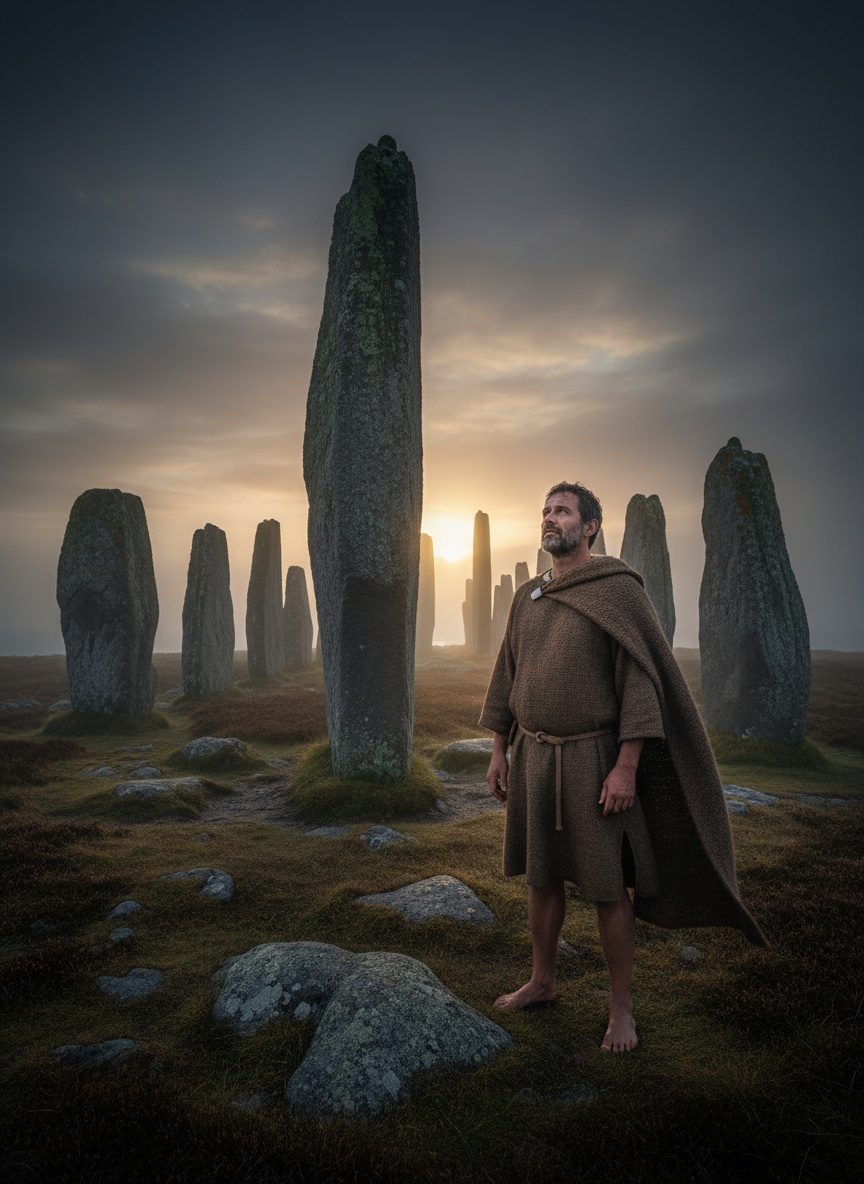
It seemed they were simply a cluster of rocks strewn across a windswept Scottish island. Yet, they stood with a purpose so precise that their alignment with the midsummer sun leaves modern minds perplexed and awed. Upon the Isle of Lewis, a mysterious circle of standing stones emerged around 2500 BCE, long before the spectacle of Stonehenge or the scribblings of recorded history marked their time.
The Callanish Stones remain an enigma wrapped in millennia, silently testifying to the sophisticated understanding of astronomy possessed by their creators. They speak of a society with the foresight and coordination required to undertake such a monumental project, in a world that was still largely ensconced in the shadows of the Bronze Age. These stones, older than many of the surviving ancient wonders of the world, scatter across landscape like cosmic messengers, positioned with near-perfect precision to capture the first light of the summer solstice.
To walk among the Callanish Stones is to step into another epoch. One can almost hear echoes of ancient rituals whispering through their silent ranks. The constructors of this stone circle operated with a level of astronomical sophistication that no one would associate with those early epochs, aligning the stones to harness the spectacle of the summer solstice. While such proficiency did not even require them to be ecclesiastics, no grave or temple endures to suggest it was a ceremonial or funerary site. Instead, they simply stood as sentinels of time and knowledge, watching the cycles of the sun and moon for nearly five thousand years.
The existence of these stones has confounded archaeologists and historians alike who strive to tease out their origins and purpose. Yet, they remain tight-lipped, their secrets buried as deeply as the earth holds their bases. Emerging abruptly from the landscape, their presence suggests that the society which placed them had a profound reverence for the understandings of the cosmos, a reverence that spoke through stones rather than words. The site embodies a curious juxtaposition of primitive and sophisticated, stones shaped by primordial hands yet laid out with such advanced intent.
Ancient as these stones are, they cast a long shadow into the present, stirring conjecture and curiosity. Did their builders realize they were setting a puzzle for the future? Or did they see themselves as simply marking the passage of time in a language that only the celestial spheres would fully understand? Surrounded by myths and local folklore, the stones are suggested to have been giants petrified for a celestial disobedience, a tale as ethereal as the morning mist that envelops them.
The allure of these towering monoliths extends beyond their sheer audacity in existence. They signify an enduring mystery—a silent, standing rebuke to the notion that the ancients were only capable of crude and brutish endeavors. Here, amidst the open fields and sweeping skies, lies evidence of far more sophisticated pursuits, perhaps theological or astronomical, poetically echoing the rhythms of the universe. This sophistication was not just confined to the Callanish Stones; it begs comparison with similar sites across Britain and Europe, suggesting a network of prehistorical knowledge exchange, an early sharing of ideas long before their time.
What the Callanish Stones lack in historical records, they more than makeup in their capability to confound and charm. Their worn surfaces tell a story, one not comprehended by empirical measures alone. Their ultimate purpose remains elusive—were they a calendar, a place of worship, an astronomical observation deck, or a social gathering point for ancient celebrations? All we possess is the intrigue they ignite in modern minds, an intrigue that echoes the ambitions of their creators to reach for comprehension of the skies.
As they stand watch over the isles, the Callanish Stones invite us to consider the richness of prehistory, the epochs where grand architectural gestures spoke volumes in absence of written language. They remind us of our insatiable quest for understanding and of the continuity of human curiosity across the ages. If there is one certainty they provide, it is that they have secured their place in the tapestry of human history as beacons of the enigmatic and unresolved, challenging our assumptions and daring us to explore further. They are not just stones; they are questions about civilization's evolution, a mystery that endures in a world that has forgotten so much and yet knows so little about its primordial past.