She was over fifty years old. The cracks in her resolve were yet to show.
The Silence of the Chiefs
In the humid, gold-laden forests of Asante, now part of modern-day Ghana, history teetered on the edge of a woman’s words. It was the year 1895, a time when the British Empire was a relentless force, marching across continents with a sense of divine entitlement and imperial ambition. The Asante Empire had already spent decades resisting British encroachment, engaging in a succession of wars that left the air heavy with smoke and uncertainty. But now, as Asante stood at a precipitous moment, it became apparent that their once unyielding voices were teetering at the edge of an unprecedented silence.
The British, with their seemingly endless resources and determination, had set their sights on Asante land. This region, steeped in cultural richness and abundant in gold—a resource as alluring and binding as a golden chain—was deemed vital for the expansion of British influence in West Africa. Yet, the stalwart Asante resisted, determined to retain their sovereignty and way of life. Several chiefs had gathered to discuss their predicament, wearing their regal attire that symbolized the enduring legacy of their traditions. As the discussions dragged on, the defeatist murmurs among them grew louder.
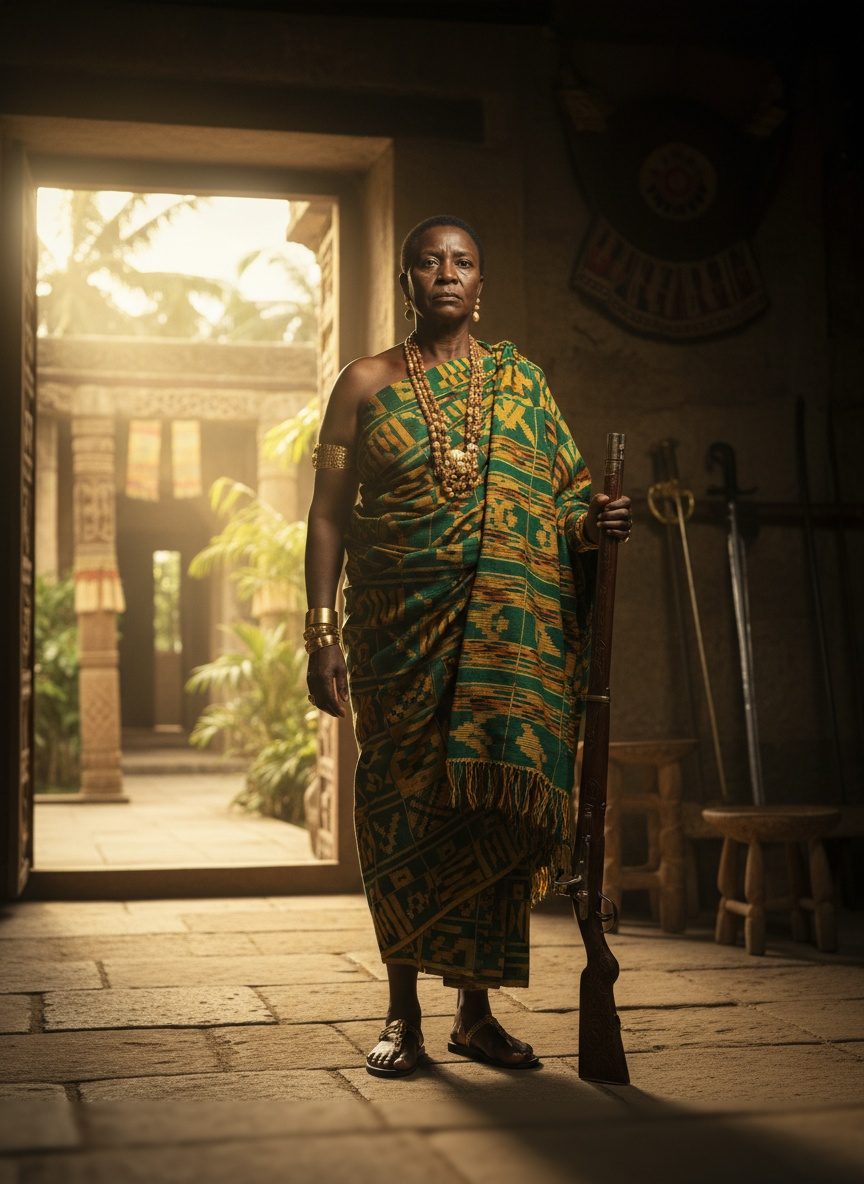
Amidst the whispers of compromise and capitulation, Queen Mother Yaa Asantewaa emerged as a lone pillar of defiance. Taking her place among the chiefs, she surveyed the men before declaring, “If the men of Asante will not go forward, then we, the women, will. I shall call upon my fellow women.” Her words, laden with power and defiance, cut through the silence like a thunderclap. The Queen Mother was more than just a symbolic figurehead; she was a seasoned leader and a farmer of exceptional skill who understood the land she was fighting for.
The impact of her address was instantaneous and electrifying. The doubt that had clouded the room began to dissipate, replaced by a flicker of hope and determination. Yaa Asantewaa would not let Asante kneel before the British demands. Her resolve was the spark needed to reignite the Asante spirit. She had appealed to the very soul of her people and tapped into a reservoir of resistance that lay dormant but not extinct.
In this pivotal moment, Yaa Asantewaa exemplified what resistance looked like—bold, fearless, and illuminating. She was more than a figure; she was a force, an embodiment of a nation’s unconquerable spirit.
The Woman Who Loaded the Rifle
Yaa Asantewaa’s resolve did not merely manifest in words but transformed into action that echoed across the conflict-ridden lands of Asante. Her intention was clear: to resist British domination and protect the rich cultural tapestry of her homeland. In an age where women rarely bore arms or led warriors, Yaa Asantewaa defied both tradition and expectation. Her rifle was not just a weapon; it was a symbol of unyielding will against colonial oppression.
The Asante kingdom was no stranger to military prowess; its warriors had tasted both the sweetness of victory and the bitterness of loss. But unlike previous conflicts with the British, this was a battle not only for territory but for the very essence of Asante identity. The dense West African forests, laden with the tropical melody of birds and the whisper of rustling leaves, would once again become the stage for a clash of empires. But this time, a formidable queen mother stood among the warriors, seasoned and resolute.
News of Yaa Asantewaa's undaunted resistance traveled beyond local borders and began to stir conversations across West Africa and beyond. While many expected the Asante Kingdom to falter in the face of a superior adversary, Yaa Asantewaa’s leadership painted a different picture. There was no underestimating the tenacity of a leader who had lived most of her life securing freedoms that some were too quick to give away. Her leadership was enough to rally the Asante people into a collective whole with a singular purpose: defense of their sovereignty.
As battles raged on, Yaa Asantewaa stood not merely as a participant but as a beacon. Her guidance was both tactical and symbolic, charging her people with the spirit of resilience. The rifle she raised was not just a tool of defense but a rallying cry for autonomy and liberation. British records of the time, often filled with hubris, found themselves compelled to acknowledge the resistance put forth by an Asante kingdom led by a woman of indomitable courage.
A Legacy of Defiance
The story of Yaa Asantewaa is not just one of resistance in the late Victorian era—it transcends time, continuing to inspire those who are told they must remain silent or complacent in the face of overpowering force. The Asante kingdom may have faced significant challenges during this tumultuous period, but the legacy of their queen mother lives on as an enduring testament to the power of fearless leadership and the struggle for self-determination.
Calling upon the depths of Asante culture, Yaa Asantewaa championed a cause larger than any single individual. Her refusal to bow to pressure symbolized the indelible resolve of a people carved from resilient roots. In the decades that followed, as colonies around the world fought for independence, the actions of Yaa Asantewaa reverberated through history as a reminder that one voice, fortified by resolve and courage, is capable of echoing across the corridors of time.
The story of Yaa Asantewaa speaks directly to a world teeming with challenges and complexities. It serves as a resonant reminder that, when found at the brink of suppression, the courage to stand—armed not just with weapons but with unwavering will—is often the greatest act of defiance. Her stand defined not just a moment in 1895 but a message of hope and resistance that continues to inspire generations. Yaa Asantewaa shows us that courage, even in its quietest form, can change the world.