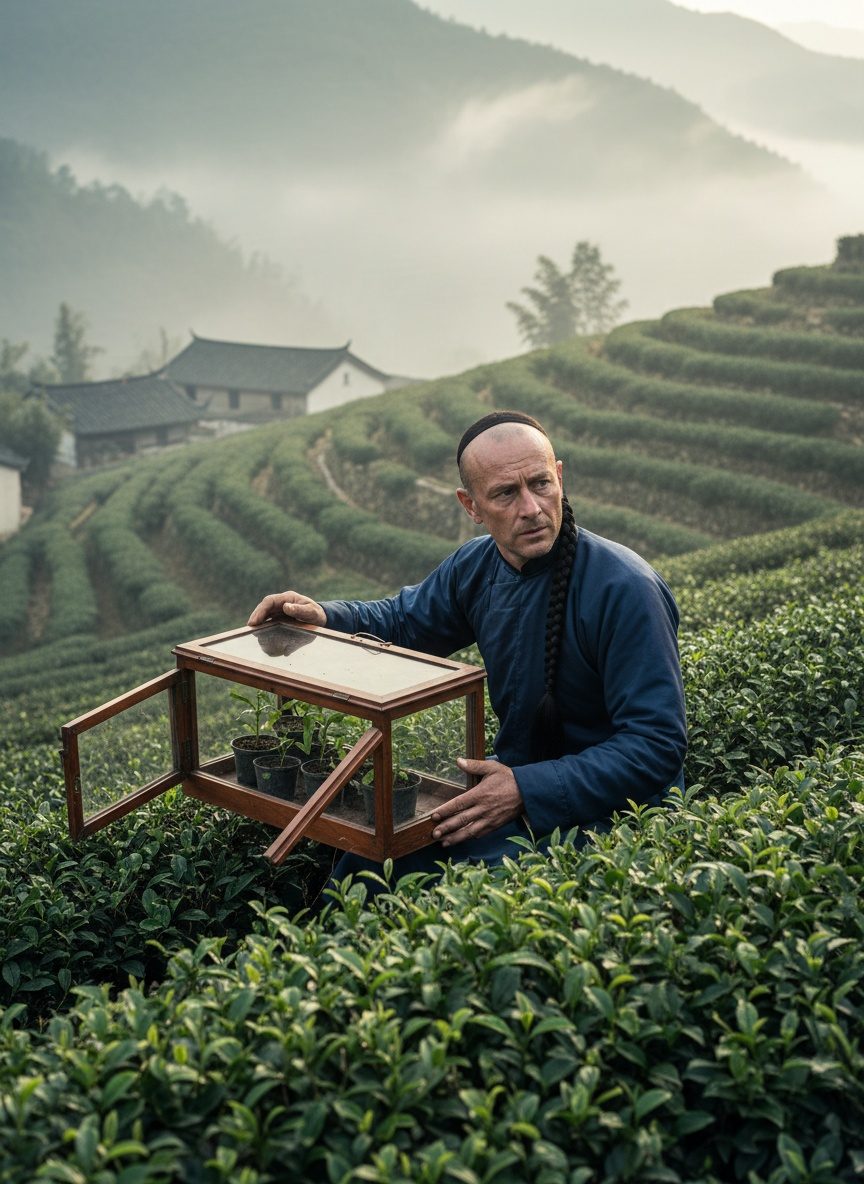
On an overcast morning in 1848, a determined Scottish botanist named Robert Fortune stood at the edge of the lush Chinese landscape, ready to embark on a journey that would forever alter the course of global commerce. Masked by the guise of a Chinese merchant, Fortune prepared to penetrate the veiled heart of an empire that had long concealed its greatest treasure — the secret of tea cultivation. His audacious mission led him into a world both mystical and fiercely guarded, culminating in an astonishing heist that would see the great British Empire sever the chains of dependency on China's monopoly of the tea trade.
Unlocking the Mystery of the Green Gold
The Qing Dynasty, lords over a vast realm in the mid-19th century, commanded not only immense lands but also the world's coveted supply of tea. For centuries, the tea trade with China enriched Eastern coffers, while European merchants were bound by their insatiable thirst for what was known as "green gold." By the time Fortune arrived, tea was not merely a beverage in Britain; it was a national obsession, penned into the rituals of everyday life. With the balance of trade firmly tilted in favor of China, Britain faced a quandary of financial dependency.
The East India Company, Britain’s commercial behemoth, audaciously decided to disrupt this monopoly — a task that required someone with botanical expertise and a gambler's nerve. Enter Robert Fortune, a horticulturist of repute and curiosity, already acquainted with the flora of the Orient. The mission was clear: extract the secrets of tea cultivation by infiltrating the most secluded regions of China. His adventure promised not just rich tales but transformative global impact.
The Disguise of a Lifetime
To evade detection in the close-knit villages, Fortune donned the attire of a traditional Chinese merchant, complete with shaven forehead and plaited pigtail. His disguise was meticulous, a testament to necessity and ingenuity in the age of imperial exploration. Guided by Chinese-speaking contacts, Fortune journeyed clandestinely across tea-growing provinces, notably Fujian and Jiangxi — territories zealously protected by the Qing’s edicts against foreign presence.
A key ally in Fortune's subterfuge was his Chinese servant, who acted as an interpreter and local liaison. Together, they gathered invaluable insights on the intricate processes of seed and plant cultivation, witnessing practices that had been held as Chinese imperial secrets for generations. For months, Fortune maneuvered past wary eyes, collecting samples and knowledge as he trekked the path of ill-disguised hospitality in a land leery of outsiders.
The Great Tea Heist
As Fortune navigated the swirling mists of the tea bushes, he understood that mere seeds would not secure the enterprise’s success — full-fledged plants were the key. Ingeniously, he packed terrariums known as "Wardian cases" with live tea plants to withstand the arduous journey back. By the time Fortune’s intrepid expedition reached completion, he transported approximately 20,000 plants and 17,000 seeds to British-controlled India — a horticultural coup de maître.
Back in Darjeeling, these botanical treasures found root in the fertile soils of a rising tea empire. The speedy acclimatization and eventual flourishing of the plants in India marked an end to the British economic stranglehold by the Chinese tea monopoly. The clandestine exploitation of knowledge, though unethical by modern standards, set the stage for an industrial crescendo in British-controlled regions spanning generations.
Ripple Effects Across the Empire
Robert Fortune's exploits transcended the realm of botanical studies. They effectively birthed the Indian tea industry, which would grow to become one of the largest global tea suppliers, rivaling China in production and exportation. Between 1851 and the turn of the century, tea cultivation burgeoned from hundreds of acres to hundreds of thousands, harmonizing with the imperial cadence of Britain’s voracious desire for self-sustainability.
With the bursting of China’s exclusive bubble, accompanying global shifts rapidly ensued. The transfer of tea's botanical secrets was a catalyst for Britain's industrial revolution in agriculture, sparking innovations that would ripple beyond tea to other cash crops. This irrevocably tied colonial India’s economy to Britain and shifted the dynamics of economic power, affecting geopolitics and trade patterns even beyond the Victorian era.
The Legacy of Fortune’s Fortune
Today, the legacy of Robert Fortune's daring undercover mission offers a lens through which to view the complexities of globalization, intellectual property, and ethical implications of intercultural exchanges. His story underscores an era where botanical espionage influenced empires, reminding us of the enduring power of plants to shape human narratives.
Contemporary readers, sipping their morning cup of tea, may take a moment to ponder the intricate web of historical contingencies that delivered their brew. Fortune's saga is more than a tale of scientific endeavor; it serves as a testament to human curiosity and the lengths to which we will go to make the unfamiliar known.
In the end, Robert Fortune's extraordinary journey into the heart of the Qing Dynasty is a story not just of botanical triumph but of a world in a state of perpetual discovery — intrinsically linked and continuously reshaped by the secrets we uncover and the legacies we leave behind.