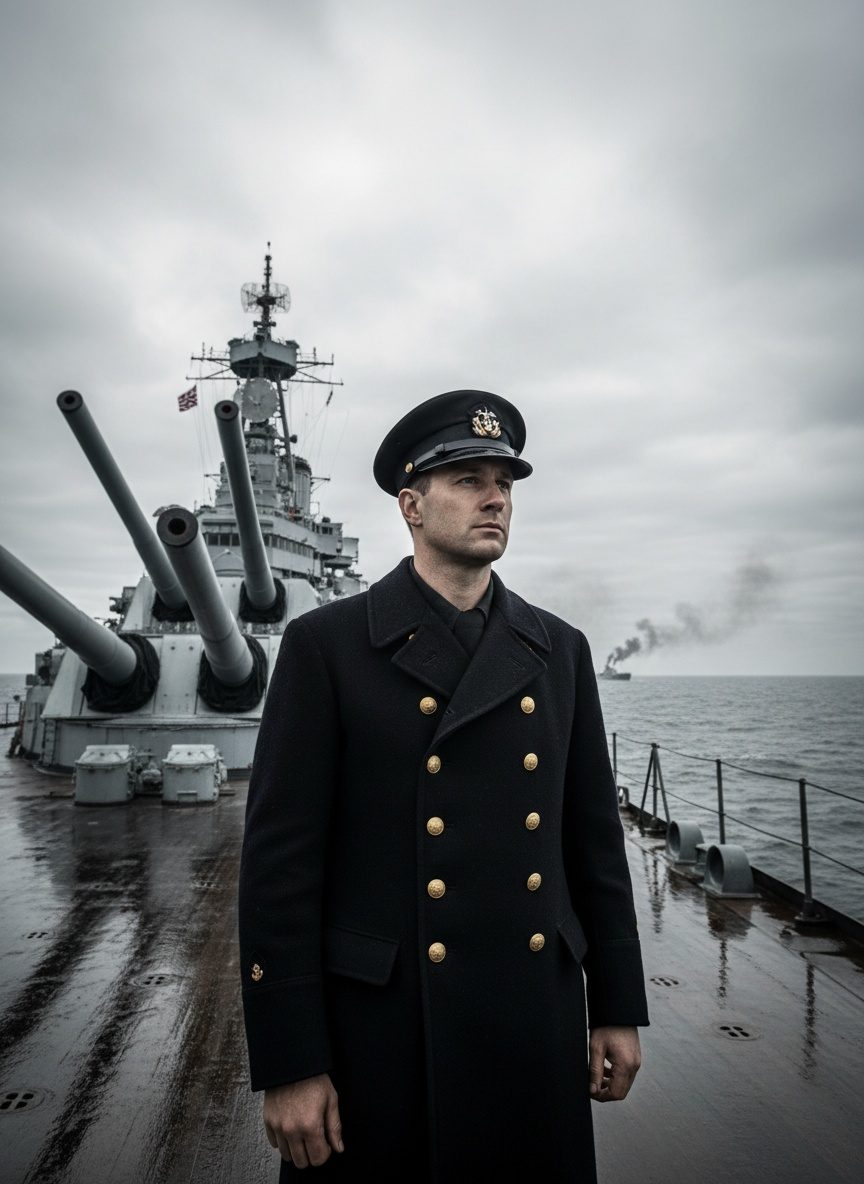
The USS Wisconsin suffered a blow during its service in the Korean War. But it was hardly the kind you’d expect would go down in history. Yet, it did, for reasons that go far beyond the scale of the damage inflicted.
On March 15, 1952, the formidable Iowa-class battleship USS Wisconsin was patrolling off the coast of Korea. With her crew of nearly 2,400 and 16-inch guns that could shoot projectiles weighing as much as 2,700 pounds over 20 miles, she was a floating fortress and a symbol of American naval power. But on this day, she was met with an unexpected and almost farcically inconsequential confrontation. Somewhere from the North Korean coast, an artillery shell found its mark — or rather, lightly grazed it. The shell hit Wisconsin, leaving behind what one might rather cynically call a smudge on her armor. Trivial damage did little to hinder the vessel’s mission or morale. However, if the North Koreans intended this as a display of defiance against the naval might of the United States, what followed was certainly not the outcome they anticipated.
The U.S. Navy's response to the hit was as theatrical as it was calculated. If the North Koreans intended to test the American resolve or elicit a show of strength, they succeeded. The USS Wisconsin turned the tables, responding not in the way a mere dent deserved, but with the full measure of might the situation permitted. Operating under the saying "speak softly and carry a big stick," the Navy decided this stick would roar across the coast. Wisconsin opened up with her 16-inch guns, unleashing a barrage that one could best describe as overkill with a purpose. Within moments, the coastline from which the shell had originated was lit up in an inferno of artillery mayhem, effectively turning a minor injury into a major tactical lesson on power projection.
There is something narratively irresistible about the image of a behemoth of a battleship firing its gargantuan complement of firepower in response to a minor threat. The USS Wisconsin’s volley that day was a show not only of force but also of psychological warfare. It broadcasted a message loud and clear: the U.S. Navy was not to be trifled with, and any hostile act, however small, could invoke monumental repercussions.
The incident became part of the ship’s lore, earning the nickname "The Last Battleship," in part for its legendary toughness and in part because battleships like Wisconsin were nearing the end of their era. Technology was evolving, with aircraft carriers and submarines taking over the roles once filled by the towering battleships. Nonetheless, on this day in 1952, that towering legacy unfurled once again. The USS Wisconsin exemplified the lesson of appearing larger than life, embodying the principles of intimidation and deterrence amid the evolving theater of war.
Yet, the story behind Wisconsin’s response is woven with more than just steel and gunpowder. It reflects a broader military approach that understands the theatre of war is as much psychological as it is physical. It posits that sometimes the reaction to an act is more significant than the act itself, shaping perceptions and setting the tone for engagement. This understanding was not born on the Korean peninsula but is a time-tested strategy that resonates through all of military history, from the ancient Greeks to the modern era.
As far as naval encounters go, Wisconsin’s skirmish with North Korean artillery on that March day might seem minor in the great tapestry of conflict. Yet, it highlights the immense complexity behind the NATO-led UN forces' operations during the Korean War. Every action carried weight, even when it appeared light as a feather. The simplicity of the incident belies the sophisticated layers of strategy and diplomacy at play. It’s a classic tale of making much ado about nothing yet achieving everything intended with that ado.
And so, the shell that hit the USS Wisconsin became more than a statistic in a logbook, transcending its physicality to become a story of brinksmanship, strategy, and human ingenuity. It is a narrative that paints a vivid image of a time when battleships like the Wisconsin reigned supreme on the waves, their steel hide barely ruffled by even the loudest diminutive of opposing shells. An encounter that captures the grandiosity of naval warfare and reflects on how, sometimes, perceived trivialities could usher in grand spectacles that define the turning points of strategy and history.
The tale of Wisconsin’s dramatic reply is not just a military footnote; it is a sharp reminder of the value of perception in warfare. In its meticulously calculated noise, the U.S. Navy managed, in a moment, to amplify a blurred line cast out of a gaunt tranquil sea into a vivid declaration cut clear across the geopolitical landscape. Today, as we face new challenges and ever-changing dynamics on the global stage, the story of the USS Wisconsin remains a subtle yet potent narrative, reminding us that the weight of power sometimes rests not just in action but in the shadow it casts.