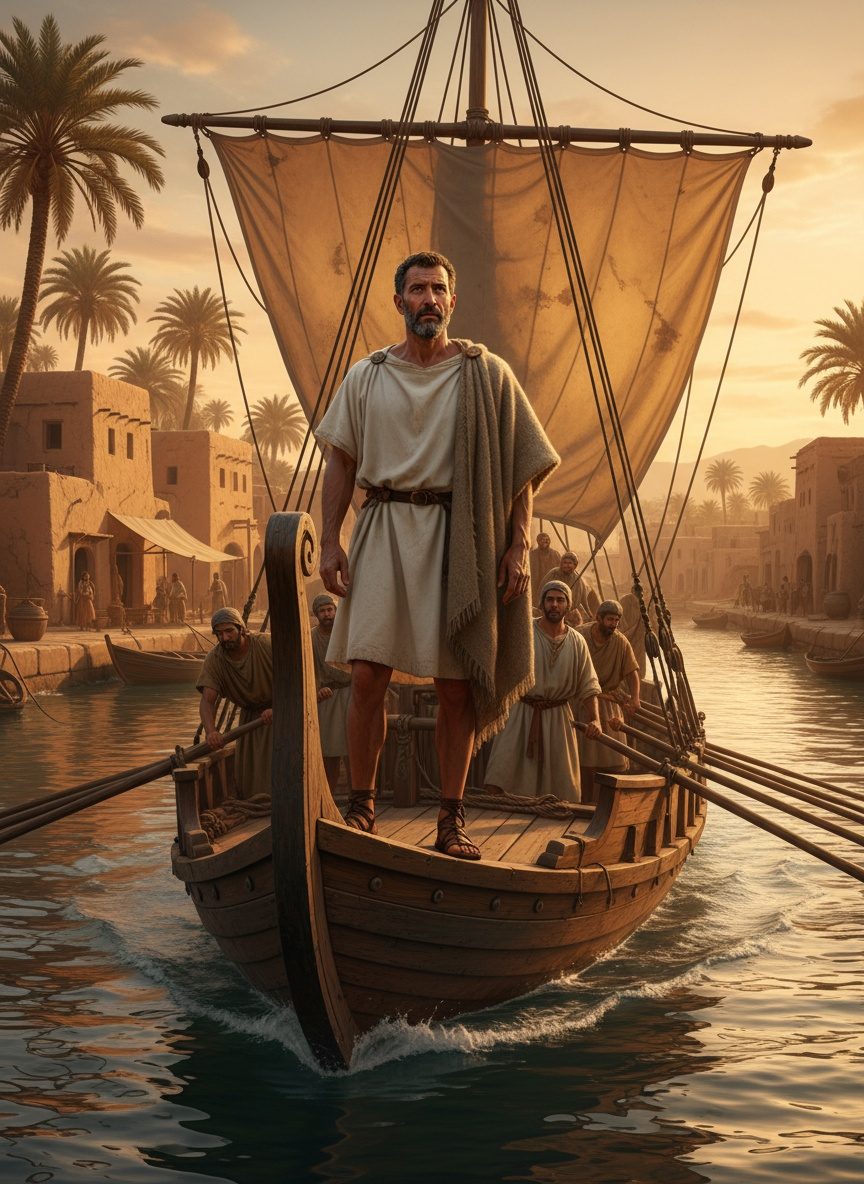
326 BCE. The air was stifling with the tang of salt and sun on the barren sands of Carmania, present-day southern Iran. The silence hung heavy over Alexander's sprawling camp, the unfamiliar stillness only occasionally punctuated by the distant cry of a seabird. Rifts and the unknown had swallowed the fleet sent by Alexander the Great. In its wake were whispers of doubts, of dread, that the waters had claimed yet more of their brethren.
Tales from the mouth of the Indus River to the embrace of the Persian Gulf had been shrouded in mystery. No Greek before had charted these unknown expanses, and yet, under orders from the great Macedonian king himself, Admiral Nearchus had ventured forth. His mission was to circumnavigate this vast, unseen ocean, to find passage where none had dared, through storms and tempests, through waters feared as the edge of the world.
It was an audacious command issued in 325 BCE, with Alexander himself immersed deep within the heart of India, a continent vast in land and legend. The division of the army meant that while Alexander would march inland, Nearchus would take to the sea with his fleet—a decision not devoid of criticism, for uncertainty loomed like an ominous specter. The Indus bore them away from familiar shores and into a world painted only in the stories of merchants and mariners.
Time stretched in the haze of those passing months. The fleet became lost to both land and lore, an absence that grew heavier with each dawn. Without maps to guide or tales to trace, drifting on tides and storms, the fleet was a captive of the elements. Supplies dwindled and morale ebbed with every passing day. What thoughts must have plagued the minds of those on board during perilous nights under uncharted skies? Would they fall prey to myths of monsters and misfortune that plagued the unknowing?
Those who had remained on land, their eyes ever out for ships on the horizon, often met with nothing but the unbroken stretch of sea. These missing men became ghosts among their own, a silent reminder of the empire's grasp, reaching further than any had dared imagine. Days bled into weeks, and weeks into months without word, without hope, yet the sea retained its secrets. What held the crew together during this trial? Was it the iron will imbued by Alexander’s vision or a simpler, more primal, hope of survival?
And then, as suddenly as they'd vanished, they reappeared. Nearchus strode into the camp as if stepping from the pages of a mythological epic. The pallor of exhaustion clung to him, his skin a testament to the searing sun and relentless salt, his figure worn by wind and wave. Yet, he was triumph personified—a man who had traversed the unthinkable and emerged triumphant, carrying with him tales that would ripple through history.
The reunion in Carmania was electric, almost celestial, as Alexander listened to tales of the ocean's fury and the resilience of mankind. Nearchus had indeed sailed the vast span from the Indus delta to the mouth of the Euphrates, threading the needle through the island chains and tempestuous channels of the Arabian Sea. His journey, fraught with starvation and shipwrecks, yet met with triumphant success, came as proof of human endurance and determination in the face of overwhelming odds.
This feat was not merely one of distance conquered, but one of domain extended. Nearchus came home victorious, his escapade fortifying Alexander's legacy even further, showcasing the reach of Greek influence across realms previously sealed to the west. Southeast Asia had begun to unveil its chimeric vistas to Greek minds, brimming with the promise of new territories and untapped resources, awaiting integration into the mosaic of the Hellenistic world.
Why did this seafaring saga matter amidst the grand canvas of history? It was a poignant reminder of the human spirit's capacity for adventure and exploration. In the wake of conquest, territory was not merely measured in land charted, but in knowledge acquired, fears conquered, horizons expanded. Nearchus’ journey testified to the notion that the boundaries of civilizations were not defined solely by the contours of continents, but by the courage to venture into the unknown.
This tale from antiquity is a testament that speaks to all who dare to chart new courses, who face the void of uncertainty with the determination to return with stories that enrich the tapestry of human experience. As the echoes of Nearchus’ voyage reverberate through time, they remind us that the essence of exploration lies not only in the lands discovered but in the limits of what we dare to dream and accomplish.