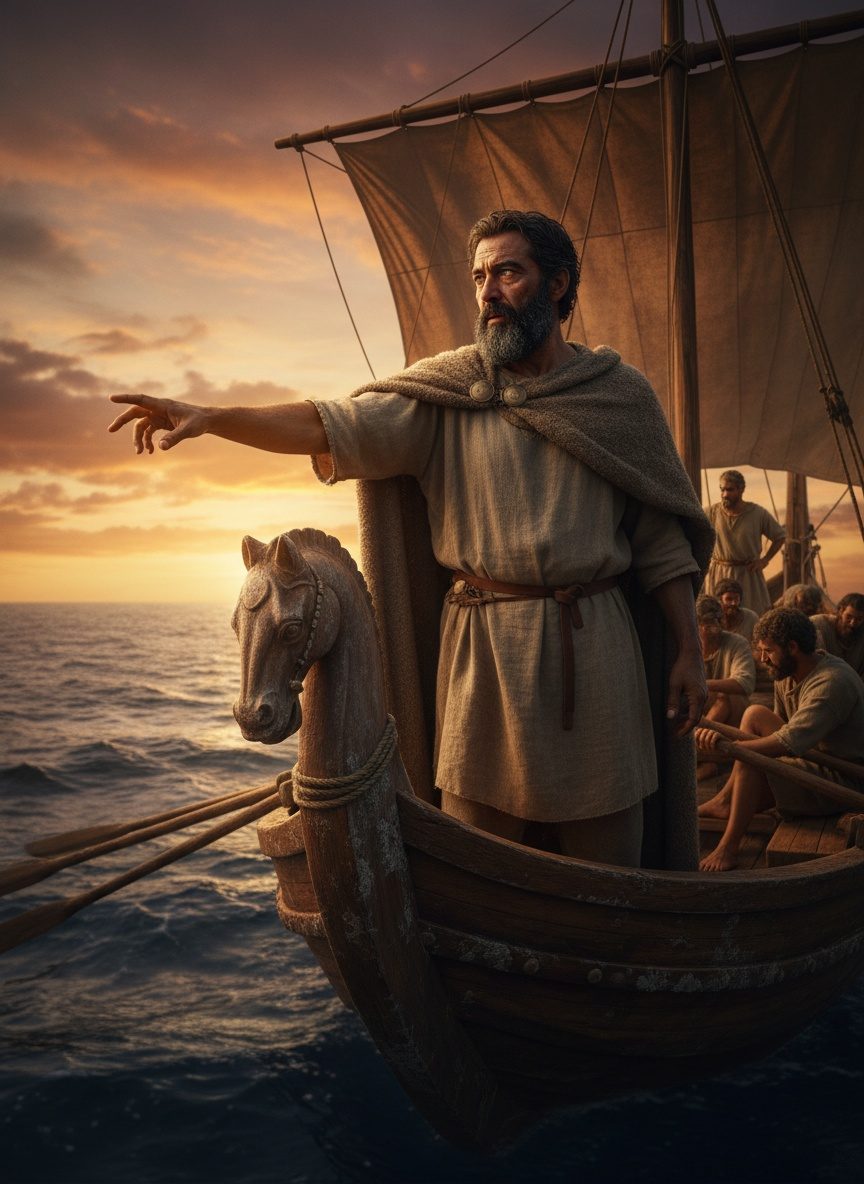
The air was heavy with the salty tang of the sea, a constant companion to the crews on the Phoenician fleet as they prepared to embark on a journey that would take them to the edges of the known world and beyond. The cries of gulls echoed under a sun already gathering strength for the day, casting long shadows on the bustling port of Egypt from which their epic voyage would begin. The waters of the Red Sea shimmered invitingly, but the horizons hinted at the unknown dangers that lay beyond. For these sailors, it was not just a voyage they were undertaking — it was a leap into a realm shrouded in mystery, teetering on the edge of impossibility. Their task was clear yet daunting: to circumnavigate the massive continent of Africa, a challenge no seafaring civilization had ever documented, spurred by the ambitious decree of Pharaoh Necho II.
In the context of the ancient world, where the ends of the earth were as much myth as they were cartography, the proposition seemed as intangible as it was daring. The Phoenicians, however, were not strangers to the allure and peril of uncharted waters. Renowned as the master mariners of the Mediterranean, their slender ships were the ocean's swiftest messengers. With sturdy cedar hulls and sails billowing like bird wings, they stole secrets from the wind and sea alike. Still, the magnitude of their mission was formidable. As they sailed southward, the lands grew ever distant, and their own language, once the melodic accompaniment to the sea shanties of the Mediterranean, faded in favor of the silent inhalation of distant, unnameable shores.
The fleet pressed onward, a quiet camaraderie amongst the crews growing deeper. As weeks turned into months, the infinite azure canopy above them spun its celestial patterns, guiding their voyage with starry signals that only the most seasoned souls could read. The deserts of Africa rolled away to reveal coasts teeming with exotic wildlife, vast stretches of uninterrupted sands, and towering mountain ranges rising starkly against the relentless blue sky. Yet, perhaps the most astonishing aspect of their travel lay not in the geography they traversed, but in the course of the sun that journeyed with them.
As they navigated the expansive southern arc of the continent, the phenomenon that confounded minds upon their return slowly revealed itself — the sun appeared on their right side as they sailed west. For those aboard, it was a silent witness to the unseen, inexplicable changes at play. It suggested a world larger than any previously conceived, one where the known rules of navigation and the heavens bent. It was the kind of revelation that burned brightly in the consciousness of those who had ever ventured beyond, a secret kept close to the chest and revealed in awed whispers.
Three years carved their mark into the faces of the sailors and the hulls of their ships. Time had weathered them in the manner of all great explorers. When their vessels crested the familiar waves of the Mediterranean once again, they bore stories more fantastical than the spun silk and rare ivory they had traded for along the African coasts. Their return was not met with the expected acclamation but with skepticism that bordered on disbelief. Theirs was no ordinary tale, after all, but one which challenged foundational understanding. Could it be true? A single continent that harbored both sun-drenched deserts and lush, forgotten shores, that stretched the entirety of what was then an unimaginable breadth?
The ancient world had always held its own secrets, both hidden and revealed in equal measure by those daring enough to seek them. The skeptics who gathered to hear the sailors' story might scorn their testimony, but the mariners knew what they had seen. A sun that had slipped to their right marked the greatest proof of their odyssey — a celestial confirmation that their voyage had bent the bounds of imagination and remapped the edges of the earth itself.
In attempting to circumnavigate the mysterious continent of Africa, the Phoenician fleet had done more than complete an astonishing mission; they had provided inklings of a globality that would not be fully realized or accepted for centuries. Amid fresh skepticism, their accounts sparked interest among geographers and rulers alike, those whose minds lingered over the possibility of lands and peoples yet unknown. It seems unfathomable today to grasp just how groundbreaking it was for these ancient sailors to conceive of such a voyage and to complete it with such detailing of their fantastic discovery.
This Phoenician circumnavigation provokes the contemplation of all unraveled mysteries, of seas crossed, and lands discovered. It serves as an enduring reminder of humanity's insatiable urge to venture forth and seek out realms unimagined. In this ancient feat of maritime endeavor, we glimpse the spirit that would drive future generations of explorers to stretch the horizons yet further and challenge the confines of their worlds. Such revelations hold the promise and peril of redefined frontiers. It is in these daring stories, whispered among wooden decks and charted by starlight, that we find the eternal flames of curiosity and exploration which continue to shape the nations and perceptions of our world today.