The chill of a damp English evening clung to the cobblestones of a Birmingham street, muted whispers of a day's bustle finally hushed. Gas lamps flickered feebly against the encroaching night, casting long shadows over the huddled figure of shopkeepers sliding through the streets, carriage drivers curving their crooked paths home, and clerks slipping unnoticed from teeming office blocks. As they trudged toward a common meeting spot — the local drill hall, repurposed but hardly refurbished — the undercurrent of apprehension threaded through the air like a fine mist. While most of Britain drifted into the half-consciousness of sleep, these men of ordinary trade quietly transformed under the emerging stars, preparing for the night’s unofficial yet fervent vigilance.
The Rise of the Riflemen
Around tables cluttered with paperwork and balance sheets, across counters shaded by awnings, and within classrooms echoing with idle chatter, a nervous tremor coursed through 1859 Britain. The French invasion scare, a haunting possibility whispered from Dover to Edinburgh, had unsettled the Victorian peace. Yet no decrees from Queen or Parliament, those pinnacles of British governance, seemed forthcoming. Instead, it was the everyday citizens — laborers, shopkeepers, teachers — who felt the urgent pulse of action beat beneath their skin. As days waned and city streets were muted into repose, these men harnessed a truth: preparedness was the province of every man.
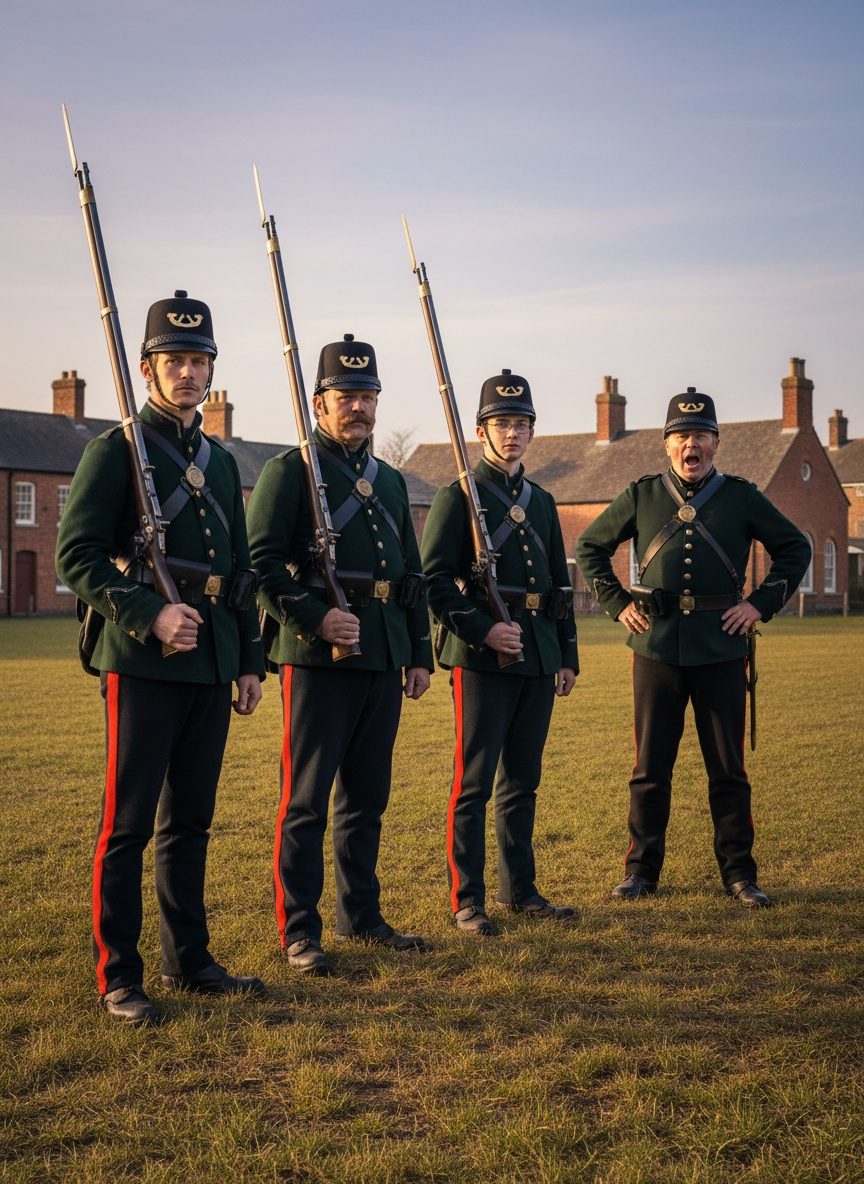
Gradually, the voluntary rifle corps burgeoned from this grassroots groundswell. Across the country, men grouped by hundreds into rifle corps, dotting the landscape from pastoral villages to industrial towns. Birmingham hosted one such corps, its members gathering weekly to train. On weekends, participants in makeshift uniforms, their trousers hastily dyed and boots repurposed from workday wear, assembled in public fields. Their training comprised drills steeped in precision, the rhythmic clatter of boots on dirt punctuated by barked commands. Yet it wasn't just the sharp aim or the cadence of training they honed; it was the emergence of a camaraderie bred not of allegiance to crown but of shared purpose and community resilience.
This nascent volunteer force, scattering light against the specter of invasion, was a peculiar anomaly in British history — one propelled not by governmental edict, but by a citizenry resolved not to stand idly by. Yet no fanfare greeted their efforts. Aside from a gentle nod in the local newspapers, the government remained a phantom presence, offering neither sanction nor support. Thus persisted a paradox: a burgeoning volunteer force, at its zenith numbering 160,000 strong, who would step into the breach when no official body had mobilized to meet it.
Drills and Discipline
As the Volunteer Force expanded, a typical drill evening offered an unusual spectacle. In the lantern-lit dusk, riflemen — fathers, brothers, and sons — converged in open fields and town squares. The volunteers practiced tirelessly. Buildings once considered barns or municipal extenders reverberated with shouts, their interiors transformed by lines of men, rifles at the ready, following the insistent cries of makeshift officers who were as much teachers as they were students in the trade of war.
The shadowy figures practiced with dedication rivaling any professional regiment, their drills characterized by intense repetition. Volunteers honed not only their marksmanship but also strategic formations — advancing, retreating, positioning as a unified whole. Through searing cold and summer sweat, they stood resolute. Generals did not command this discipline; it arose purely from an innate demand for readiness, burning unmistakably in their veins.
The sight was not lost on their countrymen peering through windows and walking past, many of whom viewed these endeavors as both curious and commendable. These civilians donned uniforms, their exterior simple and often tattered but rich with an inner armor of purpose. They mimicked battleground tactics alongside familiar civilian routines — daytime commerce melding into nighttime custodianship. As dusk deepened into night, riflemen returned home — some to slumber, others to the remainder of night shifts — carrying forth the profound truth that national defense had transcended the purview of nobility.
Invisible by Choice
In this juxtaposition of civilian life with martial diligence, the volunteers crafted a legacy less visible than that of conventional soldiers. What began as an amalgamation of professions, united merely by a collective dread, evolved into a movement driven by commitment and ingenuity. The men’s dedication knew no official acknowledgment, yet their contribution bore the weight of a nation’s subconscious sigh of relief. They remained an organic sentry, an ever-watchful entity that garnered collective assurance — albeit from the shadows.
The Volunteer Force’s story lay dormant in the recesses of history, issuing no grand proclamations nor soliciting emphatic citations. Over time, their formations would fuse into more formal military organizations, their origins obscured by evolutions and institutional memories. By the turn of the century, as victorian society relaxed beneath the arc of a sprawling empire, the torch borne by these volunteers flickered quietly into new hands.
Yet this tale resonates even today. It serves as an unintentional reminder of the civilian spirit — of a determination uncomplicated by officiousness, defined not by title but by resilience. The civilian soldiers who drilled while Britain slept etched an understated legacy, underscoring how ordinary individuals, in times of uncertainty, can mold extraordinary paths. It asks of us today: in times of dormant threat or imminent peril, how might the quiet readiness of a collective stand prepared to emerge once more?