August 24, 79 AD. A massive column of ash darkened the sky.
The Day the Mountain Spoke
On that fateful day, the bustling towns surrounding Mount Vesuvius, nestled comfortably near the serene Neapolitan Bay, experienced something unprecedented. The sky, once azure, thickened with a rising black plume, transforming day into night. Below this ominous fissure occurred an unfolding catastrophe of epic proportions, yet it was in the town of Herculaneum, less famed than its neighbor Pompeii, where an enigmatic relic of the past became sealed into history.
The Villa of the Papyri lay in the path of the volcanic onslaught. Owned by the father-in-law of Julius Caesar, this grand villa housed a luxurious collection fit for the most discerning of Roman intellectuals. As Vesuvius erupted violently, cremating the town below, the villa was entombed beneath layers of volcanic debris, much of its grandeur preserved — including its extraordinary library. A silent monument to what would become known as one of the most remarkable collections of ancient literature.
The Bookworms' Dilemma: Charred and Forgotten
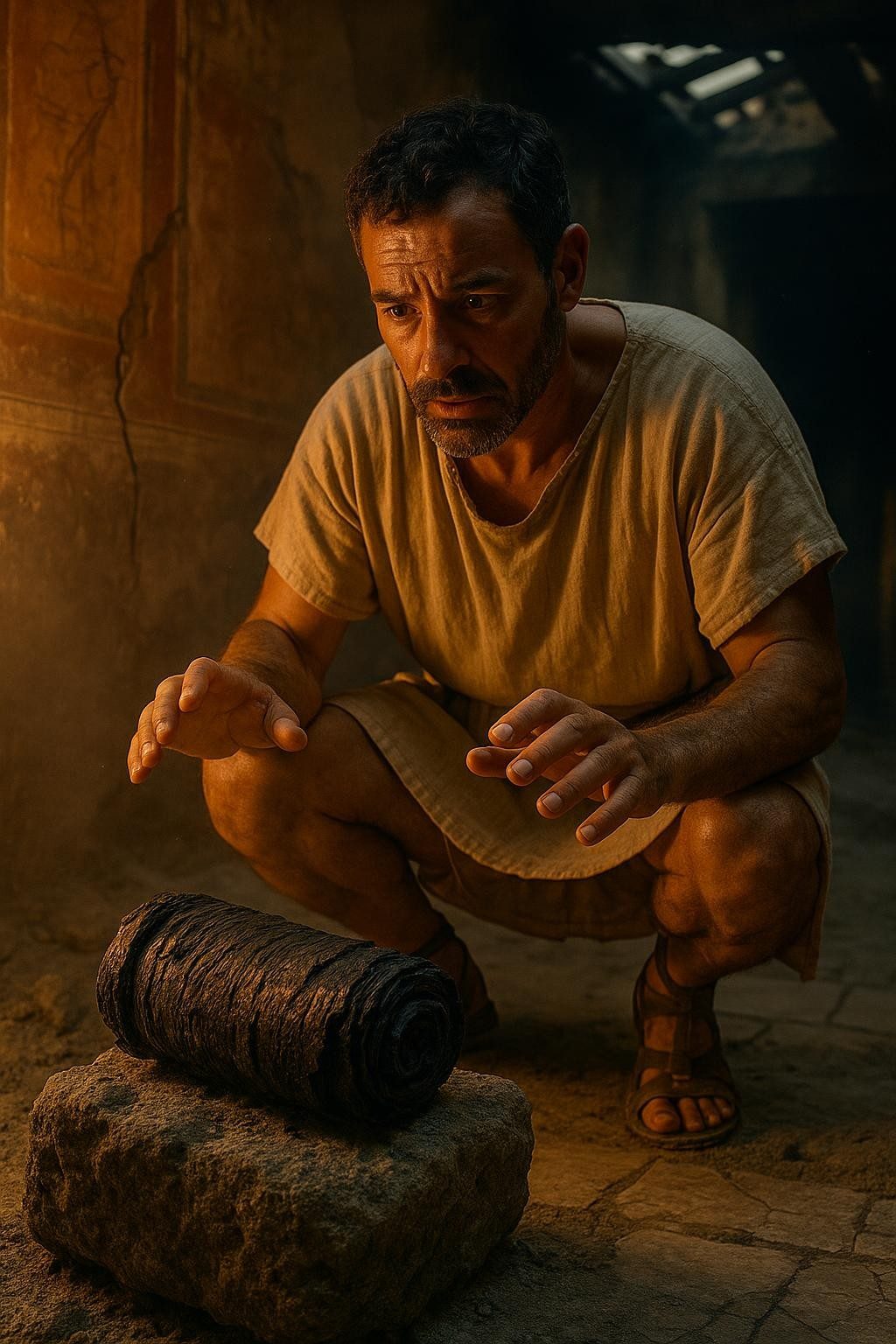
When explorers in the 18th century unearthed the lost villa, they found their way into the forgotten world of Herculaneum — along with its precious library. Initially, the charcoal-like remnants of scrolls brought excitement, revealing promises of lost Greek philosophy, history, and poetry. But herein lay the scholars’ dilemma; the scrolls, fragile from the fiery crucible, disintegrated at the slightest touch. What once were rolls of papyrus perished in an instant, leaving academia with nothing but piles of ash and the ghosts of ancient thought.
For centuries subsequent, students of antiquity could do little but mourn the unread words that eluded them. Not for lack of trying; countless attempts to unroll, open, or even micro-crack the scrolls only resulted in further ruin. Some audacious scholars even tried dissolving parts of the scrolls using various chemical concoctions, hoping to uncover what was written without totally destroying the artifact. The scientific folly left few successes — the words stubbornly remained a mystery.
Reading as the Gods: The Machine of Light
In an era defined by technological capability, where space-age technologies feed our most imaginative dreams, the unremarkable and crumbled remains of the Herculaneum scrolls met a new form of discovery. Techniques born of astrophysics, intended for probing distant galaxies, turned their gaze back home. Enter the non-invasive eye of the X-ray, specifically, a type of imaging known as X-ray phase contrast tomography.
This method, originally devised to delve into the secrets of the stars, could read jet-black scrolls without unrolling them, scanning layer by layer with meticulous precision. Without so much as lifting a fragile corner, researchers were able to witness the shadows of ink, resting invisibly atop the carbonized papyrus, rendered into legible text lines. This ground-breaking technique has since decoded fragments of words, names, and philosophies long thought obliterated — a lexicon resurrected after two millennia.
The Silent Rediscovery: Words Meant to Endure
Among the detached words gleamed the name "Philodemus," a once-lauded philosopher associated with the Epicurean school of thought. His ideas bridged gaps between philosophy and poetry, opening windows to ancient intellectual discourse. The scrolls bore his works, virtually unknown in modern times, nudging the world closer to understanding Roman intellectual life, once thriving in the shadows of an erupting Vesuvius.
These scrolls also served as a time capsule, providing insight into the aesthetics, culture, and sophistication of the library owners. Unique scribal practices, specific writing styles, and the selection of manuscripts offered a glimpse into the minds at the heart of literary and philosophical conversation of their era. What might have been lost to antiquity, erased by nature’s zeal, once more danced into the light of understanding, re-etching Roman antiquity’s intellectual pursuits into the fabric of history.
The Echo of a Buried World
The rediscovery of the Herculaneum scrolls is a tale wrapped in chance and perseverance, narrated by existential curiosity and propelled by cutting-edge science. These scrolls do more than reveal what the ancients knew; they allow us to engage with the philosophers and poets on their own terms. This rediscovery has not only deepened our comprehension of ancient writing but has outstripped the idea that technology and tradition are at odds. Instead, the story of the scrolls showcases the symbiosis between the past and the present.
It is a profound reminder of the unpredictable nature of preservation: how something intended to be read and engaged with for millennia became extinct yet, against odds, was reclaimed by the ingenuity of modernity. Perhaps within these scrolls lie further secrets — ones yet untold, ideas waiting at wisdom’s gate — reminding us that history is not a mere shadow smothered by time, but a living dialogue with those who came before us.