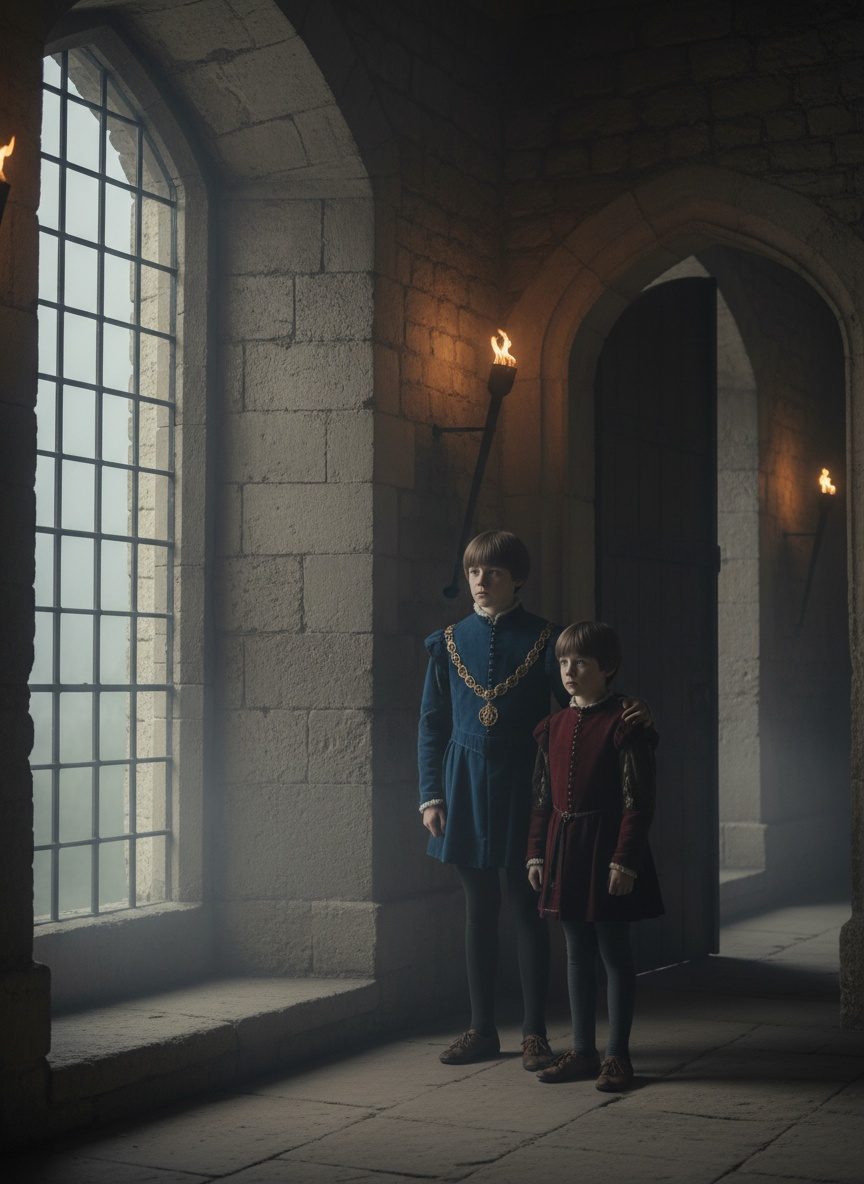
The heavy wooden doors creaked ominously as they swung open, revealing a dimly lit chamber within the Tower of London. The air was thick with foreboding, and the sound of soft whispers bounced off the cold stone walls. Outside, the city of London teemed with life, yet within these walls, time seemed to stand still. Twelve-year-old King Edward V and his nine-year-old brother Richard, Duke of York, were escorted into this fortress, never to be seen again beyond these forbidding ramparts. The footsteps of the guards echoed into oblivion, and soon, the two young boys disappeared into the shadows of history, leaving behind one of Britain's most enduring mysteries.
The Tower of London's Unyielding Silence
The majestic Tower of London, constructed originally by William the Conqueror, served as a symbol of royal power, but its thick walls also concealed the secrets of state and the bloodstained intrigues of court life. In early summer 1483, the tower was a place of perceived safety for the young princes, yet it became their final known abode. The Tower was both a palace and a prison, a paradox that played out in its silent corridors. The boys were seen playing happily on the grounds, clad in the finery befitting their royal station, laughing and unaware of the peril that surrounded them. Yet the smiles of children too soon disappeared, echoing amidst the heinous schemes possibly unfolding beyond their understanding.
Despite the Tower’s walls remaining unchanged, the whispers of betrayal and ambition crept outside. The power struggle within the royal family was palpable, and the young boys were caught in its deadly web. Edward V, barely given the chance to understand the weight of the crown, found himself entangled in the political machinations that would seal his fate. The Duke of York followed closely in his brother’s shadow, both bound together not just by blood, but by a shared destiny that would see them vanish into legend. History reports no screams, no cries for help; the Tower held its secrets close.
A Throne in Turmoil
While the Tower stood immovable, the power dynamics of England teetered on a knife's edge. The ascent of their uncle, Richard, Duke of Gloucester, to the throne marked a dramatic turn in the landscape of royal succession. Richard’s claim to the throne was supported by allegations questioning the legitimacy of the princes, a claim that set off a cascade of political recalibrations. Little did those boys know that their very existence posed a threat capable of altering the realm’s future.
Edward V and his brother's plight held the court in suspenseful anticipation and hushed discussions. Speculation ran rampant, yet no firm evidence emerged to clarify their fate. The boys disappeared from public memory as quickly as they had entered its consciousness. The silence surrounding their disappearance was deafening. Official accounts failed to provide answers, and the fate of the princes became the stuff of whispers rather than proclamations. Did they meet a grim end within the Tower, or were they spirited away under the cover of night? Five centuries of inquiry yield no certain knowledge.
Richard of Gloucester, crowned Richard III, ruled for only two turbulent years before meeting his own end at the Battle of Bosworth. His death marked not just the fall of a king but the close of the War of the Roses era. The vanishing of the princes continued to linger, a ghost haunting his reign, casting shadows over his rule. The mystery brewing since summer 1483 has become an enduring enigma, perpetuating the debate among scholars and enthusiasts.
Echoes Through Time
Centuries later, the grisly siren of potential discovery continues to call out. Excavations at the Tower have introduced new possibilities, but no definitive answers. The missing chapter in the story of the princes transcends their era, resonating with the courtrooms and archives of later years. The chilling account of their disappearance is a testament to both the fragility of young lives trapped in political strife and the enduring allure of historical enigmas.
The emotional undercurrent flows persistently through each retelling, making the mystery of the princes a tantalizing topic for historians, forensic scientists, and novelists alike. The lack of resolution allows the imagination to soar unchecked, constructing explanations that nod to human power's capacity for both benevolence and malevolence. Tellingly, no royal decree or historical document dispels the fog of secrecy enveloping their fateful stay at the Tower. It's a silence that has withstood generations, the echo of their absence whispering through the ages.
Today, the tale of the lost princes continues to capture the public's attention, fueling speculations and sparking the passions of those who seek to untangle the web of history in pursuit of truth. As visitors amble through the cobbled stones of the Tower of London, they are touched by the ghosts of the past, the laughter of two young boys frozen in time, and the unyielding mystery that remains at the heart of England's narrative. The facts may elude, but the importance of their story lies in its ability to remind us of the limits of power and the silenced voices, eternally echoing through history, forever young in the annals of intrigue.