Most people have never heard of Charles Brasseur de Bourbourg. They really should have.
The Manuscript at the British Museum
In the heart of Victorian London, under the grim specters of soot-stained skies and the relentless drone of industrial progress, a different sort of discovery was waiting to unfold. Tucked away in the bowels of the British Museum, a particular manuscript lay steadfast in its silence. It was a crumbling Maya codex, its pages teeming with glyphs that whispered tales of a bygone civilization — one no living soul could read. It became a focal point of tantalizing mystery amid the imperial grandeur of the age, a testament to a time when the New World pulsated with life, cities rose like stone titans from the jungle floor, and gods danced in the imaginations of their scribes.
Enter Charles Brasseur de Bourbourg, a man more persistent than the jungle itself. A French priest turned adventurer, Brasseur de Bourbourg was no stranger to the mysteries of Mesoamerica. His fervor was fueled by an insatiable curiosity and a profound respect for the cultures lost beneath the weight of history and colonial conquest. For years, he immersed himself in the language and legends of the indigenous people, combing the tangled threads of their past. Little did the world know that it would be this solitary figure, seemingly drawn from the pages of a Gothic novel, who would breach the walls of silence surrounding the Maya script.
The painstaking work required dedication bordering on obsession. Within the hushed confines of dusty libraries, Brasseur de Bourbourg embarked on a journey inward, into the labyrinthine curls and twists of the Maya hieroglyphs. His breakthrough moment came when he discovered the Popol Vuh — a sacred text of the K'iche' Maya, which unlocked the linguistic doorways he'd toiled so long to open. It was a revelation of such magnitude that it rekindled the flames of interest in a civilization thought lost to the ages. His work, part chance and part brilliance, became the Rosetta Stone for all Maya studies to follow.
Into the Jungle with Alfred Maudslay
Enter Alfred Maudslay, a British diplomat turned pioneering explorer who would take Brasseur de Bourbourg’s work and catapult it into the heart of the civilization it once described. His journey began in the 1860s, a time when tropical disease and impenetrable jungle stood sentinel against even the most intrepid adventurers. But Maudslay was undeterred. With Brasseur's translations and a heavy camera in tow, he voyaged toward the mysterious ruins buried deep in the shadows of Central America.
The trip into the dense thickets of the unknown was no mere expedition; it was a romantic endeavor to resurrect the greatness of the Maya. Maudslay saw himself not just as a discoverer but as a caretaker for the story of a people whose voices had been muffled by the jungle's relentless embrace. The journey itself was treacherous and filled with the cacophony of the wild — screeching howler monkeys and the brush of unseen wings through the canopy. Despite the oppressive heat and lurking threats of rainforest denizens, Maudslay was relentless.
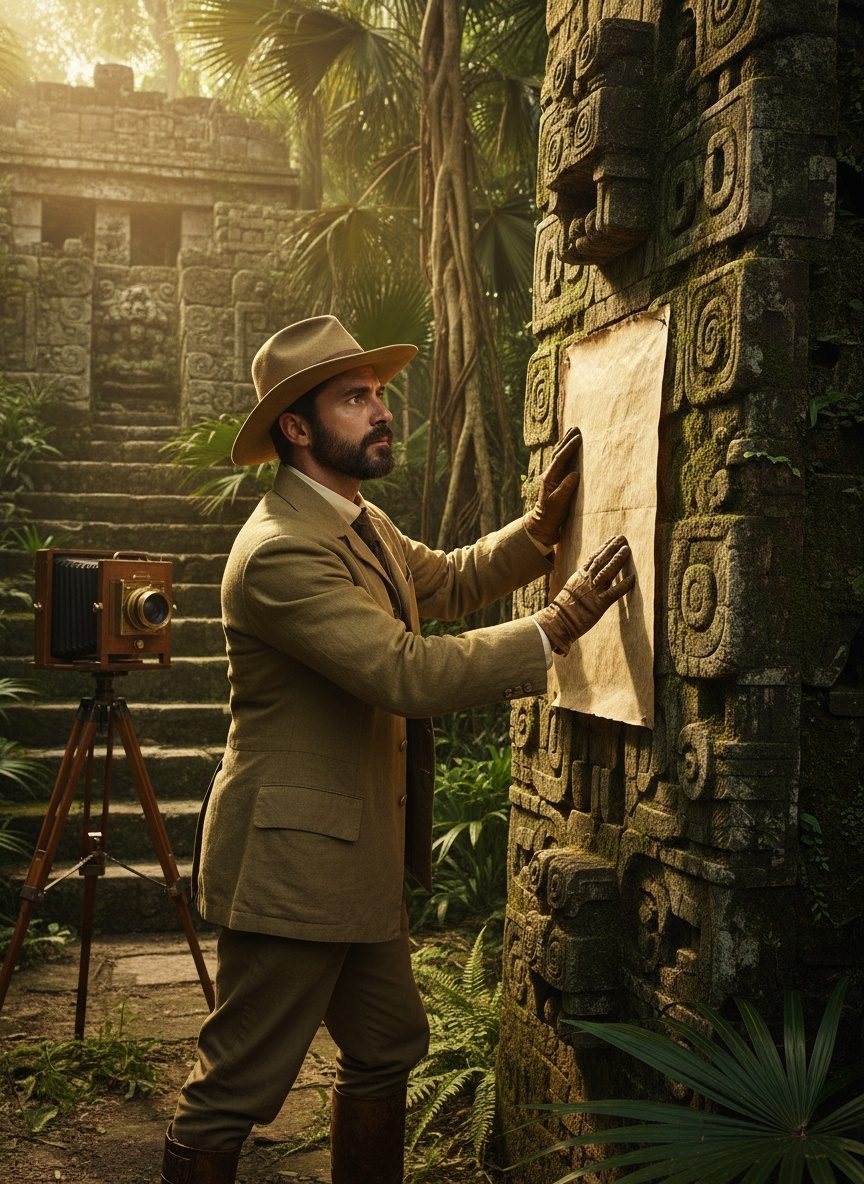
At the base of these crumbling stone giants, he worked laboriously, capturing detailed paper casts, snapping photographs framed by the massive carved glyphs, and tracing the faded lines of what he knew were stories grand as nation's legends. His meticulous cataloging and vivid accounts laid bare the magnificence of a civilization that had long been shrouded in mystery. The moment his photographs reached London, the Maya were no longer spectral echoes in forgotten manuscripts. They were a civilization vibrant and alive, replete with astronomers, mathematicians, and architects who had once built cities that flourished under a canopy that promised both life and death.
The Web of Rediscovery
The rediscovery of the Maya was not just an academic triumph; it was a watershed moment in understanding the complex tapestry of human history. The work of Charles Brasseur de Bourbourg and Alfred Maudslay illuminated the world with a past rich in cultural and technological achievements that rivaled those of Egypt or Greece. For the first time, the stories of kings and queens, their historical triumphs and defeats, and their celestial calendars drawn with such precision, came alive, altering the scholarly landscape forever.
But beyond historical script work and crumbling temples, this moment marked a turning point in the broader narrative of archaeology and anthropology. It reminded the world that history is not fixed in the foundations of Europe and the Near East; indeed, its stones are scattered realm-wide, hidden beneath foreign, and sometimes, unimaginable climes. It beckoned explorers and scholars to redirect their gazes, take heed of the lands and cultures obliterated by colonial few, and consider the broader expanse of human endeavor.
This collaborative, though time-staggered, achievement of Brasseur de Bourbourg and Maudslay was a crucial step toward globalizing our understanding of history. Through their extraordinary efforts, the Maya civilization was no longer an enigma. Their story stood testament to the resilience and achievements of the indigenous people of the Americas, whose contributions to the human saga have always been profound, yet often obscured. The tale serves as a poignant reminder that our shared history is as complex and layered as the dense jungles that once swallowed cities whole and returned them to light once more. It is a story of rediscovery that continues to resonate, compounding its importance with each retelling. The silence was broken, the stories emerged, and history whispered anew. It asks every generation to listen, to search, and never to forget what once was, and what wonders may lay yet undiscovered.