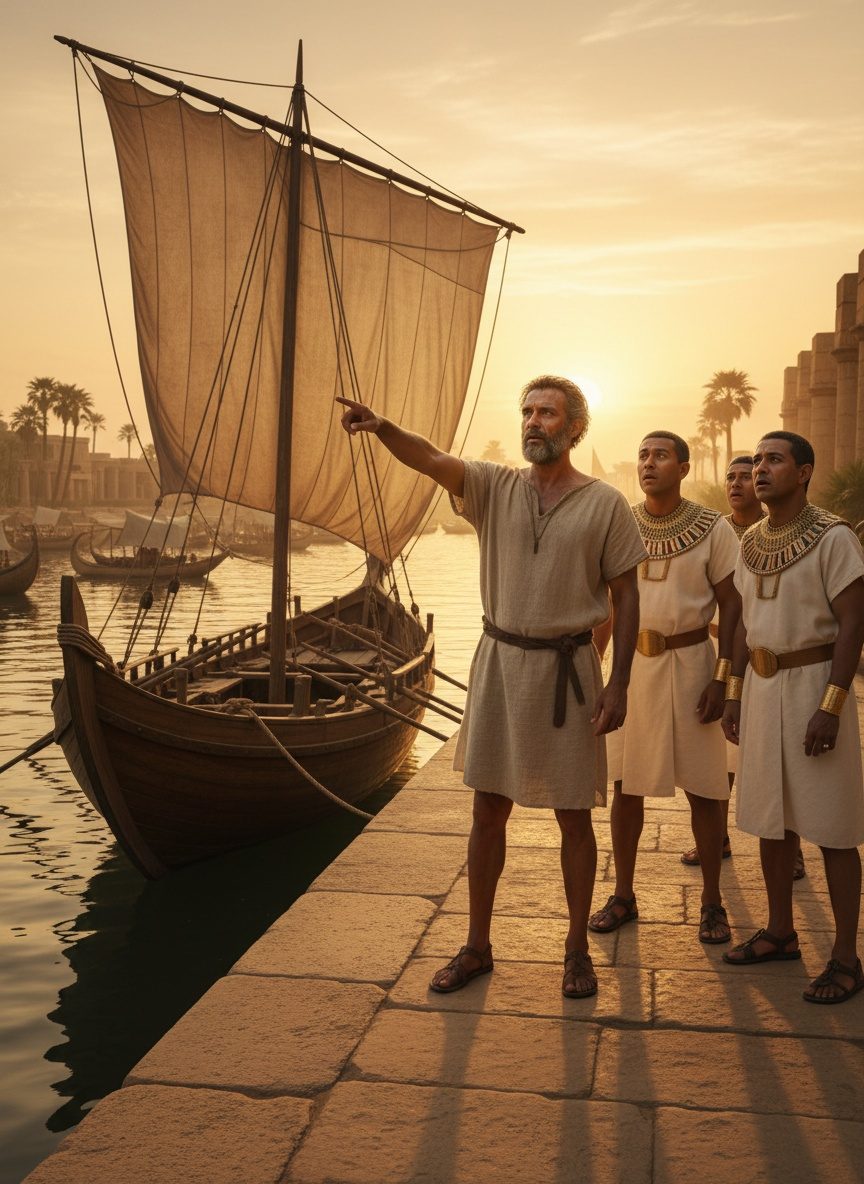
Most believed no one had ever circumnavigated Africa. But then a Phoenician fleet returned and dared to profess they had.
The Ambitious Pharaoh and a Daring Plan
Ancient Egypt, around 600 BCE, was a world of mysteries and ambitions. As Pharaoh Necho II looked upon his kingdom, he dreamt of securing trade dominance and expanding his empire's knowledge of the vast, unexplored world. His gaze turned south, towards the endless expanse of Africa, and contemplated a feat that seemed impossible: circumnavigating the continent.
It was a task that required not just ambition, but the expertise of the most adept seafarers of the age — the Phoenicians. Renowned for their mastery over the seas and their exceptional boat-building skills, the Phoenicians were the logical choice for this hazardous venture. Necho II's collaboration with them was not just a gesture of diplomacy but a declaration of faith in their unmatched navigational prowess.
Into the Uncharted Waters
Setting sail southwards, the fleet embarked on a journey that would test their limits and challenge their resolve. The expedition carried the hopes of a new sea route that could link the Eastern Mediterranean to untapped markets and unknown territories. But beyond trade, there lay the promise of an unparalleled achievement in human exploration.
The Phoenician vessels, elegant and robust, cut through the azure waters with determination. While ancient accounts are sparse, the image of these adventurers, their faces weather-beaten and spirits undeterred, emerges vividly. They sailed south along the eastern coast of Africa, experiencing the rhythmic ebbs and flows of the ocean and the gentle sway of the trade winds.
The Southernmost Mystery
As the fleet journeyed onward, the sailors faced the formidable challenge of rounding the Cape of Good Hope — a feat unheard of until then. This southern tip of Africa held its own secrets, a juxtaposition of terror and wonder. As they rounded this distant promontory, they found themselves in the Southern Hemisphere, a region unfamiliar to Mediterranean mariners.
It was here that the most curious observation was recorded. To the Phoenician sailors, the sun's path across the sky defied everything they knew. The sun appeared on the right side of their vessels as they voyaged westward. This detail, so incredulous to ancient scholars, stood as proof to later generations that these mariners had indeed ventured into the realm where the antipodal sun reigned.
The Long Voyage Home
Three years after their departure, as the Mediterranean embraced them once again, the Phoenicians returned with stories rich in strange coastal cultures and navigational challenges. Their account was both a triumph and a conundrum. No one could deny their return, yet their tales of a sun in the wrong place sewed doubt among the learned men of their era.
They had wandered into the unknown, tasting the fruits of lands unseen by their contemporaries. The expedition had been far longer than anticipated, a testament to both the trials they faced and the relentless spirit that drove them forward. This was not merely a nautical feat; it was an odyssey that placed the human spirit above the machinations of nature.
The Legacy of Skepticism and Triumph
In the end, the Phoenicians' claim was doubted by many of their time. The ancient world wasn't prepared for such a monumental achievement. They returned with riches they couldn't have plucked from mere fable and with tales no one could verify until the age of exploration dawned anew, thousands of years later.
Yet, whether believed or not, their journey into the unknown holds a significance that modern eyes should not overlook. It reminds us of a world not limited by what is known, but expanded by the boldness to seek the unseeable. This forgotten chapter challenges us to consider how many other tales of discovery languished in the shadows of skepticism and apathy.
In the swirling mists of time, the Phoenician journey stands as a nuanced narrative of achievement. It suggests that history is sometimes as much about belief as it is about fact. Their adventure around Africa, unbeknownst to them, scripted the early chapters of human exploration, etching a daring human spirit across the eternal waters of the seas.