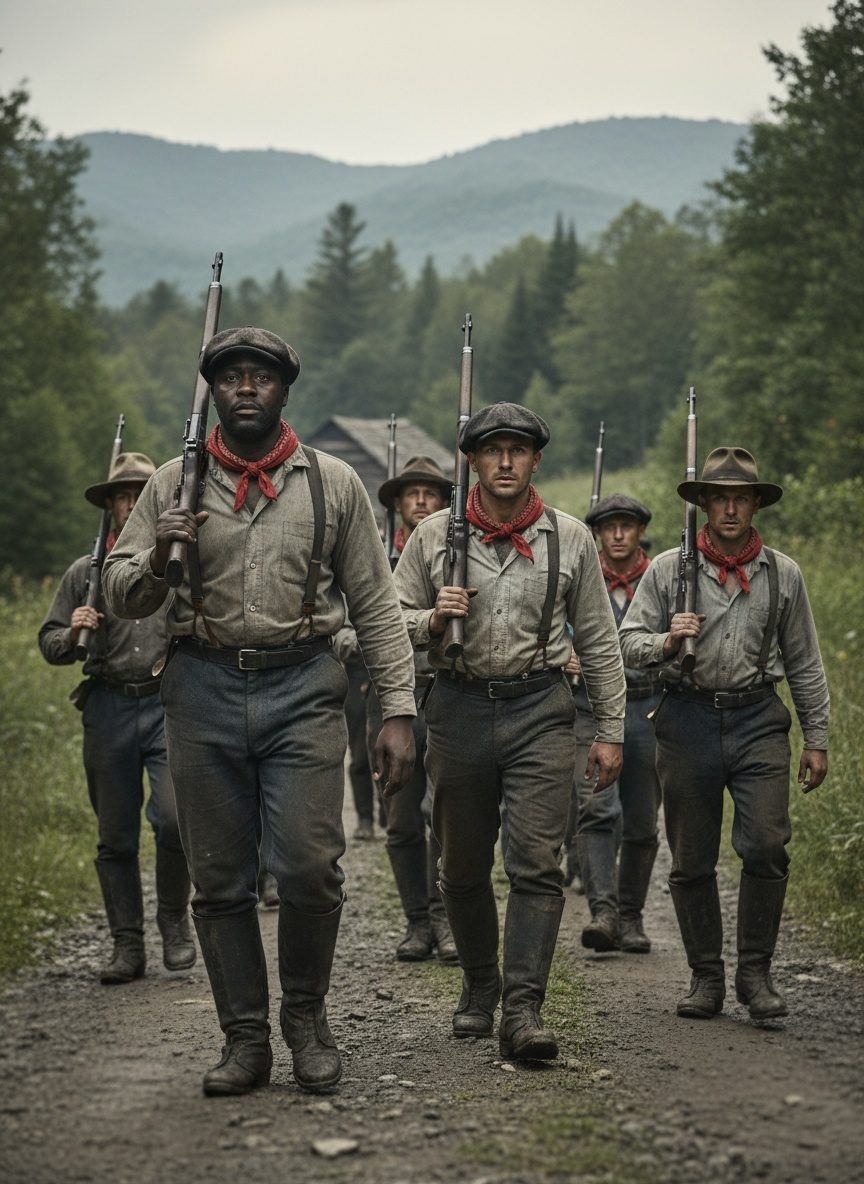
He was just an ordinary miner, inhaling coal dust deep in the bowels of the earth. But on one August day in 1921, he became part of the largest armed uprising on U.S. soil since the Civil War. Tying a red bandana around his neck, he joined an army of ten thousand like himself, marching fifty miles through the rugged hills of West Virginia toward Blair Mountain.
The air was thick with desperation and resolve, a potent mix brewed from years of exploitation and brutality at the hands of the coal companies. For decades, these miners had toiled under oppressive conditions, their every movement dictated by the mining companies that paid them in scrip only redeemable at company stores, effectively tethering them to their employers with invisible chains. The red bandana became their symbol; it wasn't just a piece of cloth but a badge of solidarity and defiance. Black, white, immigrant, and veteran miners stood unified, a wave crashing down on the entrenched powers of Logan County.
The march began in the town of Marmet, ignited by a simmering outrage at the assassination of labor activist Sid Hatfield, a man who had embodied the struggle against the tyrannical coal barons. The news of his murder was a spark that set ablaze an already volatile landscape. As the miners moved southwest through the hilly terrain, their numbers swelled. To some, it felt like a crusade; to others, a final stand.
Approaching Blair Mountain, the miners faced a formidable barricade. Awaiting them were machine-gun nests and private mercenaries hired by the coal companies. These defenders had fortified the mountain at strategic points, their guns trained on the laborers approaching through the dense canopy of trees. The battlelines were drawn not just in geography but ideology; the right to organize against the relentless march of capitalism was at the heart of this looming conflict.
Over the course of several days, the surrounding valleys echoed with the crack of gunfire. The miners, many of whom had brought along rifles they once carried through the gnawing muck of Europe in World War I, fought for dignity and better working conditions. These were no untrained rabble but disciplined marksmen who knew their way around a battlefield. Yet, for all their resolve, they were no match for the technological might arrayed against them. Biplane planes, piloted by hired guns, soared above, releasing homemade bombs that snaked trails of smoke against the sky. It was the first time aerial bomb attacks were used on American soil.
This was not merely a struggle between employers and the employed; it was a clash mirrored in the pages of American history—a tale of might versus right. The country's post-war industrial boom showed little empathy for the laborers who formed its backbone. The miners’ march was driven by years of unmet promises and unending toil. Some newspapers of the day decried them as anarchists and Bolsheviks, painting their cause with the broad strokes of fear and disdain that often cloaked movements for change.
As the days wore on, despite initial victories, the miners found their momentum stalling. Against them stood not only the hired thugs and corporate militias but the full power of the United States government. Sent in to restore order, federal troops, many veterans themselves, descended on Blair Mountain. The sight of military insignias and the thundering presence of artillery was disheartening to some; capitulation was inevitable.
Faced with overwhelming firepower and dwindling supplies, the miners began to lay down their arms. It is said that more than a million rounds of ammunition had been expended in those fevered few days—enough to stain the very ground upon which they stood. The miners retreated, their dream of pushing back the titans who controlled their lives momentarily shattered. But for all the firing and fury, no company official or politician saw a courtroom or a cell.
The tale of the Battle of Blair Mountain did not end there, buried beneath the Appalachian mountainside. It left a haunting legacy, one that underscored the continuous struggle for workers’ rights and fair labor practices. Blair Mountain became both a memory and a motivating force for labor movements in America. Though the miners lost their battle, their story remains a reminder of the courage ordinary people have rendered when pushed to their limits.
In the quiet of today’s Appalachian landscape, it may be hard to envision the clamor of conflict that once echoed through the mountains. The steep ridges that watched silently over the uprising have long since been reshaped and reclaimed by nature. Yet, the miners' march on Blair Mountain continues to spark debates on economic disparity and corporate power in America. Their fight serves as an indelible testimonial to the lengths to which a laboring people will go in search of justice and a better life, undeterred by the seemingly insurmountable forces ranged against them. This story, seldom told in vivid classrooms, speaks to the heart and soul of one nation's history, a history that still echoes into the present day.