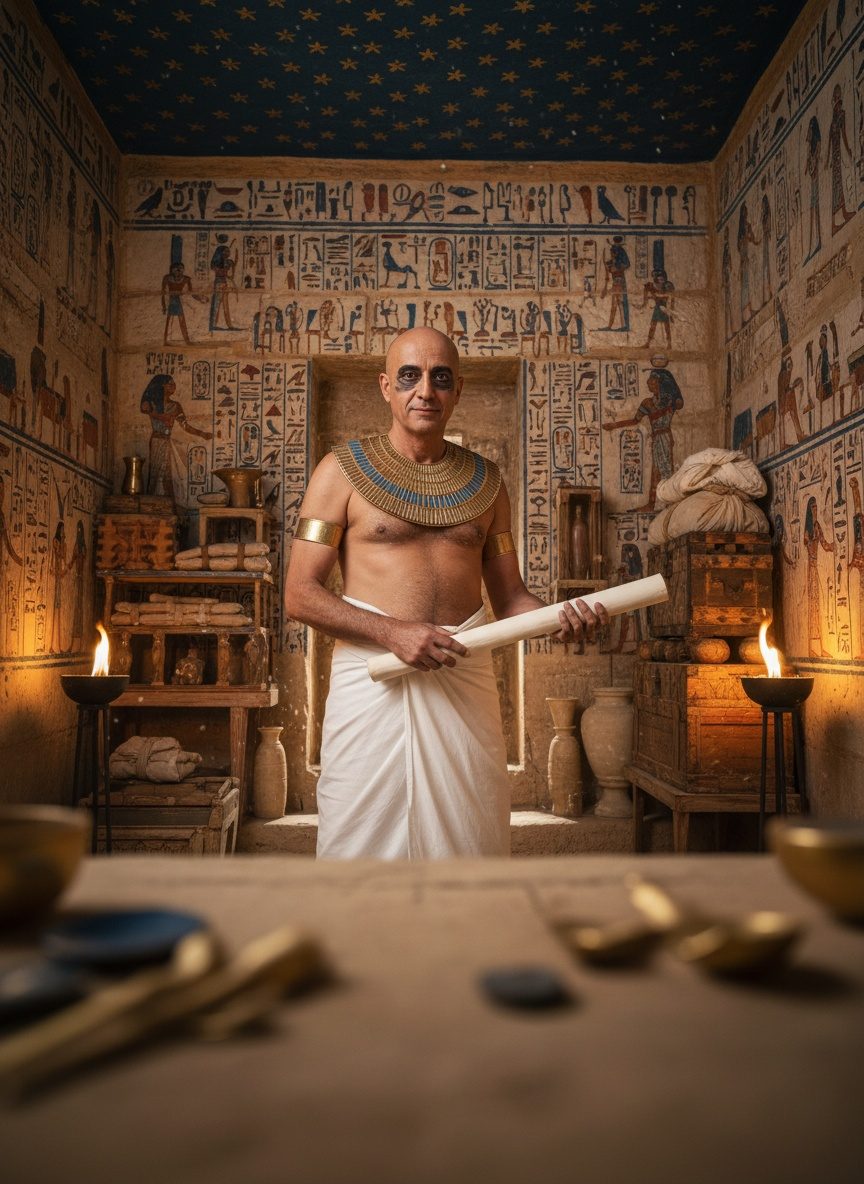
February 15, 1906. The desert breeze rustled the sand dunes of Deir el-Medina, carrying whispers of ancient times. Nestled on the west bank of the Nile, this small settlement was once home to a community tasked with crafting the eternal homes for Egypt's pharaohs and nobility. Among them was Kha, a master architect whose work aimed to safeguard the passage of kings into the afterlife. Little did they know, he would create a legacy as profound as the monumental tombs he constructed.
Renowned as the chief architect of a bygone Egyptian era, Kha lived around 1400 BCE during the New Kingdom, a time when the nation flourished under the rule of powerful pharaohs like Amenhotep II and Thutmose IV. Tasked with the design and completion of royal burial chambers, Kha dedicated his life to ensuring that others were prepared for eternity. This intimate knowledge of funerary practices would, over decades, shape a vision for his own journey beyond the grave.
Unlike the pharaohs he served, who commanded vast resources and manpower, Kha approached his eternal resting place with a personal touch that speaks to his character and his era. His tomb, discovered by an Italian archaeological team led by Ernesto Schiaparelli, was hidden in the rocky hills overlooking the village of Deir el-Medina. Untouched by the hands of tomb robbers for over three millennia, Kha’s burial site was as pristine as the day it was sealed.
Inside, the tomb not only housed Kha but also his wife, Merit, whose presence speaks volumes about ancient Egyptian family life and burial customs. The two were laid to rest together, facing eternity as companions. This aspect of tomb design, pairing spouses and including domestic items, underscored the Egyptians’ view of the afterlife—not as an abstract concept, but a continuation of life’s familiar comforts.
The inventory within Kha’s tomb could rival the meticulous lists of the pharaohs’ own grave goods: wooden chests of linen garments, finely woven and impeccably preserved; pottery vessels, each filled with foodstuffs carefully calculated for sustenance in the hereafter; and personal items like razors, lamps, and even a folding bed—an unexpected find that fused both functionality and portability in a manner quite ahead of its time.
Perhaps the most astonishing finds were the provisions of bread and other food, which lay in perfect repose upon unwrapping. These humble loaves, converted by the desert's dry air into enduring relics, offered a tangible connection to a daily ritual that Kha likely practiced with his own hands. Such preparations illustrate the Egyptian conviction that the dead required nourishment for the soul’s protracted journey—an eternal picnic set for a lengthy voyage.
Indeed, Kha’s foresight into crafting a tomb that withstood the ravages of time and plunder—when tomb robbery was rampant—is a testament to his understanding of architecture and security. He excelled in the art of disguise, creating a tomb entrance so cunningly hidden that it remained overlooked for millennia. His talent for design was matched only by his intuitive grasp of materials, ensuring the lasting integrity of both the structure and its contents.
Deir el-Medina, while a center of tomb-building activity, also represented a unique social experiment in ancient Egypt. The community was vibrant, comprised of artisans, craftsmen, and their families—ground zero for the workforce that executed the grand visions of pharaonic funerary demands. Kha, as part of this closely-knit society, was both a leader and a neighbor, commanding respect from his peers both for his skills and his role in assuring their livelihood.
Historians and archaeologists continue to glean invaluable insights from Kha’s tomb, which remains one of the most complete and untouched burial sites ever discovered. It offers a microcosm of daily life, beliefs, and practices of its time, serving as a silent storyteller that whispers secrets of an ancient civilization directly into the present. Every artifact bears a narrative thread connecting us to the continuity and change that transcended millennia, drawing a fragile yet durable thread between the distant past and our present.
The discovery of Kha and Merit’s tomb has reshaped our understanding of non-royal burial practices and daily life in ancient Egypt. It shows us the intricate balance between professional duty and personal devotion, the meticulous care invested in life’s final chapter, and the artistry Kha wielded both in his professional works and in crafting his epitome of an immortal home.
In a world where only the stories of kings and conquerors often pierce the veil of time, Kha’s preserved tomb and its humbling artifacts provide a window into the heartbeat of everyday Egyptian life. Here, in the relentless desert, hidden beneath layers of history, rests an enduring lesson on how even the silent can tell their stories with unmatched eloquence. Kha reminds us that true legacy lies not only in grandeur but in the thoughtful, intimate acts of preparing oneself for eternity, waiting for those who come after to find and listen.