Baldwin IV was an unlikely hero. But his triumph over Saladin at Montgisard reshaped the course of history.
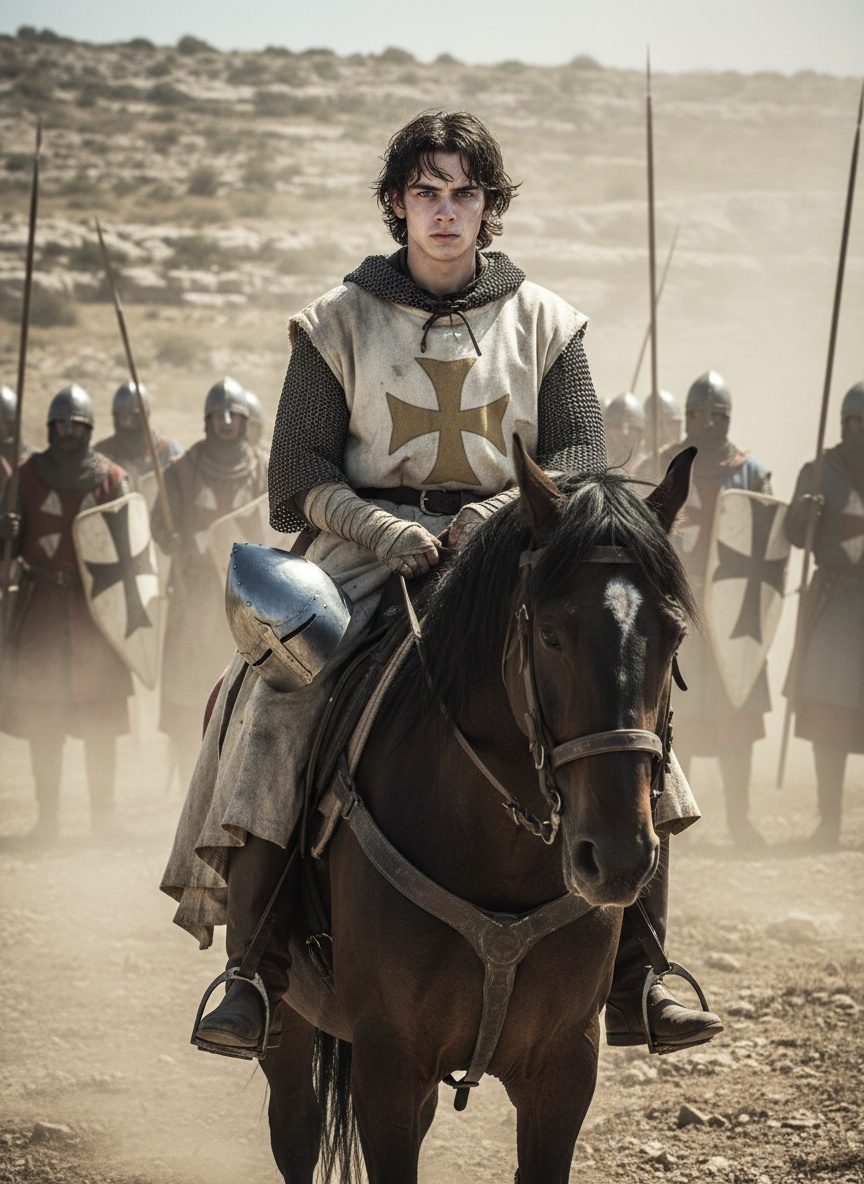
In the blistering November heat of 1177, a mirage shimmered across the arid plains near Montgisard—a testament to both the hallucinations of heat and the audacity of a youth many had already consigned to death's slow embrace. Baldwin IV, the young king of Jerusalem, was not your typical monarch. Diagnosed with leprosy at a tender age, he was already a living ghost, his body marked and pained by the disease that made others shun him. Yet, despite his physical limitations, he appeared astride a horse, a symbol of defiance against his own fate and the formidable forces arrayed against him.
The young king's hands, wrapped in leather to hide the ravages of his illness, could no longer feel the reins. His command to hold steadfast, however, was second to none. Here was a ruler who inspired awe not through physical prowess, but through sheer will and cunning. From the fringes of death, Baldwin understood that the impending storm was not just a mere battle for territorial gain but an existential confrontation for his realm's survival and, more personally, his own legacy.
From the parched lands of Egypt, Saladin advanced with a host of twenty-six thousand troops. A titan of his era, Saladin was a general whose strategic brilliance had already become legend. Yet, he would soon find himself outwitted by a king whom destiny seemed to have shortchanged. Baldwin's predicament had been desperate. With a severely outnumbered force of five hundred knights, he was urged by cautious commanders to bide time or even retreat. They questioned his apparent folly; some considered it suicidal. Yet Baldwin knew that the Crusader states stood at a precipice. The defense of the holy city did not abide patient posturing but demanded audacious maneuvering.
The dawn of the battle saw Jerusalem’s forces assemble, a paltry contingent against the horizon-filling mass of Saladin's seasoned warriors. Dust swirled in great clouds, the anguished cries of warriors melding with the fierce clashing of steel, punctuated by the relentless glare of the Levantine sun. An arduous handicap for most commanders, Baldwin's affliction held a sordid benefit—his resistance to pain crossed into near immunity, allowing him to command with relentless fervor as others would falter.
Baldwin had planned meticulously for each moment of the clash. He utilized every relic of warfare he knew, from the composure he honed under constant physical agony to his keen understanding of psychological warfare. As his army clashed with Saladin's, knight against Mamluk, they engaged in a dance of havoc. Suddenly, amid the chaos, emerged a cross carried by a bishop—a religious emblem turned fervent rallying point. Baldwin had ensured this sacred symbol traveled with them, a beacon for his men to congeal their waning spirit.
The moment of divine madness came when Baldwin, tethered to his horse more than astride it, drew his sword—strapped as it was to a hand bereft of feeling—and charged with his knights. The crush of hooves, the sudden din of armor, drove surprise deep into the ranks of their enemy. Where Saladin's forces assumed victory, they found their assumptions overturned. Amid the turmoil, Baldwin’s personal guard surrounded him, aware their king, frail yet unyielding, inspired a ferocity few had anticipated.
Despite Saladin’s skill, the cohesion of his troops waned under the unexpected fervor of Baldwin's desperate bid. Herein lay a lesser-known aspect of the ancient strategy—unflagging morale often weighed as heavily as numbers. With each blow they dealt, Baldwin's forces seized fragments of hope—an element far more potent than mere steel. In Saladin's ranks, confusion spread like wildfire, their seemingly invincible facade shattered, and their great general now fleeing astride a camel to escape the encircling tempest of knights.
Baldwin’s triumph at Montgisard did not just momentarily save Jerusalem. It salvaged the pride of a kingdom that often seemed on the edge of crumbling beneath its own ambitions. The Battle of Montgisard became a keystone in the annals of medieval warfare not for the blood it shed, but for the remarkable reversal it embodied—a true tale of the unexpected overthrowing the powerful. The unlikely king had fought not just against an enemy with unsurpassed strength, but against the creeping shadows of his mortality, becoming an enduring symbol of the unyielding human spirit.
Montgisard remained etched in history as an extraordinary victory that defied the medieval expectation. Yet the battle’s aftermath painted a more somber tale of hope temporarily rekindled. Baldwin's body remained ravaged, and his kingdom continued to teeter on political upheaval's knife edge. But through his leadership, the world glimpsed the luminosity of courage facing overwhelming odds. His life, marked by both suffering and splendor, invites reflection on the unforeseeable capacity for resilience found within the human heart. For in the annals of history, it is not always the strongest who triumph, but often those who lead with an indomitable and courageous spirit. And Baldwin IV, the Leper King, epitomized that truth as none other could.