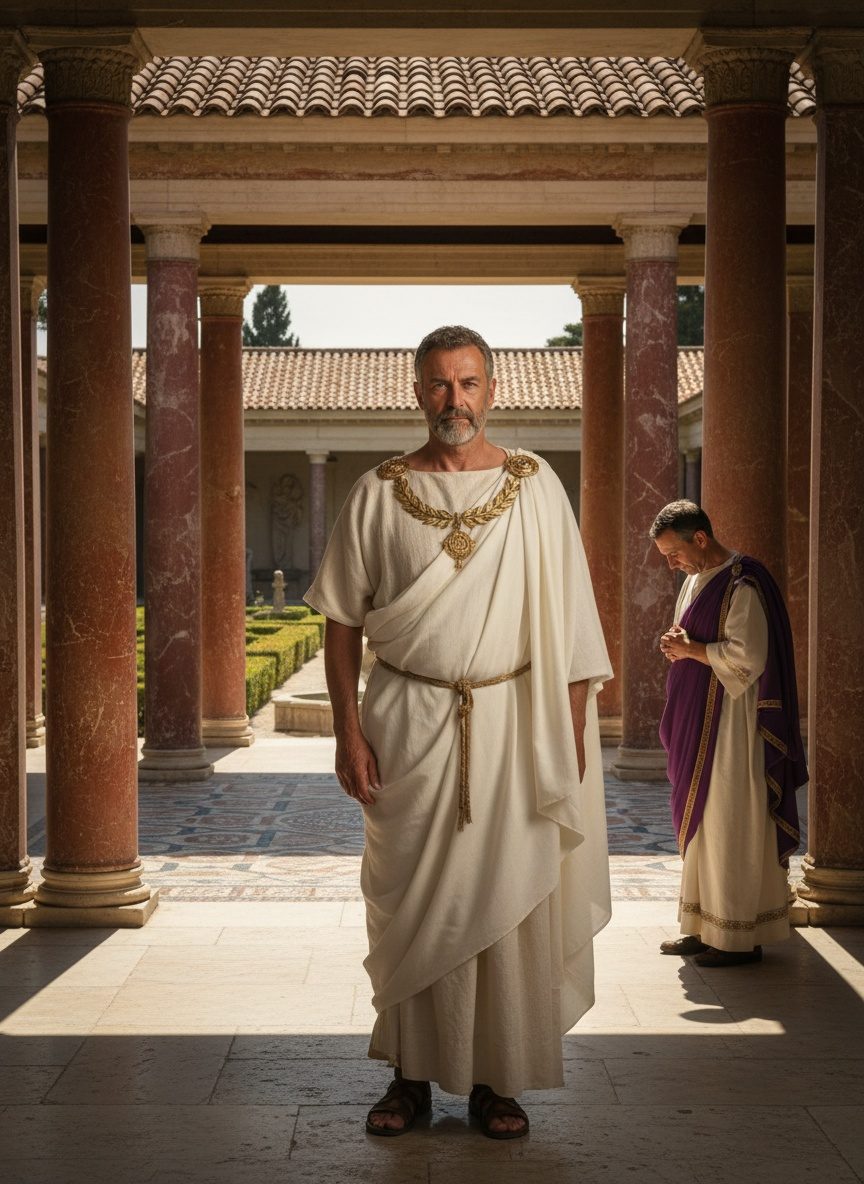
43 AD. The damp and fog clung to the shores of Britain as the Roman legions prepared to make their landing. The soil beneath their armored feet was a world away from the warm, orderly streets of Rome. For many British tribes, the sight of Roman standards marching across their mud-laden home signaled an invasion, spurring the urge to resist. However, amidst the haze and apprehension, one man made a choice that would define him: Tiberius Claudius Cogidubnus of the Atrebates decided not to fight.
Cogidubnus, the king of the tribe known as the Atrebates, welcomed the Romans with arms not of defiance, but of alliance. While his fellow British leaders braced themselves to engage with the might and ferocity of Rome, Cogidubnus took a shrewder, more cunning approach. He understood that the future of his people might not be won on the battlefield but rather forged through diplomacy. For his decision, the Romans bestowed upon him not only titles and authority but also a grand gesture that would resonate through the annals of history.
In a move perhaps unprecedented in Roman dealings with conquered lands, Cogidubnus was presented with a palace worthy of a Roman aristocrat. Located in what is today Fishbourne, West Sussex, this palatial residence was unparalleled in Britain at the time. Mosaic floors, intricately designed with patterns mirroring those of grand Roman estates, spread across its expanse, telling tales of far-off lands and cultures. The gardens were planted with exotic flora, each a testament to the reach of Roman trade networks that spanned continents. For Cogidubnus, the palace became not just a home, but a symbol of his tribe's unique relationship with Rome.
The history of Roman Britain is marked by conflict, rebellion, and the eventual subjugation of its native tribes. But Cogidubnus’s relationship with his conquerors offers a different imprint—one where a king could retain some degree of autonomy by aligning himself with Rome's interests. His rule extended peace across the lands under his influence, a reminder that strategic allegiance could supersede violent opposition. For over four decades, Cogidubnus governed his people, straddling the line between two worlds, ensuring stability through his maintained faithfulness to his Roman benefactors.
Cogidubnus was granted the title of 'rex'—a title that carried weight beyond its linguistic bounds, a nod from the Romans to his respected position and his crucial role in maintaining peace in the region. It was rare for Rome to bestow such recognition to leaders of conquered territories, particularly one as tumultuous as Britain. Yet, in Cogidubnus, the Romans found not merely a vassal king but a vital intermediary, one whose cooperation insinuated Rome’s dominion without necessitating constant military presence. This calculated concession on Rome's part spoke volumes about the importance they found in his alliance.
Under Cogidubnus’s reign, Roman influence permeated British society. Roads were built, not just as tools of conquest but as veins of commerce and culture that strengthened connections across the province. Roman customs, languages, and technologies began infusing the regions around the palace, subtly transforming the lives of the Atrebates. This transformation brought prosperity but also diluted native traditions, raising unanswered questions about cultural identity amidst such change.
However, Cogidubnus’s alignment with Rome, heralded by some as pragmatic skill, was not unanimously celebrated. Detractors beyond his borders perceived his alliance as betrayal, an abandonment of the British struggle for independence. Yet, the peace his loyalty secured allowed arts, agriculture, and trade to flourish; perhaps a pursuit as noble as any fought on a field of war. The palace in Fishbourne, long attributed to his name, today still whispers tales of these political decisions—wondering whether Cogidubnus viewed his accommodations as conquest or cooperation.
Cogidubnus’s story echoes through history not just as an illustration of Roman Britain but as a larger narrative contemplating the balance of power, cooperation, and cultural adaptation. His decision in 43 AD to embrace, rather than oppose, the Romans left a legacy that questions the nature of sovereignty and survival. In a world often dominated by tales of resistance and conquest, his stands apart—raising questions about the cost and consequence of friendship with an empire.
The lives we lead are often reconstructions of choices, paths taken with the hope of unknown outcomes. Cogidubnus’s choice to ally with Rome brought his lands a measure of Roman civilization but at the potential expense of cultural erosion. His story, woven with both vision and concession, reminds us of the enduring complexity found at the intersection of diplomacy and autonomy. As history continues to unfold, it allows us a moment of reflection on the nature of allegiance and identity amidst expansive powers, offering lessons still remarkably relevant today.